Boston, MA
May 2024
< WRITINGS
< NEWS
Collectible Architecture
Museum Building Design
Contemporary Art Museum The Prestige Effect
Architecture as Institutional Identity
This article is adapted from The Prestige Effect: Architecture as Institutional Identity - an expanded version of my master's thesis at Harvard, which examines why museums are increasingly treating their buildings as collectible objects, how the rise of the name architect became an act of institutional positioning, and what it means for the future of cultural spaces when architecture stops being the frame around the art and becomes the art itself.
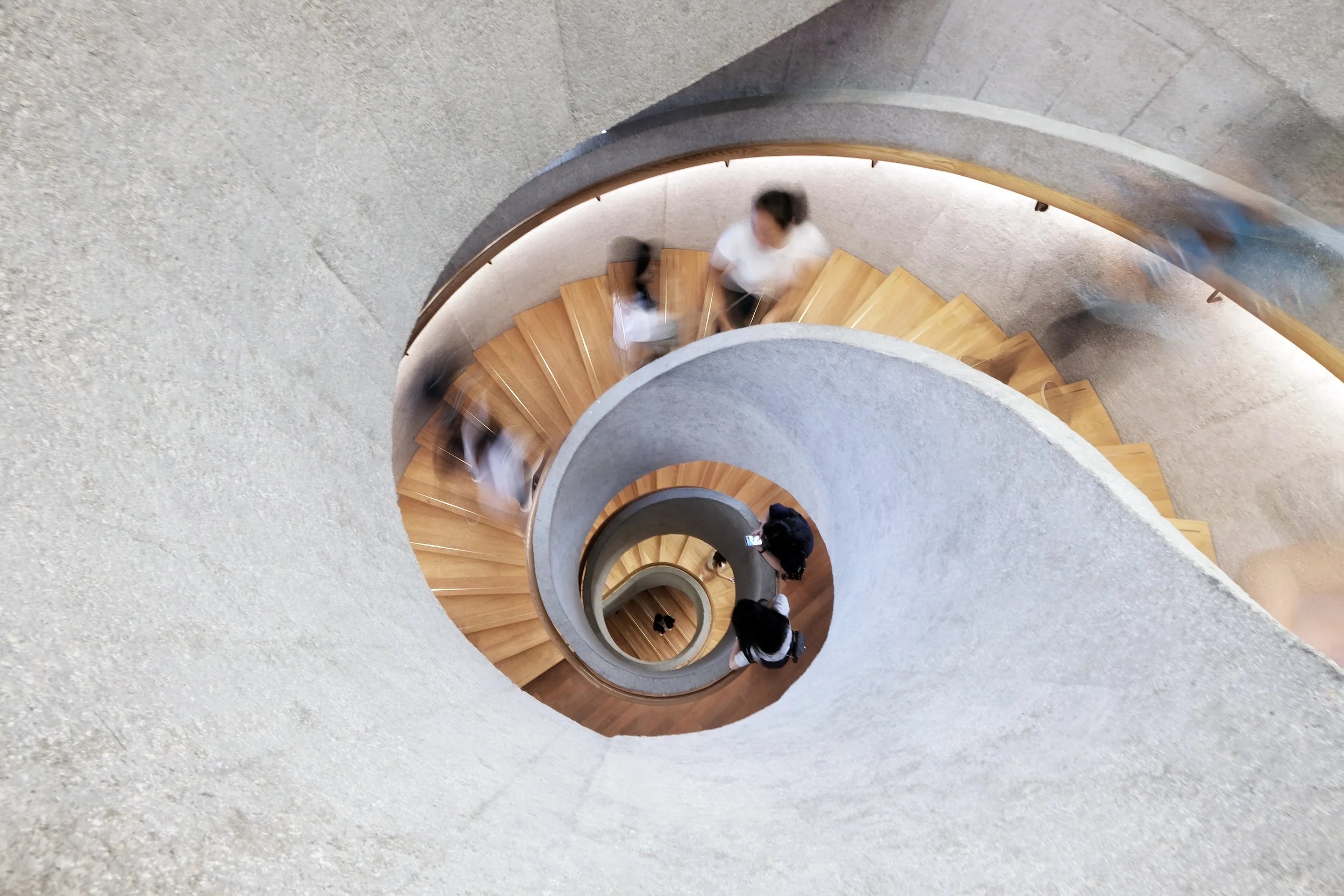
Vertigo. Metaphorically, the "stair" /ladder is a suggestive illutration for the topic of prestige. Here, Herzog de Meuron in Hing Kong at Tai Kwun Museum.
Photo by Dan Hogman.
The white cube was never neutral
For much of the twentieth century, museum architecture operated under a governing principle: the building should disappear. The ideal exhibition space was a clean, white, neutral enclosure - a vessel that effaced itself so the art could speak without competition. This was the white cube, and it was, for a long time, considered the most intellectually honest approach to displaying contemporary art.
The white cube was also, not coincidentally, an institutional comfort zone. A neutral building made no strong claims. It offended no one. It was safe.
But safety has a shelf life. As museums began competing not just for collections and donors but for tourists, civic relevance, and media attention, the neutral building became a liability. A building that says nothing is a building that gets ignored. And in a landscape where cultural institutions are fighting for visibility, survival, and funding, being ignored is not an option.
The white cube didn't disappear — but it stopped being enough.
Prestige has always been the product
To understand why name architects dominate museum commissions, you have to understand what museums are actually selling.
Museums have never been purely about the objects they house. They are, at their core, institutions of authority. Their primary product is legitimacy — the ability to confer meaning, value, and cultural significance on the things they choose to present. A painting gains stature by being in a museum. An artist gains recognition by being collected. An idea gains credibility by being exhibited.
This authority is carefully constructed and continuously maintained. It is built through the artists a museum champions, the collectors it cultivates, the critics it invites, and the boards it assembles. Every decision a museum makes is, in some sense, a statement about what matters and what doesn't.
The building is no different. Commissioning an architect is a curatorial act. The choice of designer signals to donors, peers, the press, and the public exactly what kind of institution this is — and what kind of institution it intends to become.
Why the name architect? The real answer.
Here is where the argument gets uncomfortable, because the honest answer has less to do with architecture than it does with institutional risk management.
Hiring a celebrated architect - a Pritzker Prize winner, a name that appears in the same sentence as words like "visionary" or "iconic" - is, for a museum director or board of trustees, a defensible decision. If the building succeeds, the institution is praised for its boldness and discernment. If it fails - if it goes over budget, if the spaces prove difficult, if critics are unkind - no one can accuse the leadership of a lapse in judgment. They hired the best. What more could they have done?
This is what makes the starchitect commission so persistent: it functions as institutional insurance. The name architect doesn't just bring talent. They bring cover.
But there is a second dynamic operating alongside this, and it is perhaps more revealing: museums are buying a piece of the architect. Not just their services — their identity. A building by a celebrated architect is, in the most literal sense, a collectible. It carries the architect's signature. It enters the same cultural conversation as their other works. It can be written about, photographed, toured, and referenced in the same breath as buildings on other continents. It becomes part of a canon.
This is not unlike what happens when a museum acquires a work by a canonical artist. The institution isn't just buying a painting. It's buying a relationship to a body of work, a position within an art historical narrative, and the authority that comes with both. The logic is identical when applied to architecture.
Architecture as content, not container
What this purchasing logic has produced - perhaps unintentionally, perhaps not - is a fundamental shift in the role of the building itself.
When a museum commissions a celebrated architect and then promotes the building as a destination, as a thing worth seeing in its own right, the building stops being a container for content and becomes content itself. The architecture is the exhibit. It is part of what visitors come to experience, part of what journalists come to cover, and part of what donors come to attach their names to.
This is not a marginal trend. Across a wide range of institutions — from the large, encyclopedic museum to the smaller, more experimental non-collecting spaces known as kunsthalles — there is a growing pattern of buildings being treated as objects of cultural significance independent of what they house. Architectural tours are offered. Facades are photographed and circulated. The building's design becomes central to the institution's identity and marketing.
Some institutions have taken this logic to its furthest conclusion, commissioning clusters of buildings by multiple name architects specifically so the buildings themselves can be the subject of walking tours and cultural programming. The collection is no longer just what hangs on the walls. The collection includes the walls.
What this means for the institutions commissioning it
For museum professionals, this shift raises questions that deserve honest examination.
If the building is now part of the cultural product — if it contributes to prestige, attracts audiences, and shapes perception — then the decision of who designs it is not an administrative one. It is a strategic one, and it should be evaluated with the same rigor applied to acquisitions, programming, or curatorial appointments.
This means asking not just "is this architect celebrated?" but "what does this building argue?" A building makes claims about an institution's values, its relationship to its city, its understanding of what art is and who it is for. Those claims can be coherent or incoherent, honest or aspirational, generative or merely decorative.
It also means reckoning with a tension that the field has been slow to name: the more a building becomes a statement of institutional prestige, the more it risks serving the institution's ego rather than its mission. The most compelling examples of contemporary museum architecture are those where the building's ambition and the institution's purpose are genuinely aligned — where the architecture doesn't just signal prestige, but earns it by doing something.
A larger argument
The shift from architecture as container to architecture as content is part of a broader cultural pattern that is still unfolding. As institutions compete for relevance in an increasingly crowded attention economy, the building has become one of the most powerful tools available. It is permanent, visible, reproducible in images, and capable of generating conversation long after any individual exhibition has closed.
Understanding this — understanding why name architects get these commissions, why institutions feel they cannot build without them, and what is actually being purchased when they do — is essential for anyone working in or around the museum world today.
It is also, I would argue, essential for understanding contemporary architecture itself. The buildings that define this era of museum design are not just responses to a brief. They are responses to a market — one in which cultural prestige is traded, accumulated, and displayed with the same intentionality as any other collectible.
These are questions I explore at length in my upcoming book,
The Prestige Effect: Architecture as Institutional Identity,
which examines the evolution of museum architecture from its historic roots to the present day, with a focus on the institutions and buildings that are redefining what a museum can be — and do.
"Further Reading," and why:If you want to go deeper, these are worth your time.Gerhard Mack's Art Museums into the 21st Century (Birkhäuser, 1999) is probably the most directly relevant — a collection of conversations with the architects actually shaping the field, including Herzog & de Meuron, Frank Gehry, and Peter Zumthor. It's where a lot of the ideas in this essay find their architectural voice.Christina Bechtler and Dora Imhof's Museum of the Future. Now What? (JPR Editions, 2021) picks up the thread and asks where all of this is heading — an honest reckoning with what museums are becoming and whether the institutions can keep pace with their own ambitions.Sharon Macdonald's A Companion to Museum Studies (Wiley-Blackwell, 2011) is the foundational academic text for anyone serious about understanding how museums construct authority, identity, and meaning — including through the buildings they inhabit.And for a sharper focus on the architectural dimension specifically, Vittorio Magnago Lampugnani's essay "Insight Versus Entertainment", included in the Macdonald volume, remains one of the most clear-eyed critiques of what happens when spectacle overtakes purpose in museum design.