The Fifth Facade
From Residual Surface to Primary Design Act
San Francisco, California
September 2014


< WRITINGS
< NEWS


Fifth facade
Architectural theory
Urban roofscapes
The fifth facade reframes the roof as an active architectural surface rather than a technical afterthought. In dense urban environments, where elevated viewpoints are increasingly common, the roof is often the most visible plane of a building. Treating it with the same rigor as any facade opens opportunities for environmental performance, spatial extension, and formal coherence. This article argues that designing the fifth facade is not optional—it is a fundamental condition of contemporary architecture.
Note: An abbreviated version of this article was published in print - Hogman, Dan. "The Fifth Facade." Dapper Dan: Men’s Fashion & Philosophy, no. 9, Spring/Summer 2014, pp. 52-53.a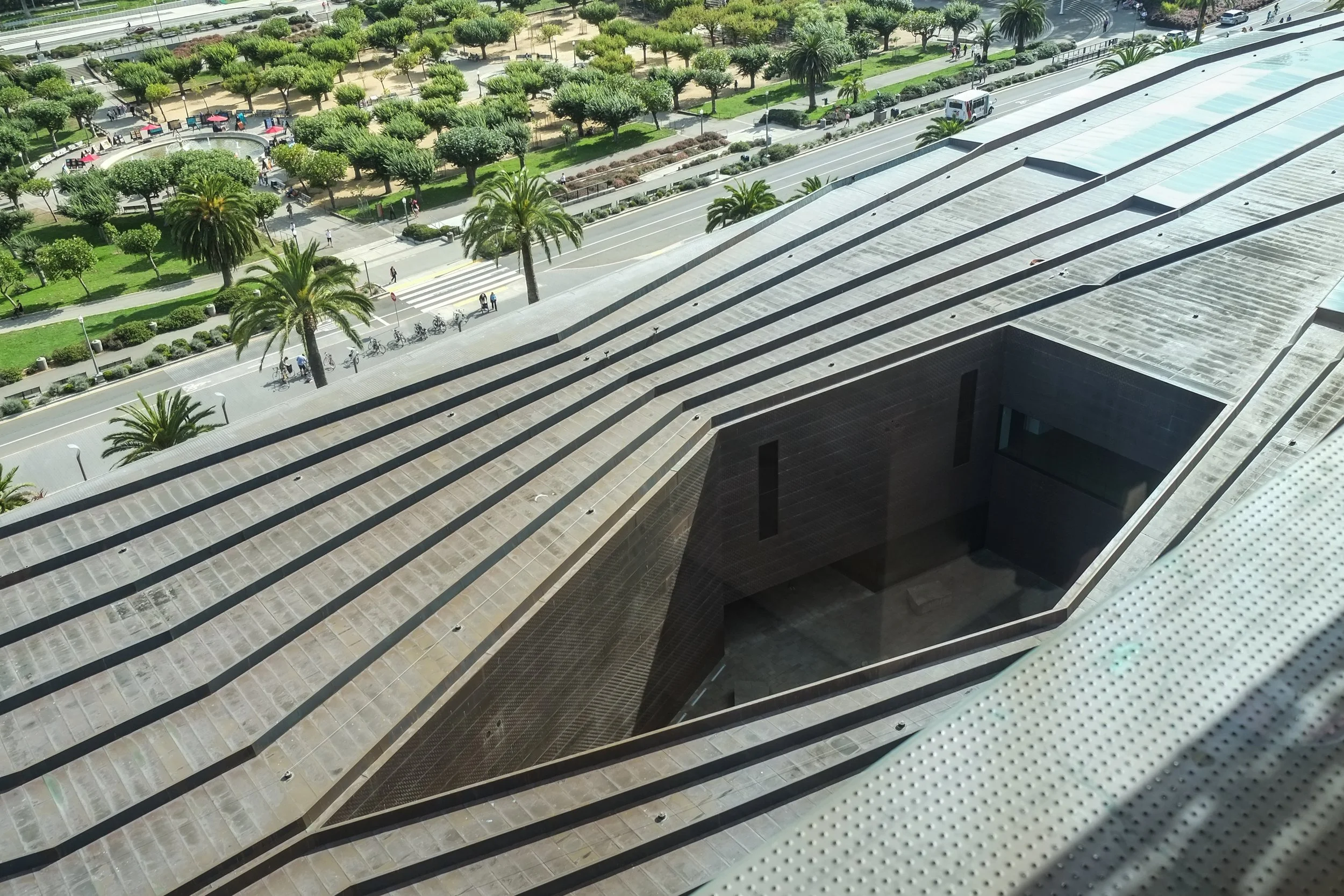
What you get on your Sunday morning walk - coffee in hand, fog on the horizon. View from the Hamon Tower, de Young Museum, looking down across the designed roofscape of the building within Golden Gate Park.I live in the Richmond District, San Francisco at the moment - I am basically minutes away from the de Young Museum. I walk to it quite often. I approach the museum less as a destination and more as an extension of daily spatial routine—something to enter, pass through, and inhabit episodically. On a Sunday morning, coffee in hand, the tower offered a particular kind of stillness: an elevated pause above the park canopy, where the act of simply standing and looking became the primary experience.
The Hamon Tower offers unrestricted public access - the panoramic views are the driver. What comes sharply into focus is the roofscape of the museum itself, several stories below - a deliberate composition form and materiality. This registers not as a technical residue but as a designed surface fully integrated into the park's spatial design. The roof does not assert itself through contrast; it aligns with the park through subtle continuity. The architecture recedes while remaining legible as an object of design. This is where the concept of the fifth facade becomes operative.
Here, the fifth facade reframes the roof as a primary architectural surface rather than a residual condition. Traditionally, roofs have been treated as purely functional systems - they house mechanical equipment, water management, and remain largely invisible from the vantage points that architecture conventionally addresses - mainly street. That convention has been overtaken by circumstance.
In contemporary cities, buildings are routinely perceived from above: from elevated platforms and neighboring towers - more and more common as we keep breaking the heights and density in high-rise architecture. The roof is no longer visually peripheral—it is frequently the most consistently observed elevation of a building.
The fifth facade asserts that this surface demands the same rigor as any other: attention to design and details. It acknowledges that architecture is now experienced across multiple registers simultaneously, making the roof an essential component of a building's public and perceptual identity.
The de Young is not singular. Many key projects illustrate the range of positions available within this framework. Three are listed below - two demonstrate the roof's potential with considerable clarity, and one of exposes the limits of treating it primarily as spectacle.
The Oslo Opera House, by Snøhetta, removes the distinction between roof and ground by transforming its inclined surface into a publicly accessible landscape. The roof is not concealed in the building's upper plane - the architects extend the urban field upward. This allows pedestrians to ascend and traverse the roof as an extension of the harbor promenade. Here, the fifth facade is not merely visual but programmatic: it becomes circulation, gathering space, and civic infrastructure. The white marble surface is deliberately continuous and minimally articulated. The tectonic ideas are clear.
Crucially, this space is not vegetated; its power lies in material and geometric precision. The predominant color is white. It reads cleanly. The absence of conventional landscape reinforces the architectural intention—it is not an imitation of a park but a deliberate redefinition of what public space can be when lifted onto a building. The roof operates as a civic space: a place of gathering, rest, and passage that is simultaneously formal and open-ended. In this sense, the building dissolves the boundary between architecture and city, allowing the roof to act as an instrument of collective life rather than a technical enclosure of it.
The Yokohama International Passenger Terminal, by Foreign Office Architects, pursues a related logic through a different set of means. The project reconceives the roof as a continuous folded ground, integrating it into a seamless circulation surface that extends from the city to the waterfront.
The timber deck is meticulously articulated and its striping, joints, and curvature is designed to guide movement and frame views. It’s design intent extends beyond surface resolution. The continuous folded geometry resists conventional distinctions between floor, wall, and roof. This produces a topological field in which movement, structure, and spatial experience are organized as a single system. The project reframes the building not as a composition of discrete elements but as a continuous surface condition. The roof here is not one element among others, but the primary generator of architectural form. Conceptually, this is taken to an extreme.
During my time in architecture school, this project generated considerable discussion precisely because it challenged inherited assumptions about facade hierarchy: the vertical side elevations recede almost to zero when measured against the architectural agency of the roof, which operates simultaneously as circulation infrastructure, structural logic, and urban interface. We used it as a case study over and over again.
Marina Bay Sands, designed by Moshe Safdie, occupies a more ambiguous position. The SkyPark bridges three towers and operates at the scale of urban iconography—a horizontal megastructure legible from aerial, distant, and adjacent high-rise viewpoints. It houses a circulation and an infinity pool that you usually see in all magazines and postcards. This is not a roof to look at, but a roof to look out from, from a position of privilege. The SkyPark is accessible primarily to hotel guests and, by extension, to those with the financial means to occupy that environment. This is, in practice, a privatized amenity - a roof optimized for photography, global visibility, and branded spectacle rather than collective use. The result is a clear divergence between architectural image and civic responsibility: a fifth facade that performs exceptionally well as a visual object while contributing little to none to the broader social fabric of the city it inhabits.
The concept of the fifth facade comes in many shapes and functions. These three examples locate the fifth facade within a spectrum that runs from civic infrastructure to privatized spectacle. What Oslo and Yokohama share—beyond their formal inventiveness—is a conception of the roof as a surface with obligations: to the city, to movement, to collective experience. What Marina Bay Sands demonstrates by contrast is that formal ambition alone does not constitute a fully realized fifth facade.
The distinction matters because it clarifies what is actually at stake in treating the roof as an additional design surface. This is not for the production of striking aerial imagery, but for the expansion of the architectural project to include surfaces and programs that have historically been excluded from serious design consideration. Treating the roof with the same rigor as any facade means engaging the same questions that need to be resolved with a side facade - proportions, material articulation, structural expression, and environmental performance. This shift dissolves the historical hierarchy that privileged street-facing elevations over all others.
The approach now needs to a holistic architectural condition in which every surface participates in the building's presence. In this framework, the roof becomes an active interface - simultaneously technical, spatial, and representational—demanding the same level of authorship as any primary facade.
The design opportunity it presents is not marginal; in many contemporary contexts it is the largest continuous surface a building offers, and frequently the most observed.
The many roles that a roof can take - There are specific opportunities in relation to the ecological and spatial pressures of dense urban environments. Urban land scarcity demands that ecological surface be treated as a primary rather than residual resource, and roofs represent one of the few remaining opportunities to expand that resource vertically. When designed to host vegetation, they extend the city's ecological footprint upward, enabling stormwater retention, heat island mitigation, and improved air quality. Simultaneously, they can offer an accessible public space.
This is not merely an environmental gesture but a spatial strategy - rooftops can become extensions of parks, gardens, and informal social ground planes, compensating for the density and privatization of street-level space. The architectural implication is significant—structure, waterproofing, load capacity, and landscape integration must be considered from the start.
Even where full accessibility is not achievable, designing roofs with the latent capacity for greening ensures that buildings contribute to a continuous, layered urban landscape rather than terminating it. Or even simpler, they can successfully function as a visual amenity - still a win for architecture.
Architects need to take this aspect into account. There is nothing to hide. Most rooftops, from above, look like a mechanical graveyard—a chaotic sprawl of HVAC units that architects simply gave up on.
Failing to design the roof is, in this context, not a neutral omission but an active failure - one whose consequences accumulate across the skyline of every city that permits it. A roof left as an afterthought becomes a repository for mechanical clutter. The danger lies in creating a surface that neither contributes to the building's formal coherence nor assumes any responsibility toward the urban environment it occupies.
This approach reinforces a narrow conception of architecture in which effort is concentrated on a limited register of visible elevation elements. Meanwhile, the most elevated and often most ecologically significant surface is left to technical necessity alone. The result diminishes not only the individual building but the collective urban field: each undesigned roof represents a forfeited opportunity to extend green space, support ecological infrastructure, or contribute a coherent surface to the skyline as seen from above.
The argument for the fifth facade is ultimately an argument for completeness. It insists that design authorship cannot be selectively applied. The argument extends to the building's public presence, which extends beyond its street-facing elevations to every surface that is seen, experienced, or capable of performing at some level.
As cities continue to densify and as the aerial and elevated perception of urban form becomes increasingly normalized, the roof will only grow in significance as an architectural surface. To design it well is to accept the full scope of the discipline's obligations; to neglect it is to produce an architecture that is, by its own structural logic, incomplete.
- dh, 2014
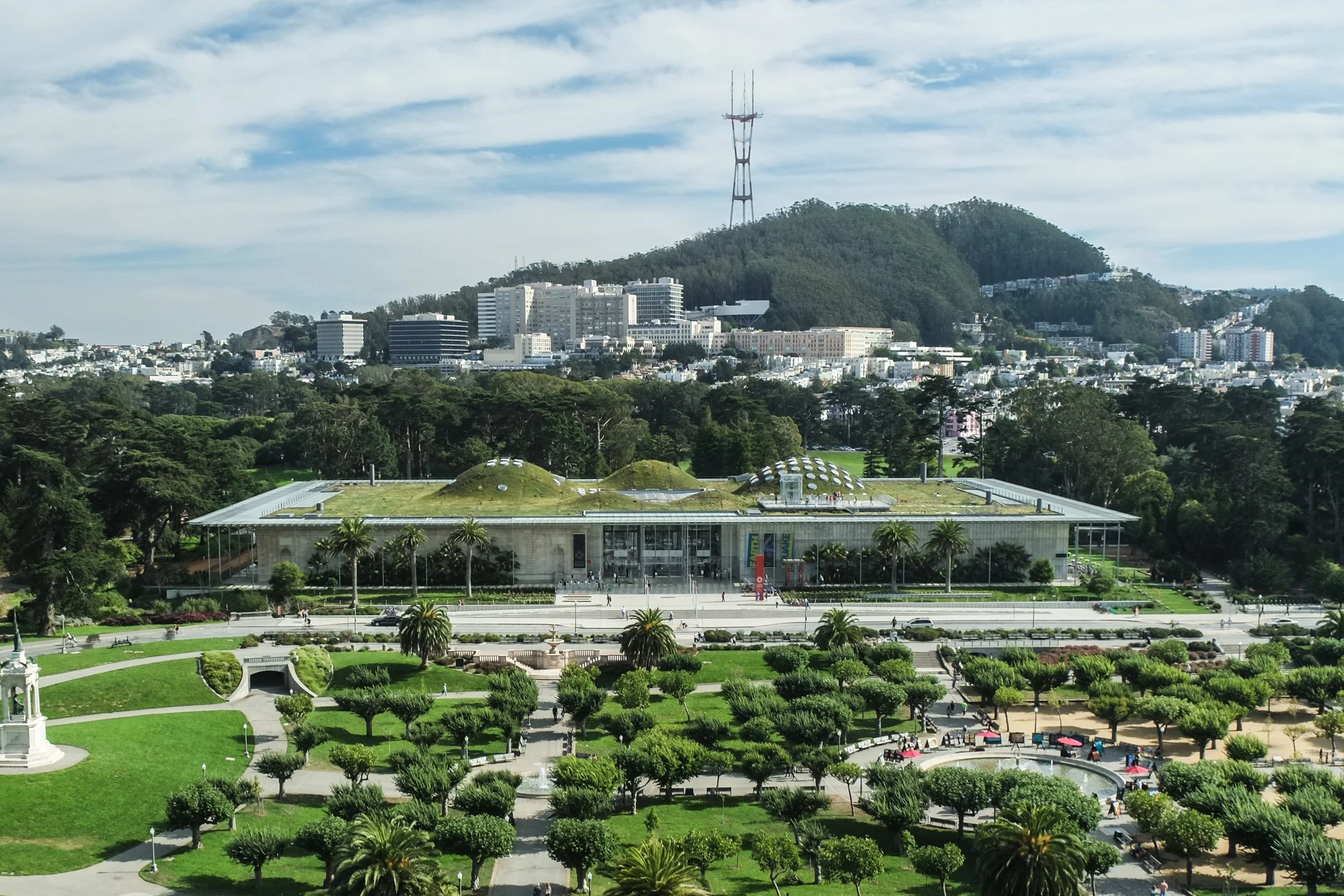
From afar, the Academy of Science gree roof blends well with the surroudings. Acces to it is highly curated. Photography: Dan HogmanFurther Reading -
Corner, James, editor. Recovering Landscape: Essays in Contemporary Landscape Architecture. Princeton Architectural Press, 1999.
Hogman, Dan. "The Fifth Facade." Dapper Dan: Men’s Fashion & Philosophy, no. 9, Spring/Summer 2014, pp. 52-53.
Leatherbarrow, David. Topographical Stories: Studies in Landscape and Architecture. University of Pennsylvania Press, 2004.
Mostafavi, Mohsen, and Gareth Doherty, editors. Ecological Urbanism. Lars Müller Publishers, 2010.