The Authorship Problem
The Loss of Critical Discourse in Corporate Architecture
Basel, Switzerland
July 2021
< WRITINGS
< NEWS
Design Autorship
Corporate Architecture
Architectural PracticeThere is a particular kind of architectural failure so pervasive it has stopped registering as failure. Buildings that are technically resolved, broadly acceptable, and conceptually underdetermined. Projects that meet every requirement and exceed none of them. This is not the result of insufficient talent inside large firms, but the result of organizational structures that make design intent informal, and therefore expendable. We have said it at conferences, glared over the intriguing cover shorts at the Monterey Design Conference or similar, only to return to our desks on Monday morning - business as usual…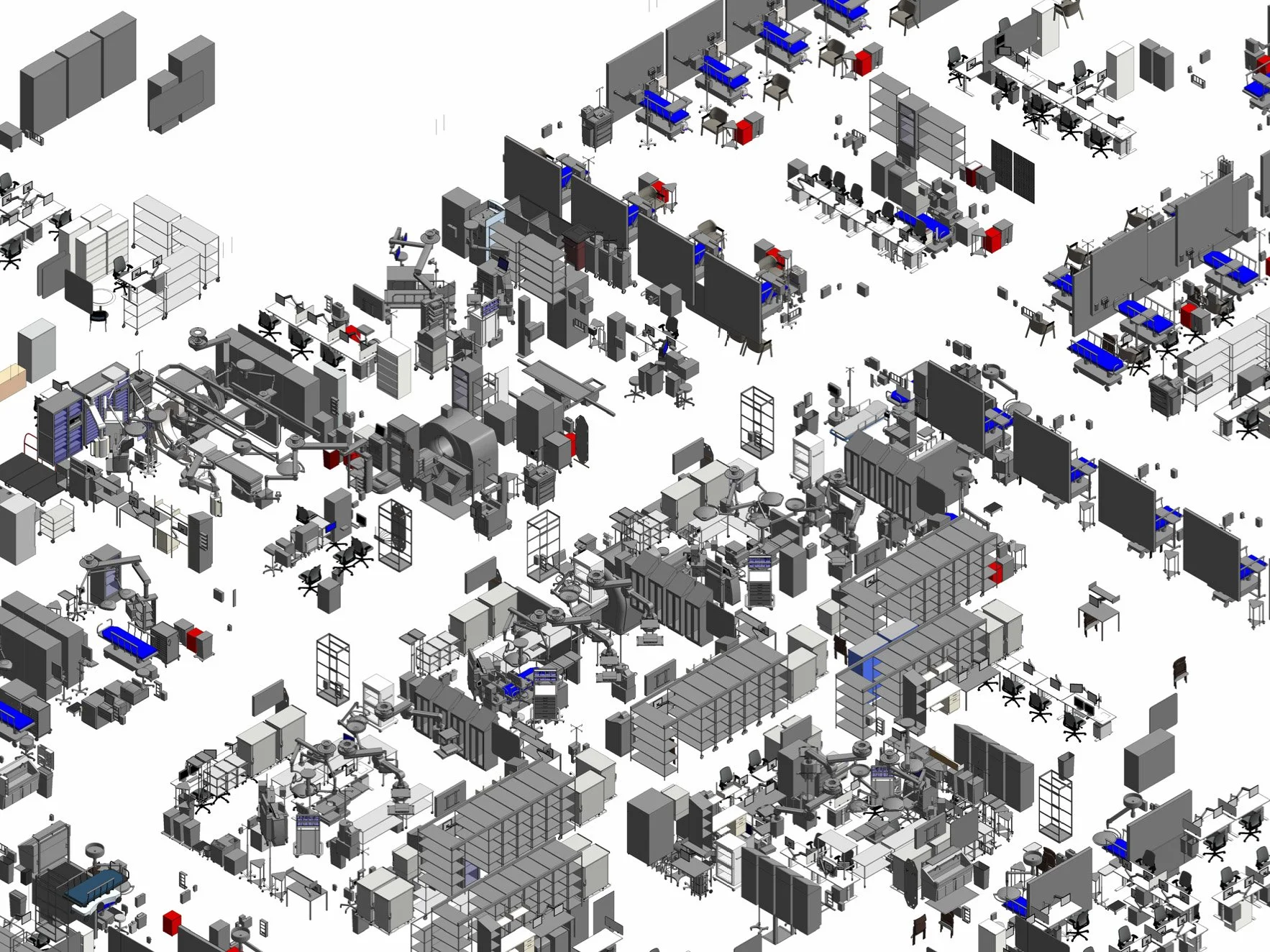
A Revit model showing the Furniture, Fixtures, and Equipment (FF&E) alone. Consider the number of specialists required to produce this single view. No one person could recreate it. The knowledge exists only as consensus among a dozen disciplines — and consensus, by definition, belongs to no one. A minor part in the overall picture... Visual - Dan HogmanThe critique of large-firm architectural practice is familiar enough at this point. Corporate firms prioritize risk management over design ambition, client alignment over disciplinary independence, delivery over meaning. We have said it at conferences, written it in editorials, and then returned to our desks on Monday morning.
There is a well-established mechanisms by which organizational scale suppresses the conditions under which architecture can advance as a cultural discipline. The problem is not a failure of individual ambition or moral seriousness. This is structural - there are multiple fault lines, each reinforcing the others, none correctable by good intentions or better leadership alone.
Discussed over and over again, the issues boil down to a few factors -- the liability and risk management, design as service, but also to the complexity of design process when decisions need to be delegated to multiple workers facing one common isse - labor alienation and identity loss in the process.
I’ve spend many years working in a corporate practice. It does come with a benefit to the worker. The design process, the way we work, internally or externally and the way we produce decisions is getting more and more homogenized. Assume, hypothetically, that I move to Australia or Denmark tomorrow for a office job. The transition should be fairly smooth…
The Liability Trap and the Risk Culture
There is a contradiction between risk management and design ambition. This is not primarily about timid designers or conservative clients. It is about fee structures, liability exposure, and the economics of repeat-client dependency - conditions that collectively reward proven solutions and penalize deviation. The structural result are “safe”. This is, after all, competence but without advancement, In other words, we are looking at “buildings” that function within accepted norms and rarely interrogate them.
What is rarely acknowledged is that liability is a major cause in the loss of discourse. It does not only constrain what gets built and how we go about building. It constrains what gets thought. A firm that cannot defend an idea professionally and legally is a firm that stops generating such ideas well before they reach a drawing.
Speculation, or the condition under which theory typically advances, is filtered out not at the drawing board but prior to it. Ideas must arrive pre-validated; they must be benchmarked against precedent or manufacturer data before they can be responsibly proposed. The result is what might be called the preemption of thought: not a failure of imagination, but a structural condition that makes imagination professionally indefensible.
There is a subtler deformation too. Liability culture does not merely eliminate speculative projects; it replaces critical judgment with compliance logic as the governing cognitive mode of practice. The architect's role, as discussed in design studio in design school used to be to argue on why something should exist. Now we need to prove why it cannot fail. Over time, this shift limits the architect capacity to generate new frameworks of thought.
We are the Coordinator Not Authors
Architecture is institutionally reframed as a consultancy. This is now a service industry managing constraints rather than a cultural project making arguments. The architect becomes a coordinator of budget, code, schedule, and client preference. This repositioning is not neutral. It changes what can be said, what is worth saying, and who is considered authorized to say it.
Architectural writing and conversation advances discourse. Under a service model, that language becomes justificatory: architects explain decisions in terms of client value, performance metrics, and regulatory compliance. Writing/speaking no longer advances claims about what architecture should do. Instead, it rationalizes what has already been constrained into feasibility.
The vocabulary shifts accordingly. Terms that once carried theoretical weight — type, monumentality, publicness — are displaced by neutral, transferable language: stakeholders, deliverables, outcomes, performance. The vocabulary and design jargon that we used to cover in architecture school is no longer applicable…
This is not an accident of taste. The coordination of large, multi-party projects demands low-friction shared language. More technical, more precise, less conceptual. This is for a good reason - the growing army of consultants, dictated by the added code requirements with each iterations, need clarity and shared language.
Architecture begins to speak in case studies rather than arguments. Strong, risky disciplinary positions migrate outside practice — into academia, independent writing, competition entries — and the gap between professional discourse and disciplinary thought widens with each new code iteration.
Design by Committee and the Loss of Intent
The loss of the authority in committee-based design is not simply a matter of too many voices. It is a structural shift from intention to negotiated consensus. Authorship requires a position that can be advanced, defended, and carried through decisions from concept to execution. Committees, by design, dissolve that condition — and they do so without malice, simply as a consequence of how they are built to function.
In a multi-stakeholder environment, each participant introduces partial criteria: cost, operations, branding, code, constructability. No single idea is permitted to dominate long enough to organize the whole. Design evolves not through the affirmation of a vision but through the progressive elimination of anything that cannot survive universal justification.
Committees rarely produce strong affirmative decisions; they eliminate unacceptable ones. What survives is what offends no one. The bold, the specific, and the unconventional are the first to go — not because they are wrong, but because they are hardest to defend simultaneously across every domain. Any stakeholder can veto a move that conflicts with their remit. No single stakeholder has the authority, or the incentive, to insist on coherence when conflicts arise.
The process of working with a “committee” is well set at the initial stages. At the time of contract signing, the architect agrees on the number of meetings with an entire range of stakeholders, or “user groups”, the “Operations” department, “campus” architect, depending on typology. Healthcare buildings are particularly committee heavy - a testament to the complexity in operating and maintaining a building. Their intent is constructive. The more universally acceptable the solution is, the less dominant the authorship remains.
This produces a particular kind of architectural failure - buildings that are technically resolved, somehow acceptable, but conceptually underdetermined. The problem is not the presence of too many contributors. It is the absence of any mechanism by which a single idea can survive the process intact. This only underscores the rising need for the architect to sharpen not the discourse, but the way this is filtered by the army of committees it goes through.
The Global Style and the Loss of Individuality
Large firms operating across markets develop transferable design languages — curtain wall systems, standardized typologies, formally legible gestures that read cleanly across cultural and climatic contexts. The operational logic is coherent. A multinational practice requires repeatable, exportable methods. The disciplinary consequence of that repeatability, however, is severe and underexamined.
Singularity in architecture has always depended on resistance — on forces that require a building to become this building rather than another. Climate, material culture, labor practices, construction logic, regulatory peculiarity: these are not merely contextual facts but generative constraints, productive limits that historically demanded invention.
When design systems are fully exportable — when the same façade package, structural kit, and spatial diagram can be deployed in Seoul and Milan without fundamental redesign — those constraints are neutralized. Design is no longer shaped by necessity. It is selected from a catalogue. Because the same catalogue is distributed in Milan as well in Seoul and the components within are easily shippable.
Materials, once carrying geographic and cultural specificity — stone from a particular region, brick from local clay, timber from nearby forests — are now industrially processed and globally distributed. They lose their locational identity and become interchangeable finishes. "Stone," "metal," and "glass" no longer signify origin or method; they signify only appearance.
Construction technique, which produced distinct formal languages through the embedded logic of how stone spans, how brick bonds, how timber joins, is replaced by pre-engineered systems and prefabricated assemblies. Form is no longer an expression of how something is made. It is an outcome of what system has been specified.
What remains is surface-level differentiation: façade patterning, cladding variation, branding gestures. Projects appear distinct in renderings but are spatially and structurally interchangeable. This is not merely an aesthetic failure. A building that is different in appearance but not in essence has lost the capacity to make an argument about its own site, climate, or culture. It occupies space without dialogue.
Architecture is Output and “Documentation”
Within a large practice, work is organized hierarchically and segmented by task. Junior staff produce drawings without authorship. Senior leadership manages client relationships, with limited agency in producing drawings. Once becoming a “senior” the worker is drawing less and less. This is argued as the lack of skill with new technology. But in reality, the issue lies witg cost - who is faster and cheaper in outputting x number of details at 1 ½” scale.
Quality does not emerge from the final drawing set. It emerges from the cycle of thought that generates it — the loop that include test, failure, and revisions. When that loop is broken by specialization and hierarchy, drawing becomes output rather than inquiry.
Junior designers, who produce the bulk of the documentation, are rarely positioned to question the brief, interrogate the diagram, or refuse a detail that dilutes the concept. The process is too segmented for anyone, other than top management, to have a full visual. This is not malice, but a result of the complexity of the project we are dealing with - again, healthcare project are an extreme case study. One can be caught doing nothing else than fireproofing details or slab edges alone for years.
Senior architects, who theoretically hold the overall review autority, are rarely close enough to the drawings to exercise them at the necessary scale of precision. The gap between authorial intention and executed form is where design quality disappears — not dramatically, but incrementally.
Long hours, tight fees, and the competitive pressures of corporate production reinforce a model in which architecture is an output, not an inquiry. The discipline's own capacity to advance through practice is gradually transferred elsewhere — to academic research, to competitions, to unbuilt work — and practice is left to consolidate what others have speculated. Architecture, in the most literal organizational sense, stops learning from itself.
The Absent Owner and Fragmented/Delegated Authority
There is a central figure missing from the standard critique of corporate practice. We tend to assume that we have an owner - a powerful, present individual sitting at the head of the conference table, capable of making consequential decisions. That figure largely no longer exists. What exists instead is the owner's representative.
The owner's rep is, in most cases, a well-intentioned and experienced professional. That is not the problem. The problem is structural: they are rarely authorized to select anything directly. Their actual function is curation - the assembly and management of inputs from a variety of parties, each with domain authority over a specific slice of the project. Finance, legal, construction management, facilities, risk/legal.
Each of those parties evaluates options through their own criteria, and the decision that survives is not the best one in any meaningful sense. It is the safest one as evaluated simultaneously from every direction at once — the option that generates the least liability exposure, the fewest scheduling complications, the smallest deviation from what has been done before.
This is the room architects are actually working in. Not a room with a decision-maker, but a room where decision-making authority has been so thoroughly distributed that no single person can be said to own the outcome. The contractor across the table makes a call — not on architectural grounds, but because one option appears to save a few days on the programme. The legal department, on a conference call from another time zone, flags a detail they cannot approve. The facilities manager objects to a material they have never specified before, not for look, cost, maintenance, but for “familiarity” or any numbe of obscure and personal reaons. Each intervention is reasonable in isolation. Cumulatively, they are devastating for the original intent.
What makes this particularly corrosive for design is the specific way it plays out in practice. The architect has studied the options. They know which one is architecturally correct — not merely preferably, but demonstrably better in terms of spatial logic, material honesty, long-term performance, or civic presence. They present it. They position it carefully. They gesture toward it in the language the room will accept — cost-benefit framing, precedent reference, risk mitigation language. And then they wait. The decision goes elsewhere, for a reason that has nothing to do with architecture.
The architect says nothing. Or rather: they say nothing that counts. The institutional architecture of the meeting, who has authority, who is accountable, who can be overridden, has already determined the outcome before the design argument is made.
This is a distinct and underexamined failure mode. It is not the client choosing wrong. It is the client having been structurally replaced by a process that cannot choose at all — only filter, eliminate, and default to the least contestable option available.
We Need to Re-Engineer the Conditions of Design
The correction must be structural at some level. The fix is not a call to dismantle corporate practice. It comes with logistical capacity, technical expertise, and institutional continuity that remain genuinely valuable, and the discipline needs firms that can build large, complex projects - which are, by default, corporations.
But that value is being extracted at too high a cost to architectural thought, and the corrections required are specific, organizational, and non-negotiable.
On risk. The answer is not its elimination - it’s inherent and an integral part of the process. The rish needs to be miditaged via deliberate allocation. Firms must establish specific areas designated for controlled experimentation, whether in façade system, circulation strategy, or structural expression. These zones must be ring-fenced contractually and financially: mock-up budgets, testing allowances, contingency tied explicitly to innovation rather than quietly absorbed when innovation fails to survive. Clients and insurers must be aligned before design begins via proper communication. Risk, in other words, must be made clear and owned.
The service model - this requires a harder intervention. Every project must operate on two tracks simultaneously: delivery and argument. This means requiring a project thesis as a contractual deliverable at concept stage. This is not a design narrative or a mood board caption, but a stated disciplinary position that can be referenced at every major milestone and against which design decisions can be tested.
This is followed up with communication - The question "does this move strengthen or dilute the thesis?" needs to become a standard item in internal review, not an aspiration for the end of a long afternoon. A project has needs an internal criteria for judgment. This might be the way for design to not become reactive. A contractually embedded thesis changes that. It is a small mechanism with serious consequences, and there is no legitimate reason for not existing in standard practice.
On design authority/authorship - We need to resist bureaucratiic fragmentation and reinstate design authority. This does not mean the dismantling of collaborative process, but a separation of authorship. Corporations are not revolving around a central figure like individual pracrices. Therefore, there is a need to assign a single design authority. This party is to be distinguished from the broader stakeholder consultation process.
Input can remain distributed. Authorship cannot. This is not bureaucracy for its own sake. It is the creation of an audit trail that makes patterns of dilution visible, traceable, accountable, and therefore correctable. Without a record, there is no basis for course correction. Once it is visible, it can be resisted or at minimum understood as a cumulative cost and a common goal, rather than a series of isolated compromisses.
On homogenization - the correction is simpler to state than to enforce: singularity must be specified, not aspired to. At least one system per project — material sourcing, assembly logic, climatic response — must be designated as non-transferable. It cannot be exported to another project or another geography without fundamental redesign. Or, at least one key material is local.
Local fabrication must be engaged early in the process as a design driver. Firms that benchmark success by the coherence of their global portfolio are engineering placelessness, whether they intend to or not. Muti-office practices need to act “locally”.
Attribution matters. Distinct parts of every project - façade, core, public interface, detail packages, etc, must be attributed to named designers internally and, where possible, publicly. Junior designers must lead structured reviews of their own components, accountable for articulating a design argument rather than simply presenting a drawing set. This is not an argument to delegate design again, but rather have name designers working closely to the one design authority for the project.
The current model, in which authorship accrues to the top and disappears everywhere below, does not merely produce alienated staff. It produces buildings without intellectual ownership at the level where decisions are actually made. That is not a human resources problem. It is a design discourse problem, and it needs to be treated as one.
To wrap this up, a clarification. None of this requires abandoning scale, clients, or delivery discipline. It requires something more demanding: that firms decide, in advance, in writing, and with organizational consequences. The idea is that design intent matters, and then build the structures that make that decision real at every stage of the process.
It’s a commitment - commitment, the trajectory is fixed. Projects will continue to converge toward the same outcome: technically resolved, broadly acceptable, and intellectually disposable. Safe buildings produced by capable architects who were never given the structural conditions to be otherwise.
The discipline can keep tolerating that, or it can decide that it cannot. In my mind, it cannot… The decision is organizational, not inspirational — and it is available to any firm willing to make it.
Further Reading -

Lupton, Sylvie, editor. The Architect in the Age of Image. Éditions de la Villette, 2004.

Pressman, Andy. Professional Practice 101: Business Strategies and Case Studies in Architecture. Wiley, 2006.

Winch, Graham M. Managing Construction Projects: An Information Processing Approach. 2nd ed., Wiley-Blackwell, 2010.