The Gallery Within:
On the Architecture of Private Domestic Display
Vienna, Austria
August 2024
< WRITINGS
< NEWS
Private art collection
Residential gallery design
Art display architectureThere is something quietly contradictory about the most ambitious private art houses being built today. They are designed with the rigour and budget of major institutions, yet, in most cases, they serve an audience of one. The architecture speaks the language of public culture, but the space is private. It’s a new typology - somewhere between museum, domestic, safe storage. This is constrained, unusually, not by budget or planning alone but by the very specific demands of the owners, which are in fact, full time residents... Such buildings start to ask questions that domestic architecture was never meant to answer.
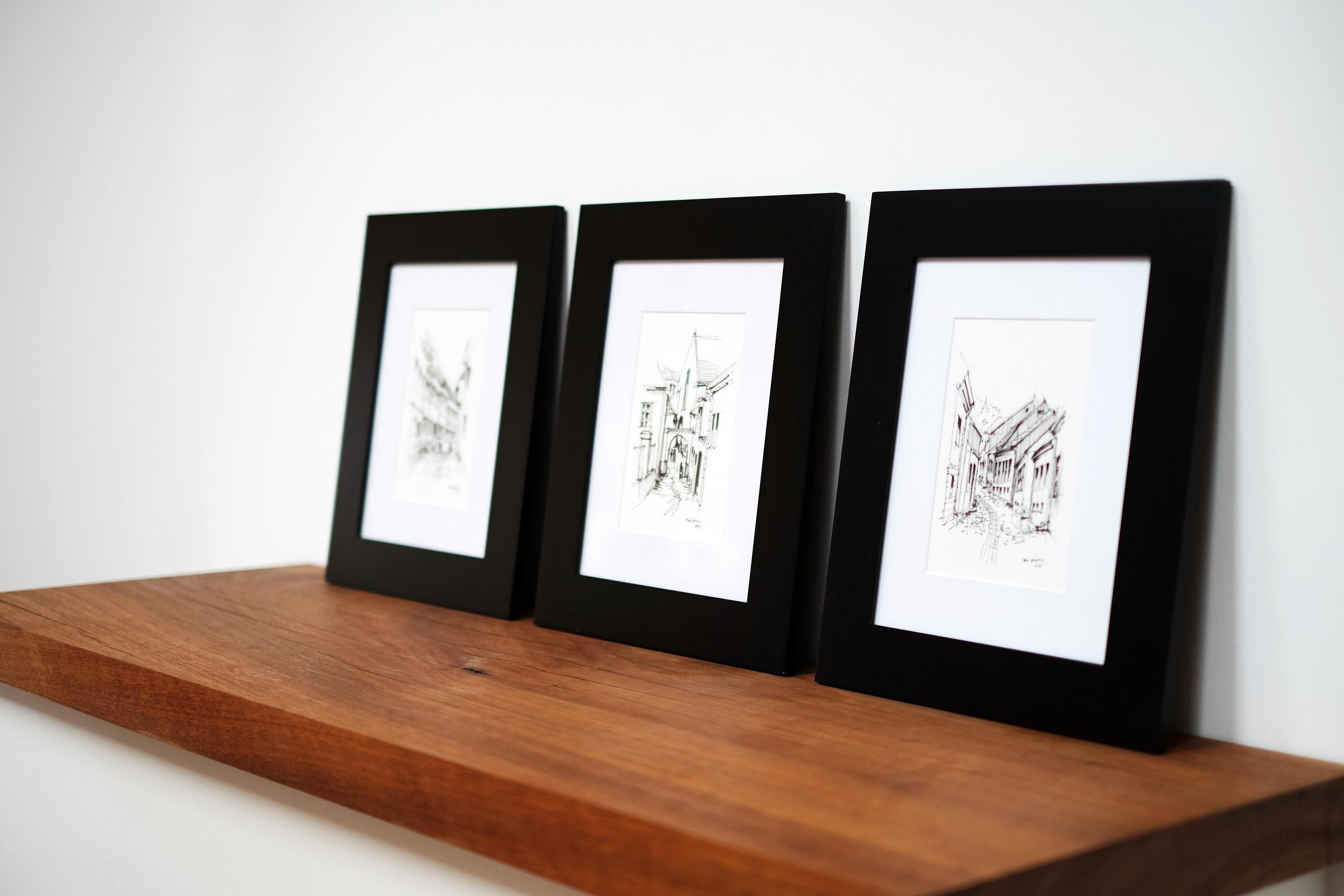
The Transylvania Series. Drawings comissioned for a private art gallery. While this is a temporary staging for photography, I took special care on how the work is ultimately displayed. This is purely an art comission, no architecture produced to reflect the writing below. Art and photo: Dan HogmanWhere does art actually belong? The dedicated museum is, in historical terms, a recent invention. Public institutions built specifically for the display of art and objects emerged largely in the nineteenth century, and for the vast majority of human history, no such category existed. What we now treat as the default setting for art — the neutral gallery, the institutional wall — is in fact a specific cultural construction, and a relatively young one.
This matters because most of the objects now housed in museums were never made for them. Ancient Greek pottery was made for use and for the domestic environment. Renaissance painting was commissioned for churches, private chapels, and the walls of aristocratic households. Chinese calligraphy was conceived as an intimate object, handled and kept close. The decision to move these things into institutions was not inevitable — it was a choice, shaped by ideas about public access, national identity, and the consolidation of cultural authority. Those were good reasons, and the gains in conservation, scholarship, and accessibility were real. But the museum was always an imposition of a particular logic onto objects that preceded it.
What is now emerging - the return of serious art to domestic and private architectural contexts - is not a regression. It may be a belated acknowledgment that the relationship between art and the spaces that contain it has always been more complicated than the institutional model suggests.
The Domestic (re)turn
There is a discernible shift in high-end residential architecture toward the integration of dedicated art spaces - rooms and sequences conceived less as living spaces and more as controlled display environments. In these houses, art is no longer dispersed across walls, mixed with family photos. They are arranged around a museum-type of logic.
Circulation begins to resemble that of a small institution: elongated galleries, compressed thresholds, and moments of release into double-height volumes designed to accommodate large works. The domestic interior becomes, in part, a curatorial device.
This development is inseparable from the changing status of art itself. For many collectors, artworks function simultaneously as cultural objects and financial assets, which leads to requiring storage and conservation means similar to what you might see at large, formal institutions. Climate control, security, and lighting are no longer secondary technical concerns but primary drivers of architectural form.
At the same time, there is a clear preference for privacy. Rather than lending works outward, collections are internalized, experienced in isolation or within a tightly controlled social circle. The result is a hybrid condition: a private museum embedded within a dwelling, where architecture mediates between inhabitation, exhibition and preservation. The distinction between the three has never been more difficult to locate.
The tension this produces is not merely aesthetic. The more rigorously a space performs as a museum, the further it drifts from the contingencies of daily life. And the more it withdraws into private life, the further it drifts from the public and interpretive function that museums were designed to serve. That gap between institutional rigor and private life is a place where some interesting architectural and cultural questions arise.
Drawing the Line Between Domestic and Exhibition
The separation between living and gallery space is rarely achieved through a single gesture. It is typically constructed through a layered set of distinctions, from spatial, environmental to behavioral, that together create a controlled gradient between two modes of inhabitation rather than a hard division.
The first mechanism is sequencing and thresholds. Architects working in this territory consistently insert transitional zones - corridors, ramps, internal courtyards, that slow movement and recalibrate attention. This is all done before the viewer arrives at a display space. The effect is that the boundary is experienced as a shift in pace and awareness rather than a simple room change. You do not step directly from a kitchen into a gallery; you pass through a neutral buffer that asks the body to adjust its tempo.
The second mechanism is environmental control. Art spaces in these houses are treated as stable, almost sealed environments, with controlled humidity, filtered light, minimal openings. Living areas, by contrast, remain responsive: operable windows, variable light, acoustic looseness. This often results in distinct construction assemblies within the same building, where one part behaves like climatized infrastructure and the other like a home. The distinction is physically real even when it is visually invisible.
Light is frequently where the separation becomes most legible. Gallery spaces use indirect illumination, like skylights, louvers, blinds, wall washers, all with the purpose of eliminating glare. In the work of John Pawson, this shift can be subtle but precise: the same material palette, but a different light discipline signals a different mode of use to the body before the mind registers the change. Circulation logic reinforces this. Art spaces are organized as linear or looped paths, encouraging progression and return—a typology closer to the museum than to the home.
Domestic spaces are designed around different priorities - they accept contrast, shadow, and variability. Living quarters are more nodal and flexible, allowing informal occupation and reoccupation. These two logics are woven together, but they remain distinguishable to anyone moving attentively through the building.
Finally, the separation is partly psychological, registered through what might be called behavioral cues. Material, proportion, and emptiness signal how to act. One speaks differently, moves differently, and stands differently in a space that performs like a gallery. Once inside, the architecture asks the visitor to suspend ordinary domestic habits. Most people, without any instruction, comply. The line is not always visible. But it is always felt.
The Program in Full
In the most developed examples of this type, the spatial hierarchy follows a consistent logic: arrival, transition, display, support, living, retreat. These are not merely functional categories but experiential ones, organized so that movement through the house becomes its own form of content.
Entry is typically compressed and controlled -a low ceiling, a narrow passage, or an opaque surface. This serves as a buffer between the outside world and the interior before any expansion occurs. Transition spaces follow: corridors, ramps, or internal courtyards that gradually shift scale, light, and material - connecting entry to the gallery sequence and living areas without belonging fully to either. The main gallery spaces need higher ceilings and are frequently organized as a linear or looped sequence. They sit at the center of this system, not as endpoints but as nodes - visited, exited, and re-encountered in the course of moving through the building. Secondary display rooms branch off from this core, providing more intimate pause points. Art storage is a critical but often overlooked component. Here, it maintains direct and discreet adjacency to the galleries, allowing rotation of works without exposure to domestic circulation.
The living core typically runs parallel to the gallery sequence or occupies a separate wing. It’s visual buffer from the display areas, but connected by the same material palette and spatial language. Private quarters are positioned at the most protected end of the sequence, separated by secondary corridors or vertical displacement. Service and support areas, including staff zones, mechanical rooms, packing areas, run along a parallel route or are placed on a lower level - this is to avoid interference with either experience.
It is worth underlining that in most cases, these houses function as primary residences. They are built for owners who live with their collections daily, and the architecture reflects that continuity. The integration of gallery spaces, climate systems, and storage is not supplementary to domestic life, but embedded in the core of how the building operates as a place of living. The presence of museum-grade conditions does not make these places less inhabited. It makes them more demanding as homes, organized around a more complex set of daily activities, in which ownership, preservation, and viewing are ongoing and intertwined.
For the Audience of One - The Question of Access
The architecture of these houses performs institutional rigor. The spaces are sealed, calibrated, and structured with the same care as a major public museum. Yet the conditions of access are entirely different. Entry is by invitation. There are no opening hours, no public programming, no institutional governance. A space may look and behave precisely like a museum—and still remain, in every meaningful sense, a private room.
This creates a condition that is worth examining without the reflex of easy criticism. There is a gray zone, and it matters. Some projects that begin as strictly private galleries drift, over time, toward a quasi-public existence: hosting curated visits, small academic gatherings, or occasional loan programs. Others remain tightly closed, functioning as controlled environments for preservation and selective viewing by a small circle. The architecture supports both possibilities, but the default position in these houses is privacy, not access. The building says museum; the governance says otherwise.
For the broader art world, this distinction has consequences. Public institutions - galleries, museums, kunsthalles - are governed by obligations of access, scholarship, and cultural distribution. Their collections can be researched, taught from, argued about. A work held in a private art house, however magnificently displayed, is effectively removed from that discourse unless its owner chooses to re-enter it through loans or publication. The architecture does not create this condition, but it reinforces and formalizes it.
Here is the paradox - space this rigorously designed for viewing is also a space from which the vast majority of viewers are excluded.
What This Does to Art
Whether this kind of environment is good or bad for the art it contains is a question that resists a single answer. In well-designed cases, the conditions are unambiguously beneficial from a preservation standpoint. Controlled lighting, stable humidity, and secure environments offer a level of care that often exceeds what is achievable in a conventional domestic setting.
Arguably, some of these private desidences do better that institutions, which are quite often underfunded and housed in inapprpriate spaces.
There is also a genuine benefit in terms of attention. When art is given a dedicated space, it ceases to compete with the noise of domestic life. The architecture slows down the act of viewing. Sightlines are considered, the approach is sequenced, and the encounter with the work becomes more concentrated. In this sense, a well-designed private art house can function as an intensifier of perception - a device for seeing more carefully, rather than a distraction from it.
But there are limits, and they are significant. Art has historically existed in dialogue - with audiences, with institutions, with the knowledge that accumulate around a work as it travels through public life. In a private house, that dialogue narrows to a very small group of viewers, which gradually reduces the work's broader cultural engagement. It becomes an object that is extremely well preserved and almost entirely unread.
There is also the risk of over-curation. When architecture becomes too dominant—too resolved, too perfect in its calibration—it begins to frame the art in ways that constrain interpretation rather than enable it. The environment becomes so complete that it competes with the work rather than supporting it. In the most extreme cases, the house itself becomes the primary object of aesthetic experience. The art art is now reduced to furnishing for the space.
This is an irony that the most careful architects are aware of and attempt to avoid, but the tendency is structural. A building designed to make art visible inevitably asserts its own presence in the act.
The Storage Counterargument
Any honest account of private art houses must reckon with a fact that complicates straightforward critique: the realistic alternative for much of the art they contain is not a public gallery wall but a storage archive. Estimates vary, but the proportion of major museum holdings kept in storage at any given time is substantial—commonly cited figures range from seventy to ninety percent for large encyclopedic institutions. The majority of institutions, no matter how much display space they have, keep the vast majority of their collection in climate-controlled vaults, catalogued but unseen.
In that context, the private art house does not simply subtract works from public view—it often replaces a condition of storage with a condition of display, however limited the audience. A work that is actively exhibited, even to a limite audience, is still in a better situation than a work of equivalent importance sitting in a vault. The difference is not one of visibility to the public - neither work is visible - but of physical condition, active maintenance, and the sustained relationship between an object and at least some viewers.
This argument is not comfortable, and it should not be used to resolve the tension too easily. The capacity of a work to inform scholars and public discourse is not present from private display alone. The physical welfare of the object and its cultural function are related but not identical, and optimizing one does not automatically serve the other.
What the storage reality does, however, is shift the terms of the debate. The choice is rarely between a private art house and a well-lit wall in a major institution. It is more often between a private art house and a vault. Framed this way, the private museum begins to look less like a failure of access and more like a partial, imperfect, but not negligible supplement to a system that was already struggling to keep its holdings visible.
Room for Exploration
There is one further dimension that sits apart from the cultural and ethical questions: these commissions offer architects a rare set of conditions for serious spatial exploration. The brief is unusually precise - a known collection, a specific owner, a defined set of environmental and experiential requirements - yet it is also unusually open, unconstrained by the institutional governance, public accountability, or budget pressures that shape museum commissions.
The architect is asked, essentially, to design the ideal conditions for encountering a particular body of work. That is not a trivial problem. It has produced some of the more rigorous thinking about light, sequence, threshold, and the relationship between architecture and perception to emerge from residential practice in recent decades.
Whether the results are publicly accessible is a separate question. As instruments of architectural inquiry, these houses have consistently pushed at the boundaries of what domestic space can be asked to do — and in that sense, whatever one concludes about their cultural politics, their disciplinary contribution is difficult to dismiss.
This is, in short, the ideal space for an architect to work with, with a caveat - the constraints/feedback from the institution and/or public comes with indirect benefits. Dialogue helps design, while hindering some of it by seeking consensus among parties.
No Clean Verdict
The house that performs as a museum is a genuinely ambiguous object. It represents a serious architectural response to a serious cultural condition: the accumulation of significant art by private individuals who want to live with it, preserve it, and experience it with care. The buildings it has produced are, in several cases, among the most spatially intelligent of their generation. The conditions they create for art are often excellent. The intentions behind them are frequently genuine.
And yet these houses also formalize and aestheticize a withdrawal. They take the language of public cultural life and place it in the service of private enclosure. They preserve art excellently for a small number of people. They make the broader cultural inaccessibility of that art feel resolved - and this may be the most ideologically consequential thing about them.
The public/private boundary in the art world has always been porous. Private collectors have always funded, shaped, and sometimes distorted public institutions. The private art house does not create this condition. It makes it spatial. It gives it a building. And in doing so, it makes visible—for anyone willing to look—the degree to which the infrastructure of culture has always been partially private, partially withheld, and never fully shared.
Toward a New Typology
The building that is neither fully a house nor fully a museum is not, strictly speaking, new. Its precedents reach back to the Renaissance studiolo — a private room conceived as a total environment for the contemplation of objects, where the arrangement of works was itself an act of knowledge-making. The Wunderkammer of the sixteenth and seventeenth centuries extended this logic into three dimensions, turning the collector's interior into a spatial argument about the order of the world. The great nineteenth-century collector's houses — Sir John Soane's Museum in London, the Isabella Stewart Gardner Museum in Boston, the Musée Gustave Moreau in Paris — pushed further. They produced buildings in which the distinction between domestic life and institutional display was deliberately collapsed, and where the collector's sensibility was the organizing principle of both the collection and the architecture.
What is new is not the impulse but the scale, the technical sophistication, and the degree to which contemporary practice has developed a coherent set of spatial strategies - repeatable, refineable, recognizable - around it.
That repeatability is what justifies speaking of a type
A typology is not simply a category of resemblance; it is a claim that a set of buildings shares not only formal characteristics but a common structural logic — a consistent relationship between program, spatial organization, and the conditions of use.
The private art house, as it has developed over the past several decades, meets that threshold. It has a recognizable spatial sequence, a consistent set of environmental requirements, a characteristic relationship between public-facing and private zones. It also has a body of architectural practice that has developed around it with sufficient self-awareness to constitute a discipline within a discipline.
What it lacks, so far, is a name — and the absence of a name has allowed it to remain peripheral in architectural discourse, discussed as a variant of the luxury residence or the private foundation rather than on its own terms. That framing understates both its cultural significance and its architectural ambition. These buildings are not large houses with gallery rooms. They are a distinct building type that has matured without being formally recognized as one — and the questions they raise about access, preservation, and the relationship between private wealth and public culture are, in part, questions about what it means for a type to exist without accountability.
Dan Hogman
2024
Below is a curated list of 20+ houses. Case studies of this “domestic gallery” / “inhabited museum” typology. While this is repeatable, refineable, recognizable to the point of claiming its own typology, the name is fluid.
-
Art exhibition space is integrated with living space at some level. Some are recent, while some are historical references that I’ve collected and bookmarked over many years. Some iconic examples, some case studies on what NOT to do, but the distinction is the subject for another future essay.
But in short, the breadth of the condition is here. Nowhere near all-inclusive and not in any order.
Rachofsky House - Richard Meier. Purpose-built as both residence and private museum-scale gallery. (Wallpaper*)
Daeyang Gallery and House — Steven Holl. House above, gallery below; spatially integrated through light and section. (Dwell)
Integral House - Brigitte Shim & Howard Sutcliffe. Primarily music, but operates as a curated spatial sequence akin to gallery. (Wikipedia)
House for an Art Collector - Quinn Architects. Townhouse reworked with a dedicated private gallery. (Architizer)
Art Collectors' Residence - Hariri Pontarini Architects. House structured around display of glass art collection. (World-Architects)
Vakis Hadjikyriacou House - Vakis Associates. Central double-height gallery with living spaces as side wings. (competition.adesignaward.com)
Private Residence I - Imai Keller Moore Architects. Art gallery runs below ground, linking separate volumes. (Imai Keller Moore Architects)
Gallery House - Raúl Sánchez Architects. Combines domestic use, hospitality, and exhibition. (Archup)
Private House by Line Architects - Line Architects. Entire house conceived as a continuous gallery sequence. (Designboom)
Artist Residence Seattle - Heliotrope Architects. Double-height studio-gallery adjacent to living spaces. (Amazing Architecture)
Casa Wabi Residence Areas - Tadao Ando. Combines living quarters with exhibition and residency spaces.
Neuendorf House - John Pawson & Claudio Silvestrin. Minimal interior used as a controlled backdrop for art.
Hadaway House — Patkau Architects - Designed as a sculptural container for objects and art. Unclear on the narrative and the reasoning of the sculptural elements beyond their practical role.
Kramlich Residence - Herzog de Meuron. Designed for a major media art collection, with specialized viewing galleries embedded into the residential program (highly controlled light and acoustics).
Alan I W Frank House - Walter Gropius & Marcel Breuer. A “total work of art,” integrating objects, interiors, and display. (Wikipedia)
Mulberry House - Edwin Lutyens. Historically adapted for art-rich interiors and display. (Wikipedia)
Valerie Traan House Gallery - Veerle Wenes. House used as an active exhibition platform. (Dwell)
Udechuku-Smith House Gallery. Domestic rooms double as curated exhibition spaces. (Dwell)
Gridchinhall Residence Complex. A hybrid of residence, studio, and exhibition hall. (Wikipedia)
Gallery House - Olson Kundig. The house is organized as a gallery first, residence second. A central spine acts simultaneously as a circulation and exhibition wall. A high-ceiling space is designed to display large artworks. (olsonkundig.com)
The Red House - Olson Kundig. This project is explicitly described as “at once a museum and a home.” The organization is vertical -ground floor - public gallery/exhibition space. Upper floors - private living
Studio House - Olson Kundig. A hybrid of house + artist workspace, where the main volume operates as a double-height studio-gallery. The central space is used for photography and display. Production, display, and living collapse into a single spatial field.
FURTHER READINGSVelthuis, Olav. Talking Prices: Symbolic Meanings of Prices on the Market for Contemporary Art. Princeton University Press, 2005.Thompson, Don. The $12 Million Stuffed Shark: The Curious Economics of Contemporary Art. Aurum Press, 2008.Conn, Steven. Do Museums Still Need Objects? University of Pennsylvania Press, 2010.Carbonell, Bettina Messias, editor. Museum Studies: An Anthology of Contexts. 2nd ed., Wiley-Blackwell, 2012.Pallasmaa, Juhani. The Eyes of the Skin: Architecture and the Senses. 3rd ed., Wiley, 2012.