Flattening the World to a Picture Plane
On Perspective as a Technology of Power in Western Visual and Architectural Culture
New York, NY
September 2020


< WRITINGS
< NEWS


Linear Perspective
Visual Culture Representation Culture Design Ideology
Abstract - Five centuries after Brunelleschi fixed the vanishing point, we remain inside the visual system he helped invent. This essay offers a critical history of linear perspective. It goes through its origins as a symbolic rupture with medieval spatial logic, through its institutionalization as the invisible law of Western architectural representation, and eventually to its survival as the organizing principle of CGI render culture. Against the persistent assumption that perspective is a neutral window onto reality, it argues that the picture plane is a technology of power. It positions the viewer as a sovereign observer, converts space into a measurable and possessable field, and pre-legitimizes buildings before they are built. Drawing on Panofsky's foundational analysis, the essay examines how the same geometric logic underwrites both the Renaissance draftsman's projection and the contemporary architectural photograph, while insisting on the fundamental ontological difference between the two.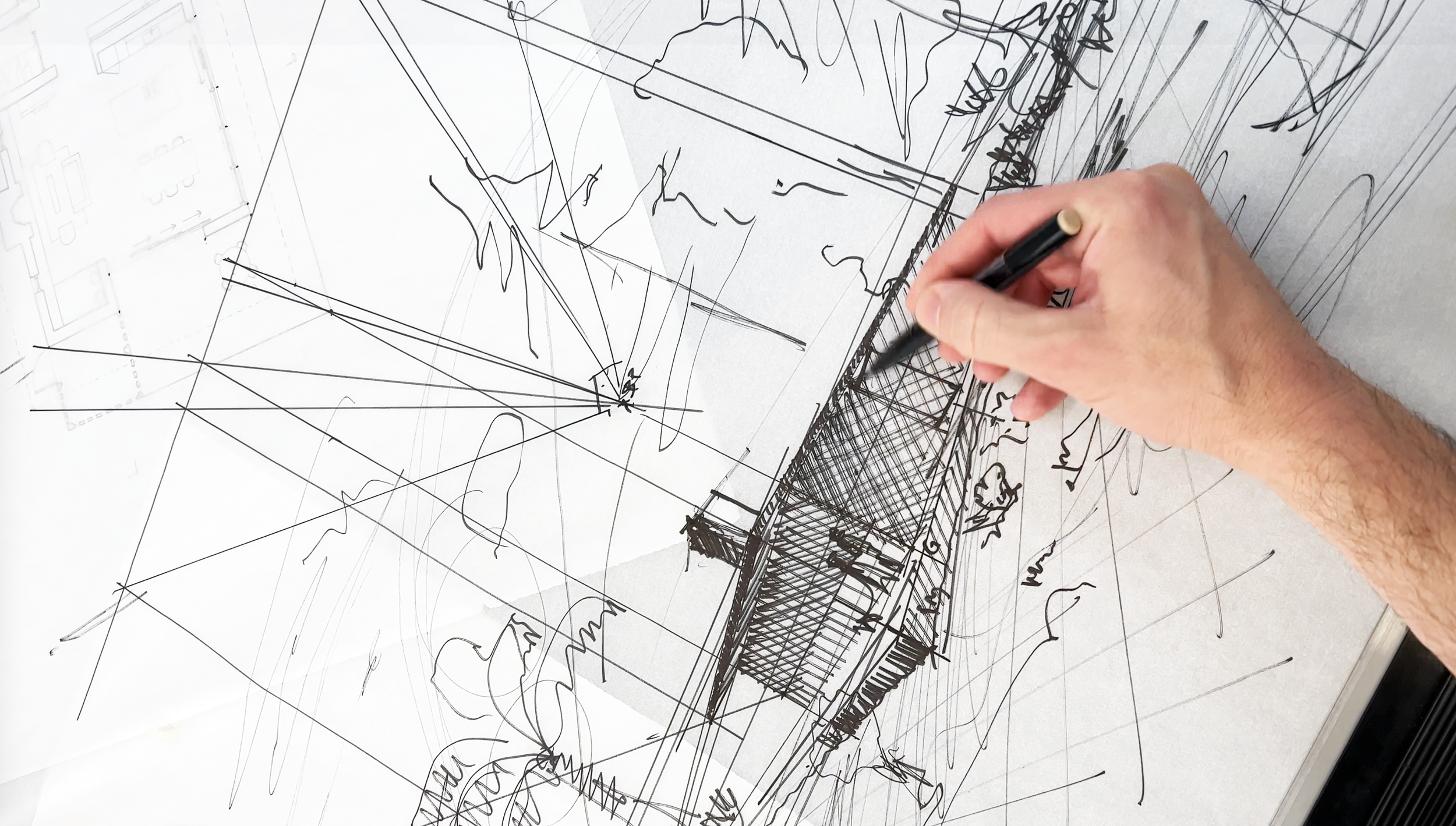
The “glass pane” as a physical object. A perspective is built by hand on vellum laid directly over a floor plan — the picture plane occupying its precise conceptual position between the two-dimensional projection and the three-dimensional illusion it generates.

Drawing by the author, Dan Hogman - a live activity while teaching a graduate architecture design studio class.
I. Theoretical Frame: Perspective as Symbolic Form
Erwin Panofsky had a foundational argument: linear perspective constitutes a “symbolic form” rather than a transparent window onto reality. This provides the indispensable theoretical basis for perceiving the Western visual culture.
Designating perspective as a symbolic form is similar to stating that this visual representation encodes a culture’s specific understanding of space, knowledge, and the human subject. In other words, the way a society pictures the world is a direct reflection of how that society thinks about its own existence.
Artistic representation is never merely a record of how the eye sees; it is a projection of how the collective mind organizes reality. Consequently, what is often dismissed as a technical achievement of the Renaissance must be read as a philosophical system embedded in visual practice: an archaeology of Western vision that equates realism with truth, and then naturalizes that equation until it becomes invisible.
Prior historical eras did not lack perspective; they employed different spatial logics tied to their own philosophical and perceptual assumptions. Ancient and medieval cultures operated under an internally coherent symbolic system shaped by their own belief. This system, built around alternate visual elements, was not a failed attempt at realism, but a fully realized alternative to it.
To recognize this is to accept Panofsky’s central challenge: that the act of seeing is itself historically constructed. Perspective does not show the world as it truly is; it shows the world as a specific culture decided it ought to be organized. The condensed consequence of this argument is both simple and destabilizing—realism is not truth, but a historically specific model of reality that has been so thoroughly institutionalized as to appear natural.
II. Historical Origins: The Collapse of the Symbolic Surface
The flattening of the medieval world was not a failure of skill, but an search for hierarchy. In pre-Renaissance visual systems, space was internal and symbolic rather than external and measurable. Figures were scaled according to their theological importance—the relative magnitude of a saint against a donor reflected a moral order. The physical distance was irrelevant. This was a world of surfaces, where the gold leaf of Byzantine icons served as an opaque barrier, denying the viewer access to a rationalized three-dimensional void.
Why should space be continuous when the visual journey, highly influenced by their hierarchical beliefs, was fragmented and episodic? The transition to perspective required more than a new drawing technique; it required the collapse of this symbolic barrier and the inauguration of the pictorial “window” as a conceptual framework for reality.
Linear perspective emerged when the Renaissance mind demanded a mathematical accounting of the infinite. By the early fifteenth century, figures such as Filippo Brunelleschi and Leon Battista Alberti replaced the opaque surface with the costruzione legittima—the radical insertion of the picture plane as a vertical glass pane intercepting the visual pyramid of light rays. Suddenly, space was no longer a collection of discrete objects but a singular, homogeneous container.
Additionally, the introduction of the vanishing point at the horizon line did not merely create depth; it anchored the entire visual universe to a single, human-centered viewpoint. A geometric rigor started to emerge, but does it mean that it conveyed truth? Arguably not. In fact, the opposite might be true - it imposes a rigid, monocular logic that forces the natural character of the human vision into a sterilized, measurable grid.
The evolution from surface to perspectival depth was ultimately a transition from participation to observation. The medieval art invited a tactile, multi-sensory engagement with symbols. The opposite is true with the perspective construction - it establishes a strict distance between subject and object. Once space could be geometrically projected, it could be possessed and manipulated—perspective became, in this sense, a technology of intellectual mastery. This shift effectively positioned the viewer as a quasi-divine observer, fixed at a point of sovereign optical clarity. We must recognize that this constructed “depth” is a historically specific technology of vision, one where the position of the eye and the body dictates the outcome.
III. The Shared Geometric Logic: Drawing and Photography as One System
The relationship between perspective drawing and architectural photography is defined by a shared structural logic: the projection of the three-dimensional world onto an imaginary flat pane of glass. Whether this projection is traced by the human hand or fixed by a digital sensor, the underlying geometry remains identical. In this sense, the photographer simulates the camera’s imaging plane, while the camera mechanizes the projection that is the basis of the classical act of drawing.
Are there similarities between the two processes? Arguably, yes – at the core of both systems lies the same abstraction. A flat, transparent plane is inserted between the observer and the world. All visible points are projected onto that plane from a single, fixed viewpoint; and the result is fixed as a two-dimensional image. This is the picture plane of the Renaissance artist and the sensor plane of the modern photographer—two implementations of the same fundamental solution: how to flatten human vision without losing spatial coherence.
In linear perspective construction, the eye is fixed at a station point, and rays extend from that point to the objects in view. Where those rays intersect the imagined glass plane, the draftsman marks the image. Even when the artist is not literally tracing on glass, the logic of the projection apparatus remains: the eye establishes the viewpoint, the mind interprets the projections, and the hand reconstructs them according to learned geometric rules.
Photography represents the mechanization of this exact process. Light rays pass through a lens and converge onto a flat sensor; the camera does not interpret space but simply registers the physical intersection of light with a plane. While the execution is electronic rather than manual, the geometry is structurally identical: a central projection onto a flat receiving surface.
This shared logic implies that images—whether drawn or photographed—are not windows into another world but flattened constructions entirely dependent on the plane that receives them. Both drawing and photography adopting the glass-pane model. At this point, both techniques force the world into a rectilinear projection. The peripheral and embodied vision is now suppressed, in favor of a standardized, fixed viewpoint.
The difference between these two media is ultimately procedural rather than structural: perspective drawing is an implementation in which the hand simulates the camera’s logic; architectural photography is an implementation in which the camera externalizes the act of drawing. Both serve to normalize a specific, historically constructed way of seeing the world.
IV. Same Logic, Different Ontology: The Nature of the Image
The perspective drawing and architectural photography have the potential to produce visually identical results, assuming that the technical accuracy of the artist is maintained. Human error is a factor to consider. But fundamentally, they different conceptual and ontological territories.
The core distinction lies in their relationship to reality: perspective drawing is a generative act that constructs space from an idea, whereas architectural photography is an extractive act that selects and constrains space from the existing world.
In perspective drawing, space is constructed from scratch as a direct projection of intent. The drawing defines reality by establishing its own geometric laws, allowing for total control over perfected or invented form. A drawing is openly artificial, but still based on the natural observation of the world. Drawing is a calculated abstraction that exists outside of time. Architectural photography, by contrast, must negotiate with a pre-existing environment. The photographer’s authority over geometry is only partial, conditioned by physical site constraints, lens distortion, and the uncompromising laws of physics.
More significantly, photography carries an indexical weight that drawing does not: it is a trace of the real, bound to a specific moment of light, weather, and occupation. Even when the photographer attempts to suppress contingency, the image retains unavoidable artifacts. There are reflections, contextual imperfections, the texture of time, all these being elements that a drawing can simply exclude at will. Every line in a drawing is intentional; photography always contains uncontrolled information. The photographer agency becomes limited at some point. Once the framing and setup is done, the machine does the work.
The functional roles of these two media are consequently diametrically opposed within the design workflow. Perspective drawing is projective: it precedes and shapes the building, forming a fundamental part of the making process. Architectural photography is interpretive and documentary: it follows the building’s completion, framing and validating the finished work. One is the birth of an architectural concept; the other is the curated evidence of its existence. Together, they represent two different modes of being—yet both deploy the same Renaissance geometric inheritance to assert their authority.
V. Architecture as Ideological Practice
In professional practice, perspective functions not merely as a representational tool but as a foundational design ideology. The architectural production relies on abstract, non-perspectival drawings - plans, elevations sections, axonometrics. A project is almost invariably validated through perspectival views. This implies that a building is conceived in the abstraction of the plan but only becomes “real” or “legitimate” when it conforms to a Renaissance-derived visual regime.
The centered subject is thereby built into physical space: linear perspective assumes a single, stable observer and a fixed horizon, which architecture encodes through axial alignments, forced symmetry, and framed vistas. The operational consequence is that design decisions are frequently prioritized for the canonical view or the photograph rather than for the fluidity of lived movement. This logic of total visual legibility, expressed through open plans and glass transparency—enforces a regime of surveillance and ownership, maintaining a strict distance between the observer and the observed.
Architectural photography acts as the primary mechanism for enforcing this system. The camera is, by definition, a perspective machine. Standard industry output—corrected verticals, controlled field of view, minimal human presence—aligns perfectly with Panofsky’s model of organized reality. The “hero shot” serves as a symbolic confirmation of this control: by deploying centered compositions, depopulated interiors, and perfect lighting conditions, these images stabilize the building and remove contingency. They present architecture as a closed, resolved object suspended in infinite space. This authoritative reading is achieved, however, through systematic exclusion. Perspective photography necessarily removes peripheral vision and the embodied messiness of movement. This is now becoming an instrument of control, but aligning the viewer’s experience strictly with the architect’s singular intent.
This logic has become hyper-inflated in contemporary render culture. CGI and high-end visualization exaggerate perspective through cinematic framing and hyper-clean vanishing points, pre-legitimizing projects before they are built. In this environment, a project can function visually before it ever functions spatially. How is this still relevant? The visuals are tools to evaluate the spatial functionality, so arguably, there is a time and place of CGI, with all the faults it come with.
Portfolios and client approvals are driven by these perspectival renders, mainly because they are easy to read and interpret by the non-technical audience. This is a little bit dangerous for the profession: architects are implicitly required to design for the image rather than for future functions or occupants. The reality is, most clients rarely engages deeply with technical drawings. The perspective-driven image becomes the primary basis for decision-making, shifting focus irreversibly from experience to appearance. Why can’t the architect tailor the visual to the client? Mainly because of the range of “client” - this does not include the owner in the traditional sense, but an entire range of stakeholders, permitting authorities and financing partners.
Understanding perspective as a tool of ideological decision-making offers two distinct paths for the practitioner. To accept the system is to optimize for the key view: to design for axial clarity and to control composition in advance so that the project is perceived as resolved. To resist it is to embrace distortion, multiplicity, and the oblique. By controlling the photography, the architect can challenge the authority of a single, definitive truth. Perspective is not merely a way to show architecture; it is a way to define what architecture is. To control the perspective is to control how a project is valued, judged, and understood.
VI. Contemporary Persistence: The Digital Glass Pane
We remain linked to the perspectival construction because our digital interfaces are fundamentally built upon its foundations. We are seeing a rise of virtual reality, augmented reality, and real-time three-dimensional rendering engines. However, the final output of architectural production almost invariably terminates at a flat surface, wether a flat screen or a printed page.
This is the central irony of the computational era: we employ complex algorithms to model form, only to compress that data back onto the glass pane of the LCD monitor. Why do we cling to this singular viewpoint? Because the human subject, conditioned by five centuries of Western visual culture, still demands a canonical, centered image to validate reality. We have traded the Renaissance draftsman’s geometrical apparatus for a digital camera object. But the internal logic, based on the intersection of a visual pyramid with a flat surface, remains the unchallenged law of legibility.
The persistence of perspective is, ultimately, a matter of power and the pre-legitimization of space. In an era of accelerated CGI production, the perspectival view has evolved from a discovery tool into a marketing instrument. Renderings do not merely represent a building; they weaponize atmosphere and cinematic depth to bypass critical spatial analysis.
While an axonometric projection or a point-cloud model might offer a more faithful account of a building’s complexity, these alternate representational modes lack the seductive authority of the human-centered view. The client does not want to inhabit a coordinate system; they want to stand at the exact, privileged point of control that perspective provides. Does this reliance on a five-hundred-year-old optical convention hinder architectural innovation? Absolutely. It forces the architect to design for the frame rather than for the experience of movement, prioritizing the static image over the temporal reality of the built environment.
Ultimately, this system endures because it provides a standardized, uniform language that most stakeholders can relate to. Perspective drawing and its digital descendants offer a closed reading of space that feels resolved and authoritative.
In the messiness of the construction site or the shifting tides of urban life, the perspectival image stands as a monument to total control—suppressing peripheral, tactile, and multi-focal modes of perception in favor of a sterile geometric order. Even as we explore immersive technologies, we find that they are most often merely 360-degree extensions of the same central projection. We are not yet prepared to abandon the glass pane, because to do so would be to abandon the very idea of the centered, observing subject upon which our entire architectural discipline is built.
-dh, 2020
Further Reading -

Alberti, Leon Battista. On Painting. Translated by John R. Spencer, Yale University Press, 1966.
Panofsky, Erwin. Perspective as Symbolic Form. Translated by Christopher S. Wood, Zone Books, 1991.Crary, Jonathan. Techniques of the Observer: On Vision and Modernity in the Nineteenth Century. MIT Press, 1990.