Office-to-Housing Conversion
Promise, Limits, and What Gets Lost in the Narrative
New York, NY
May 2022
< WRITINGS
< NEWS
Office to Housing Conversion
Multifamily, Housing
Remote WorkEmpty Offices Aren’t Just a Problem, but an Opportunity.
At least in theory…
We have too much office space and not enough housing. The math seems obvious. But the closer you look at office-to-residential conversion, the more complicated — and more interesting — the real story gets.
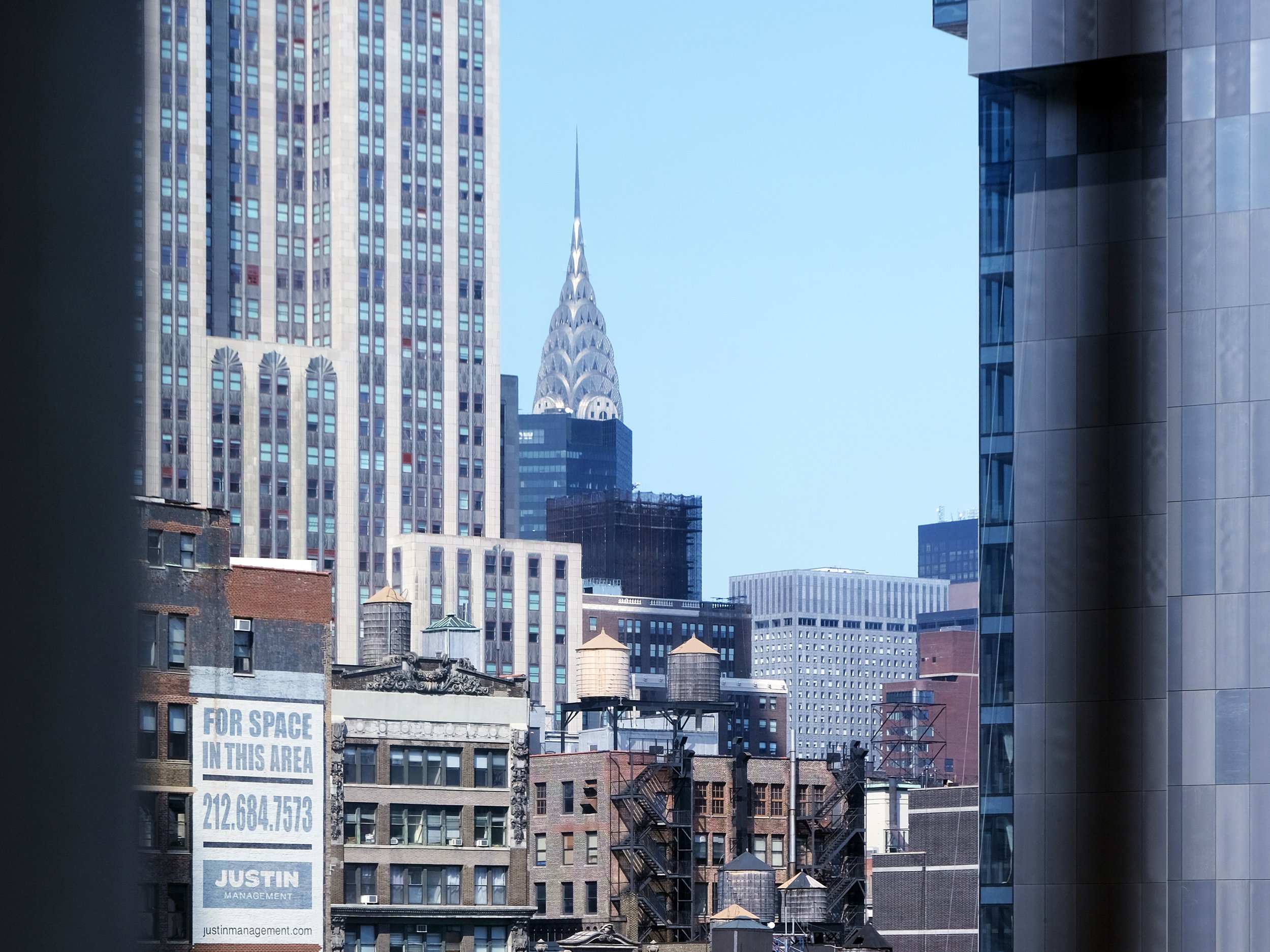
Call Justin!
Right outside my window. Manhattan, New York. May 2022.

Availabilities everywhere, more common in Class B and C office spaces. Many developers prepare to transform once-busy corporate floors into residential apartments - with a caveat... The city’s shift from daily commutes toward a new urban life shaped by housing demand and remote work. Photo by Dan Hogman.
I've always been drawn to housing at its most elemental level — not the spreadsheet version, but the lived one. A well-placed corner café. The way a ground-floor grocery store turns a block into a neighborhood. The fact that in dense, walkable places, the distance between strangers and acquaintances is often just a few daily encounters on the same sidewalk. Multifamily housing, when it works, doesn't just stack units — it creates the conditions for those encounters to happen at all.
I've spent a lot of my career thinking about how housing gets built, and more importantly, why it so often doesn't. The 2008 crisis was a formative lesson. What looked like a functioning development apparatus turned out to be a highly leveraged house of cards, entirely dependent on private capital and the assumption that values would keep climbing. The structural fragility was always there. It just took a collapse to make it visible.
Then 2020 hit, and everything shifted again — though differently, and in ways we're still sorting through.
Remote work didn't just disrupt commuting patterns. It undermined the physical rationale for a huge swath of commercial real estate, particularly the Class B and C office buildings that occupied so much of our downtown cores. The numbers bear this out. By late 2021, national office vacancy rates were hovering around 16–17%.¹ Manhattan, never a market known for excess space, hit 18.3%.² San Francisco crossed 16% — up from 4.7% before the pandemic.³ Those aren't soft numbers. That's a structural shift.
I watched it happen in my own former workplace. What had been two full floors of occupied office space compressed into one. Fifty percent gone, just like that. Whether that's representative is debatable — but directionally, it's not unusual.
Meanwhile, housing vacancy in the same cities was sitting in the low single digits. The gap between what the market needed and what existed was already significant before 2020; the pandemic didn't create the housing shortage, it just made the contrast impossible to ignore. Nationally, researchers estimate the U.S. is short by millions of units, with the deficit concentrated in exactly the dense urban markets where office vacancies surged.⁴˒⁷
And so the idea emerged — almost naturally — that we should just connect the two problems. Empty offices become homes. Quiet downtowns come back to life. Two crises, one solution. It's a genuinely appealing narrative.
The trouble is that narratives tend to smooth over the parts that don't fit.
The technical realities of office conversion are stubborn, and they don't yield gracefully to optimistic framing. Office buildings were designed around a specific set of needs: large, open floor plates, centralized HVAC optimized for daytime use, core-and-shell layouts that work fine for cubicle arrangements but create real problems when you're trying to get daylight into a bedroom. The deeper the floor plate, the more units end up with no natural light, or with circulation and egress configurations that don't meet residential code without significant reconfiguration.
Mechanical systems are often the real cost driver. Residential buildings require granular, 24/7 climate control — not the centralized, schedule-based systems that office buildings run on. Replumbing, rerouting electrical risers, reconfiguring life-safety systems: this is expensive, time-consuming work. Industry analyses consistently find that only a fraction of the existing office stock is genuinely suitable for conversion without hitting costs that make the math impossible.⁵
And even when the physical conversion is feasible, the financial model often still doesn't pencil. High acquisition costs, expensive remediation, and elevated interest rates have combined to squeeze returns on projects that look reasonable on paper. Without policy support — tax abatements, density bonuses, direct subsidies — many of these projects simply don't happen. Research suggests that only about 0.6–0.7% of U.S. office stock is likely to convert in any given year, even with persistent vacancies.⁶ That's not a rounding error. That's a ceiling.
Cities have responded with real policy tools. New York's Affordable Housing from Commercial Conversions program offers significant tax exemptions and streamlined permitting for qualifying projects.⁸ Chicago's LaSalle Street Reimagined initiative uses Tax Increment Financing to subsidize conversions contingent on affordable unit commitments.⁹ Washington, D.C.'s Housing in Downtown program extends tax abatements tied to affordability targets.¹⁰
These programs matter. They've moved projects forward that otherwise would have stalled. But they also raise a question worth sitting with: at what point does a conversion subsidy become a bailout for a commercial asset class that simply overbuilt? The line between "transformative housing strategy" and "rescue financing for struggling office landlords" isn't always clear, and the policy conversation doesn't always distinguish between them honestly.
What we do know is that conversions are happening at real scale in some markets. New York has seen thousands of apartments enter the pipeline through adaptive reuse.¹¹ Washington, D.C., Los Angeles, and Chicago are among the most active conversion markets nationally, with tens of thousands of units in the national pipeline.¹² These are meaningful numbers.
They're just not sufficient ones. Closing the housing gap meaningfully requires hundreds of thousands of new units annually. Office conversions, at their current pace and feasibility ceiling, can contribute tens of thousands. That's useful. It's not transformational.
The wrap, at least for now… Here's what bothers me most about the current conversation: the ease with which office conversion gets positioned as a comprehensive housing answer, when it's really a niche strategy with a compelling story. Cities facing acute housing shortages need zoning reform, sustained public investment in affordable development, and political willingness to permit density in places that currently resist it. Office conversion offers none of those things. It offers a relatively palatable narrative — no neighborhood opposition, no upzoning fights, just repurposing what already exists — and that palatability has, I think, allowed it to consume more policy oxygen than its actual scale warrants.
Housing matters too much for that. At its core, this is about shelter — the most basic thing a city owes its residents. The task isn't just to build more units or to reposition underperforming commercial assets. It's to build with enough deliberateness that what gets created actually serves people, connects them to daily life, and holds up over time.
Office conversion can be part of that. In the right buildings, in the right markets, with the right policy scaffolding, it's a genuinely useful tool. But it's a tool — not a strategy, and certainly not a substitute for the harder, slower work of actually addressing why housing is so scarce and expensive in the places people most want to live.
Further Readings - JLL. Office Market Insights Q4 2021. JLL, January 2022.CBRE. US Office Outlook 2022: The Road to Recovery. CBRE, December 2021. https://www.cbre.com/insights/viewpoints/us-office-outlook-2022-the-road-to-recoveryCoStar. San Francisco Office Market Report Q4 2021. CoStar News, 2021.Joint Center for Housing Studies of Harvard University (JCHS). The State of the Nation's Housing 2022. Harvard University, 2022.NAIOP Research Foundation. The Office Sector: The Need for Repositioning and Adaptive Reuse. NAIOP.org, 2022.Urban Land Institute (ULI). The Feasibility of Converting Commercial Real Estate to Multifamily. ULI, 2021.Moody's Analytics. The U.S. Housing Supply Shortage: New Estimates and Drivers. Moody's Analytics, 2022.New York City Department of Housing Preservation and Development. Affordable Housing from Commercial Conversions (AHCC) Program. NYC.gov, 2022.City of Chicago. LaSalle Reimagined: Office-to-Residential Conversions. Chicago.gov, 2022.District of Columbia Office of Planning. Housing in Downtown Program. DC.gov, 2022.Financial Times. "New York Office Buildings Converted to Apartments." Financial Times, 2022. https://www.ft.com/content/d186596f-d0f6-49c8-ae4c-0f231a961071RentCafe. Office-to-Residential Conversions: National Pipeline 2022. RentCafe, 2022. https://www.rentcafe.com/office-to-residential-conversions-2022/