An Urban Prototype in Place
Nordhavn and the Design Basis of the Five-Minute City
Copenhagen, Denmark
July 2024


< WRITINGS
< NEWS


Copenhagen urban design
Five-minute city
Urban theory
Nordhavn compresses urban life into a walkable system where water, housing, and work intersect. The experience feels immediate and informal, but it is produced through precise planning. What emerges is a city that balances efficiency with a carefully constructed sense of spontaneity.
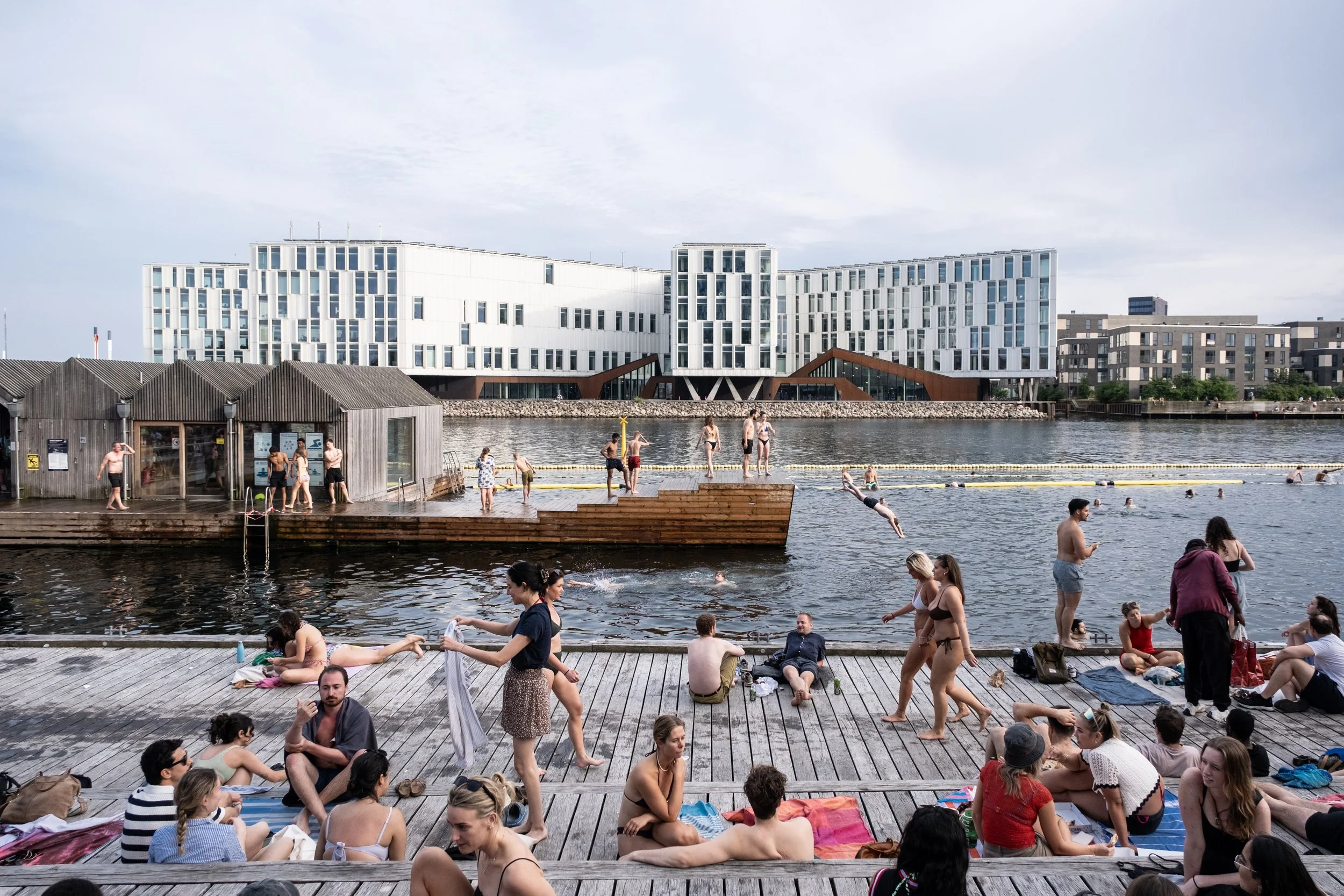
Nordvavn - a place full of life, long after the sunt sets. At least during the summers.
Swimming is not treated as a seasonal leisure activity but as an everyday extension of urban life, embedded directly into the harbor’s edge. Photo: Dan Hogman
I arrived in Nordhavn in July expecting what northern European port cities tend to offer: a certain restraint, a controlled environment, perhaps some tasteful signage in a minimalist typeface about the district's history. What I found instead was closer to a Mediterranean afternoon. The piers were crowded — people swimming, sunbathing, sitting with their legs over the edge, beers balanced on raw concrete. There was no formal entry point, no lifeguard station, no moment of official permission. A series of ladders, cut steps, and sloped edges allowed you to get into the water almost anywhere, and people were using all of them.
The Piers in July
What made this stranger, at least to an outsider, was the setting. The piers don't read as a beach. They read as a former working harbor — hard industrial surfaces, heavy typologies, no picturesque softening of the edge. As a former industrial area, one might think that the was must be polluted. However, the water was visibly clear and people were swimming without hesitation. I did what I had to do - put my camera and backpack down, left my clothes on the concrete, and jumped in. When I climbed out I grabbed a beer and sat among strangers. Palm trees expected? Nothing felt staged or unsafe.
The cleanliness of the water is not accidental. Copenhagen's harbor water quality is the result of decades of environmental regulation, investment in wastewater treatment, and the gradual removal of heavy industry from the waterfront. Strict controls on runoff and continuous monitoring have transformed what was once a working industrial port into something closer to a managed natural asset. The water is tested, tracked, and maintained. Its clarity is carefully managed. What makes this legible at street level, or rather at pier level, is that the infrastructure enabling it is largely invisible. You encounter the result — swimmable water in what looks like a port — without seeing the systems behind it. That gap between expectation and reality is part of what makes the experience register so sharply.
This almost feel improvised, like some waterfront areas in Eastern Europe where I grew up, where people used to converge on the riverfront in lack of means to go to a real resort. Except that the economy of this place suggest means - people still prefer to just walk down the pier for a swim. Because, in many ways, the casualty of the place is somehow similar to what one might find in Southern Spain.
The setting also punctures a particular stereotype. The received idea of Scandinavian cities - efficient but cold, admirable but closed, climatically hostile and socially formal - simply doesn't hold at the waterfront in July. Nordhavn, in that season, is genuinely extroverted. The public space is fully occupied, the social atmosphere is loose, and the relationship between body and environment is direct and physical.
That said, this impression is seasonal and should be named as such. July in Copenhagen means long days, warmth, and a density of people that amplifies everything. The same piers in February — short daylight, low temperatures, wind off the water — would produce an entirely different reading. The design may be permanent, but the atmosphere is not.
The Origins of Nordhavn
Nordhavn is a newly developed district built on a former industrial port on the northeastern edge of Copenhagen. Its premise is structural rather than aesthetic: compress housing, workplaces, schools, some limited retail, and leisure into a tight, walkable radius. Daily life no longer requires movement across the city. The underlying logic is simple but consequential — if most needs are within a few minutes' reach, commuting becomes optional, and with it, the stress, time loss, and emissions that define contemporary urban mobility. Distance is treated as friction, and the city is reorganized to minimize it.
This spatial logic extends into infrastructure. Cars are deprioritized in favor of cycling, walking, and public transit — a choice that aligns with Denmark's broader urban culture but also produces real environmental and social effects. Public spaces, waterfront access, and green areas appears to be designed to increase the frequency of unplanned encounters. This positions community life as a byproduct of spatial arrangement rather than a separate goal. The result is a district that presents itself as self-sufficient for a newcomer like me. This is a compact field of immediate access, where urban quality is measured by how little one needs to move to live well.
At the same time, Nordhavn operates as a prototype rather than a neutral solution. Its emphasis on design-led livability places it at the forefront of contemporary urban planning discourse. The so-called fifteen-minute city concept is visible. The convenience it promises risks being unevenly distributed if high costs determine who can participate in it. I looked at some real-estate listings - Nordhavn reframes the city; what it does not fully resolve is for whom.
A Small Network With A Shared Idea
The architecture of Nordhavn is not the product of isolated authorship. A relatively tight network of Danish and international practices is responsible for most of the built work. At the center is COBE, which not only developed the masterplan for the district but is also directly involved in multiple buildings — often working alongside Vilhelm Lauritzen Architects and landscape office Tredje Natur. A clear example is the Tip of Nordø project, a large office and public building conceived as a hybrid between workplace and civic space, where these firms operate as a combined authorship rather than distinct signatures. Architecture, landscape, and infrastructure are designed simultaneously, producing buildings that function less as autonomous objects and more as extensions of the urban system.
COBE's role is near-foundational. Having won the masterplan competition, the firm later relocated its own studio into the district, effectively turning Nordhavn into a 1:1 laboratory where urban ideas are tested at full scale. Alongside them, Bjarke Ingels Group brings a more globalized profile — a transnational practice with a base in Nordhavn, embedding its speculative, high-concept approach within the everyday fabric of the district. NORD Architects contributes a different register: socially oriented typologies like schools and healthcare facilities. This brings quieter, welfare-state logic into the area. Together, these firms establish a feedback loop: they design the city while simultaneously occupying it, collapsing the distance between production and habitation.
The result is not stylistic coherence but what might be called a controlled diversity — a field of projects shaped by a small network of practices who share methods more than a visual language. Data-driven design, programmatic mixing, and the treatment of public space as a primary driver are the common threads. We can talk now of an architectural cluster, where the district functions simultaneously as workspace, testing ground, and ongoing argument about what contemporary urban form can be.
The Cost of Ease
Nordhavn operates like a governing idea about how life should be organized. Distance is treated as friction to be eliminated, and the city is reassembled accordingly: a tight, continuous field of compressed functions. The promise is clarity — less commuting, fewer logistical decisions, a smoother daily rhythm. But this compression also redefines what counts as urban experience. Movement, once a defining feature of city life, is no longer necessary in the same way. The city becomes something you inhabit almost entirely within a fixed radius.
There is a subtle trade-off embedded in this logic. Proximity reduces effort, but it can also reduce exposure. When most needs are met locally, the incentive to cross the city - to encounter difference, friction, or unpredictability - diminishes. The five-minute model risks producing a form of spatial self-sufficiency that is efficient but inward-looking. Whether urban richness depends, at least in part, on the need to cross boundaries — both physical and social — is a question Nordhavn raises without answering.
This tension extends to the architecture itself. Nordhavn is not legible through individual buildings in the conventional sense. There are no singular monuments that dominate the district; instead, it reads as a coordinated system where architecture, landscape, and infrastructure are tightly interwoven. Authorship is diffuse, almost infrastructural. Projects are layered and co-authored, aligned with an urban logic that prioritizes continuity over distinction. The consequence is a high degree of coherence — but also a flattening of the possibility of rupture. There is little room for the anomalous building that resists its context or introduces a radically different spatial logic. Nordhavn operates through agreement - while effective, limits the range of architectural expression to what can be integrated smoothly into the whole.
“Depressingly?” Orderly…
I noticed this most clearly while walking away from the water on my second afternoon. The transitions between spaces - pier to street, street to courtyard, courtyard to building entrance - were almost too smooth. Nothing snagged. There was no misaligned curb, no awkward leftover space, no building that seemed to have arrived from somewhere else.
The neighborhood feels coherent in a way that felt considered, and considered in a way that occasionally felt total. The fact that the bulk of the buildings were developed within a relatively short timeframe, as it would naturally relate to the construction of a neighborhood, helps in establishing a common and fresh baseline for design. How would this age? What would look like if something went wrong here - not catastrophically, but productively. The kind of wrong that cities usually contain.
The Good Life, By Design
Nordhavn is frequently framed not just as a place to live, but as a model of how to live. The district packages a set of values - health, sustainability, convenience, social interaction, into a coherent spatial product. Cycling infrastructure, clean water for swimming, accessible public spaces, and mixed-use density are not isolated features; they are assembled into a narrative of the good life. This narrative is legible in the everyday: people moving easily between activities, outdoor spaces constantly in use, the absence of visible strain. The city presents itself as a solution to contemporary urban problems, from congestion to isolation.
But this coherence edges into commodification. The qualities that make Nordhavn attractive, from cleanliness to social vitality, are not incidental. They are produced through planning decisions, investment, and pricing structures that shape who can access them. What appears as an organic way of living is, in fact, highly constructed. The risk is that good urban life becomes standardized, reduced to a repeatable formula that can be marketed and replicated, rather than something that emerges unpredictably from diverse and/or conflicting conditions.
This connects to one of the more difficult aspects of Nordhavn to pin down: its simultaneous sense of authenticity and total construction. The life in the district feels real - people swimming off the piers, informal gatherings, a casual occupation of space that doesn't read as staged (the July weather was part of the reason…). But every element, from the edges of the harbor, the accessibility of the water, the placement of public spaces, has been deliberately designed to enable exactly these behaviors. Spontaneity is not accidental; it is anticipated - even scripted. The environment invites certain actions so effectively that they appear unplanned. When a place feels natural but is entirely engineered, where does authenticity reside? Nordhavn does not resolve this tension; it sustains it. The district works precisely because it blurs the line between lived experience and designed intention.
What About Gentrification - the Common Issue These Days…
Gentrification adds a further layer to this, though it operates here differently than in most cities. Nordhavn doesn't follow the classic pattern of displacement — there was no residential population to push out. The area was largely industrial before redevelopment, which also means fewer of the typical planning resistances that slow urban transformation elsewhere. In that narrow sense, the project avoids the direct social rupture seen in older inner-city neighborhoods.
But the absence of displacement doesn't mean the absence of exclusion. What emerges instead is a form of greenfield gentrification: a district built from scratch that is economically selective from the outset. High construction costs, premium positioning, and a design-forward identity set a threshold for entry before anyone arrives.
No one is forced out, but many are structurally kept out. The cost filters out many newcomers… The result is a socially narrow environment that risks reinforcing broader urban inequality — not by replacement, but by predefinition of who the city is for.
Exportable in Form, Not in Function
Nordhavn can be understood as a conditional export model rather than a universally transferable template. It works as a coherent system because it sits within a specific constellation of conditions: strong public governance, sustained investment capacity, environmental regulation, and a socio-political context that is distinctly Danish. Within that framework, the five-minute city, the integration of water as public infrastructure, and the blending of residential, commercial, and recreational programs produce a legible and functioning whole.
The model is not just architectural, but institutional. What appears as a spatial solution is, in reality, the outcome of aligned policy, capital, and planning culture.
The district demonstrates that these trade-offs can be managed, even optimized - but only within the constraints of a system capable of sustaining them. It is not a universal model, but a condition-dependent one: a city that can be exported in form, but not in function, without the underlying structures that make it possible. Nordhavn does not resolve the questions it raises — it organizes them. The result is a city (yes, we can call it city, even at a population of 6000 at the time of this writing) that feels resolved, even elegant, while remaining contingent on everything that holds it in place.
January, Imagined
On my last evening, I sat back at the water's edge later than I should have, long after the swimmers had gone. The light was still there — that particular northern light that lingers past nine in July, neither quite day nor quite dusk. The piers were nearly empty, the sidewalks were quiet, but the temperature still up, mainly due to the embodied energy in the pavement. What would this would look like in January: dark by four, the water black, the surface closed off by cold. Same design, but entirely different vibe. The question of whether Nordhavn works, in the end, might be seasonal — answered differently depending on when you arrive, and who you are when you do.
- dh, July 2024
Further Reading –Waldheim, Charles, editor. The Landscape Urbanism Reader. Princeton Architectural Press, 2006.Smith, Neil. The New Urban Frontier: Gentrification and the Revanchist City. Routledge, 1996.Careri, Francesco. Walkscapes: Walking as an Aesthetic Practice. Editorial Gustavo Gili, 2002.Soja, Edward W. Postmetropolis: Critical Studies of Cities and Regions. Blackwell, 2000.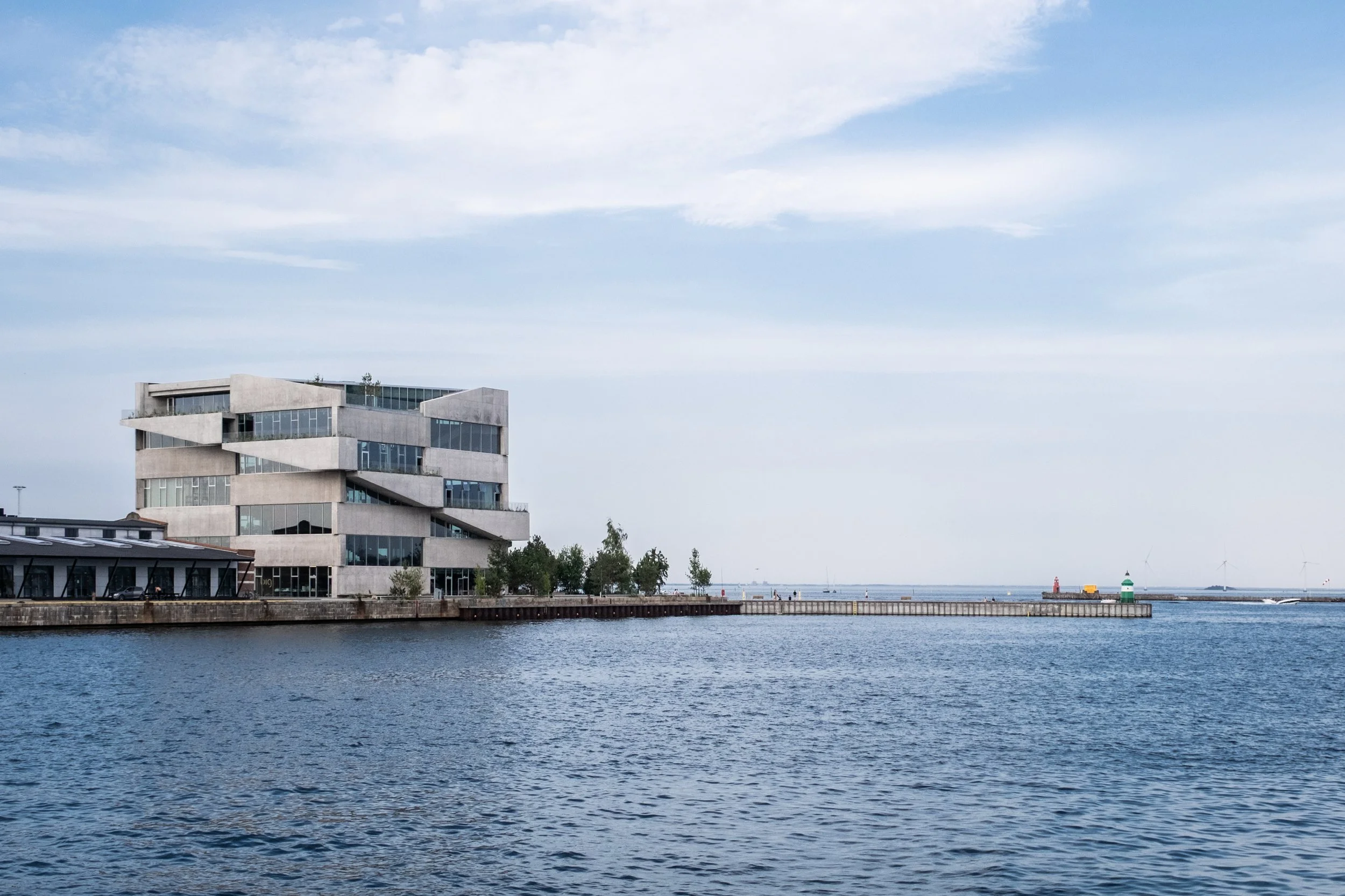
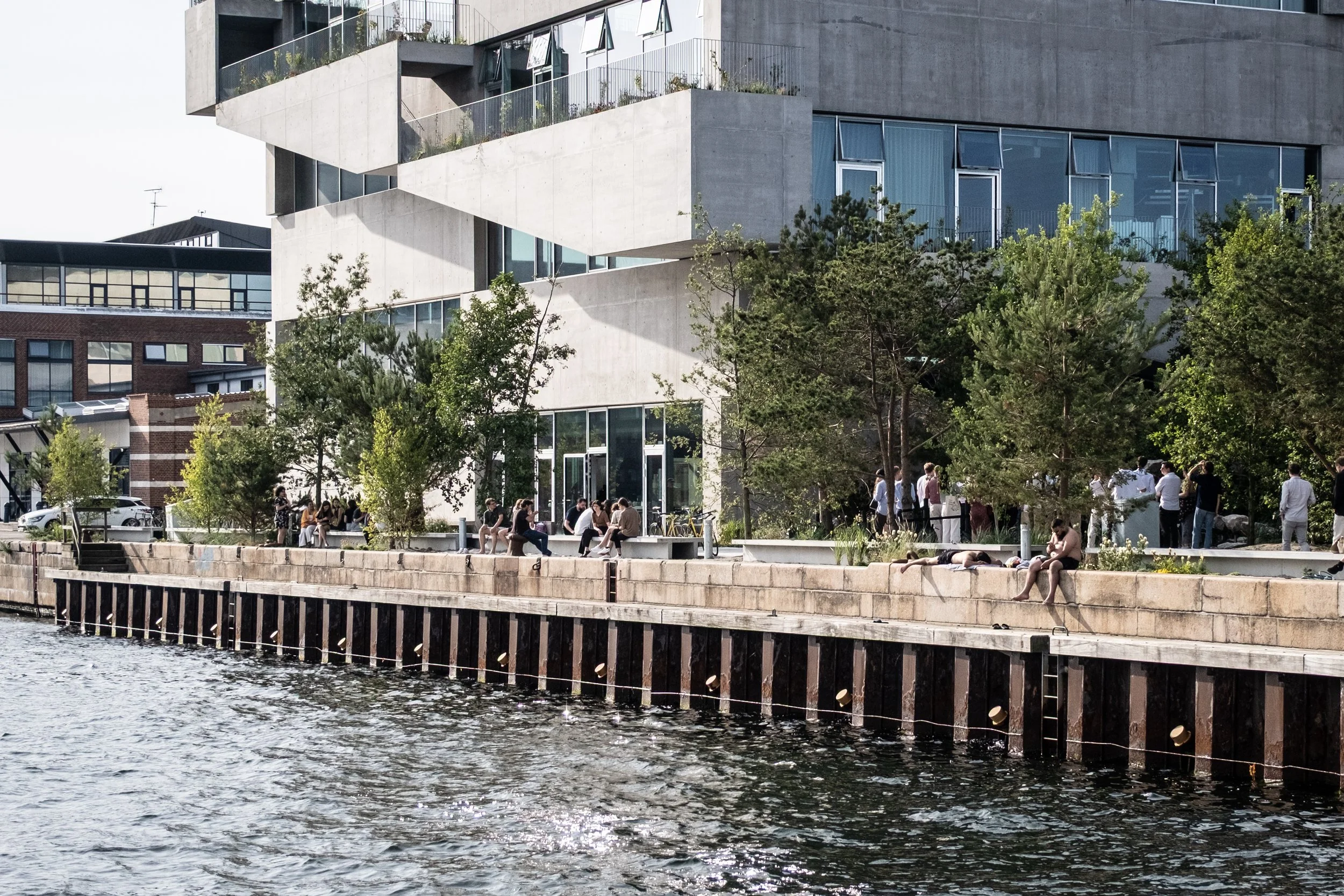
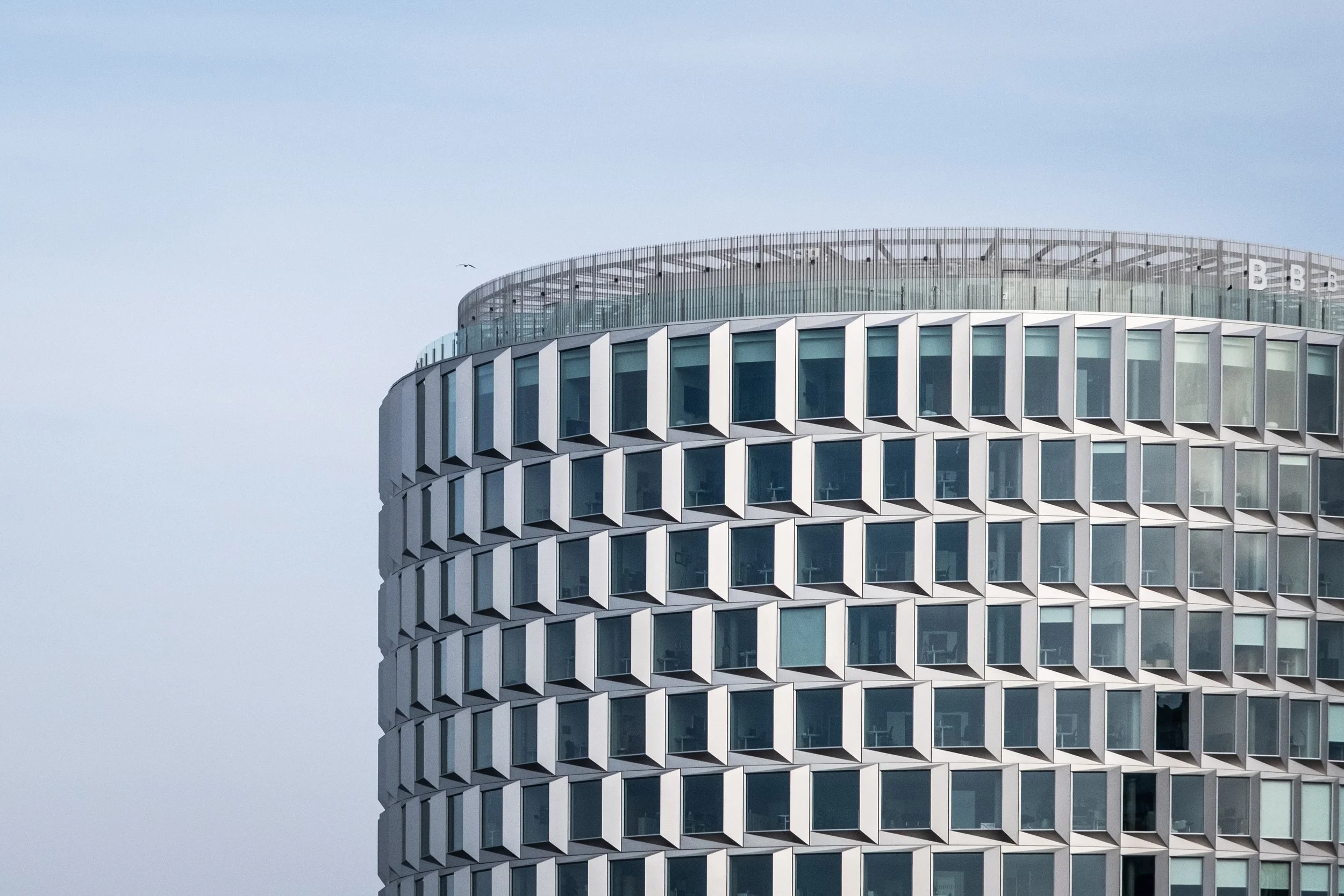
BIG HQ. Bjarke Ingels frames the “greenness” of concrete not as eliminating it, but as reformulating it. The headquarters is built with a proprietary mix, or Uni-Green, that replaces part of the cement clinker with alternative binders like calcined clay, achieving roughly a 25% reduction in CO₂ compared to conventional concrete. Ok...

The perks of the job - you get to swin on your lunch break. But this is only when weather allows. And then, you have to work for BIG! Take it as you wish...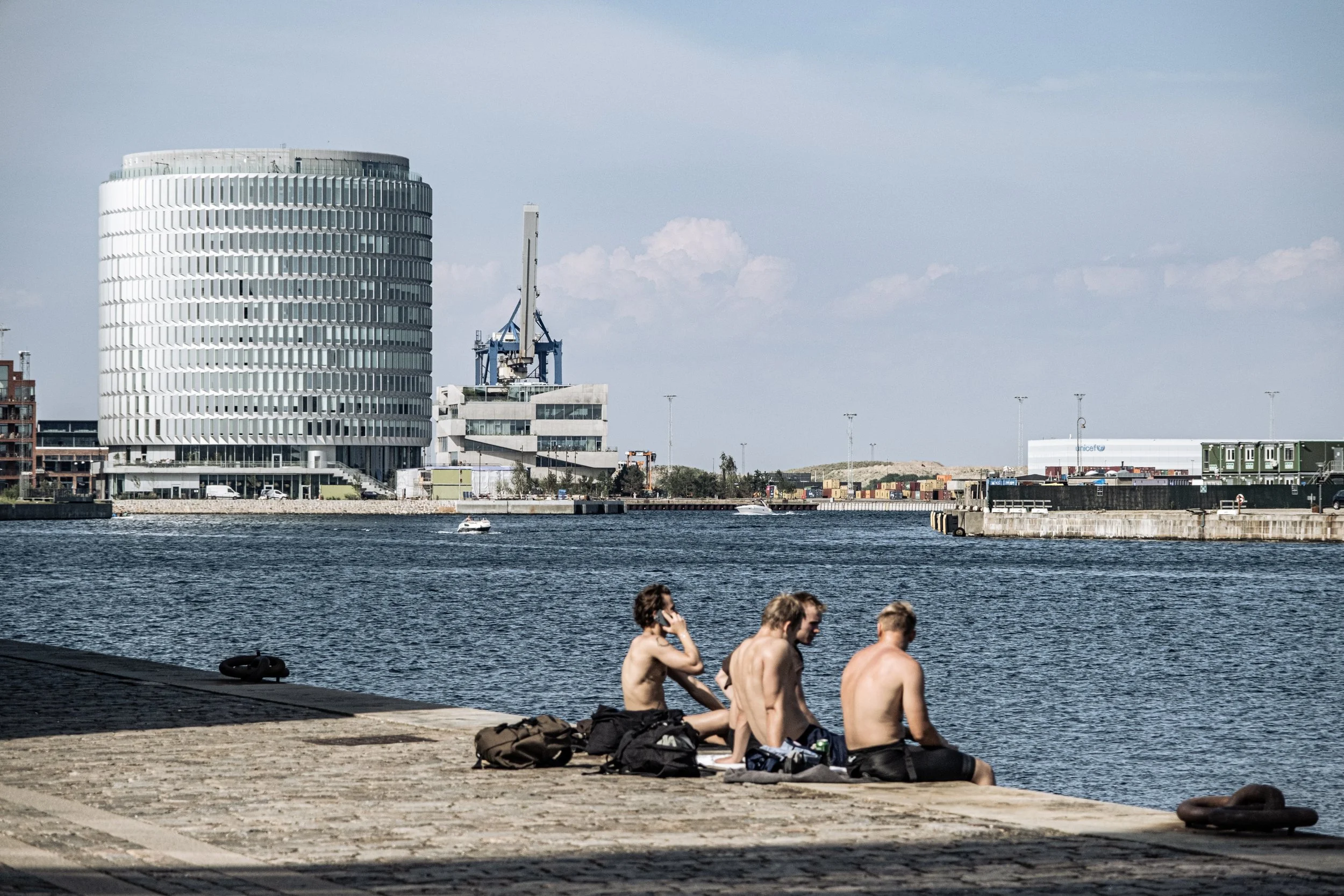
At the northern edge of Copenhagen’s harbor, The Tip of Nordø by COBE. Raw concrete surfaces, low vegetation, and precise grading extend the logic of the quay into a civic landscape. It somehow amplifies the existing industrial character—retaining a sense of exposure to wind, water, and horizon. Photography: Dan Hogman
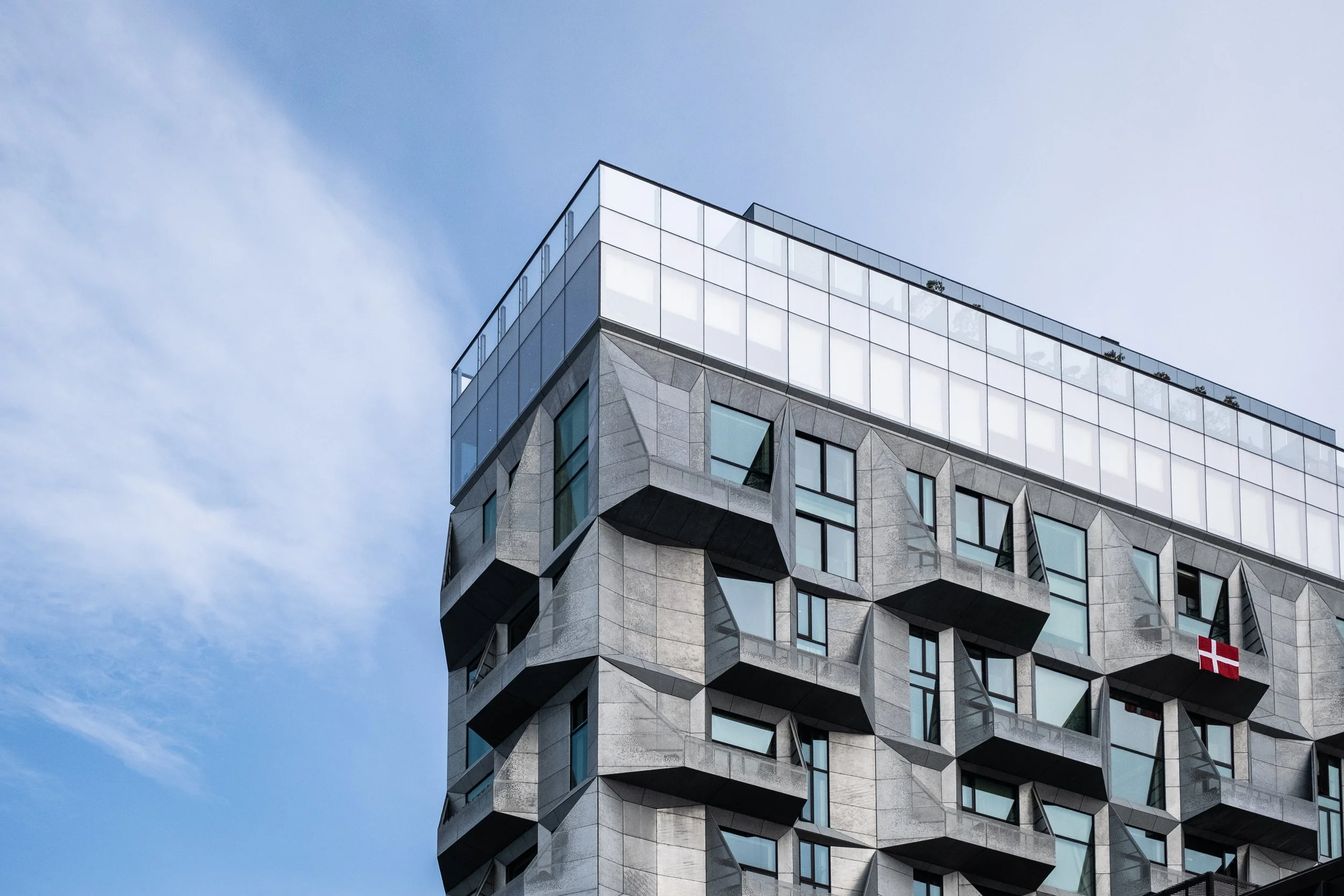
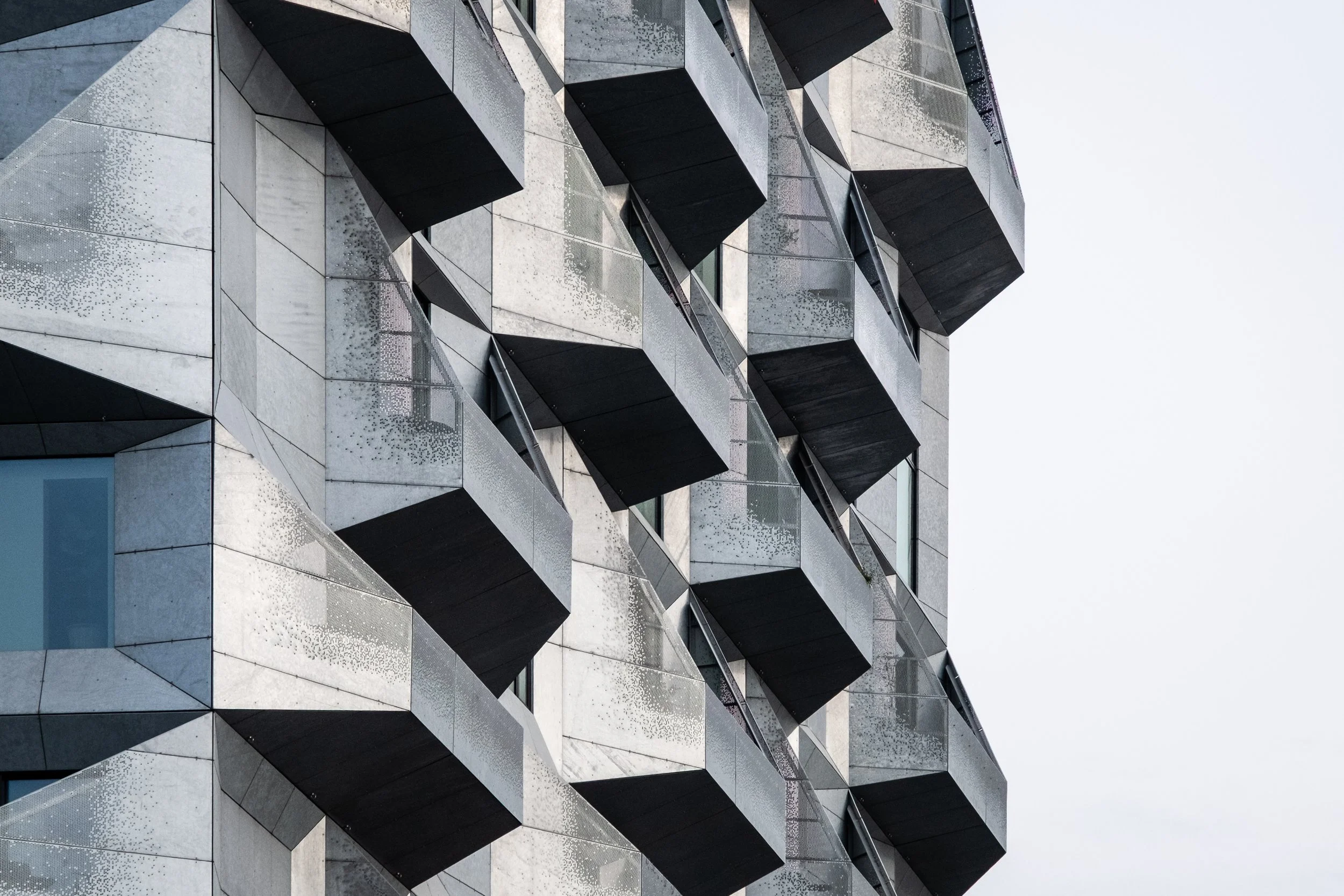
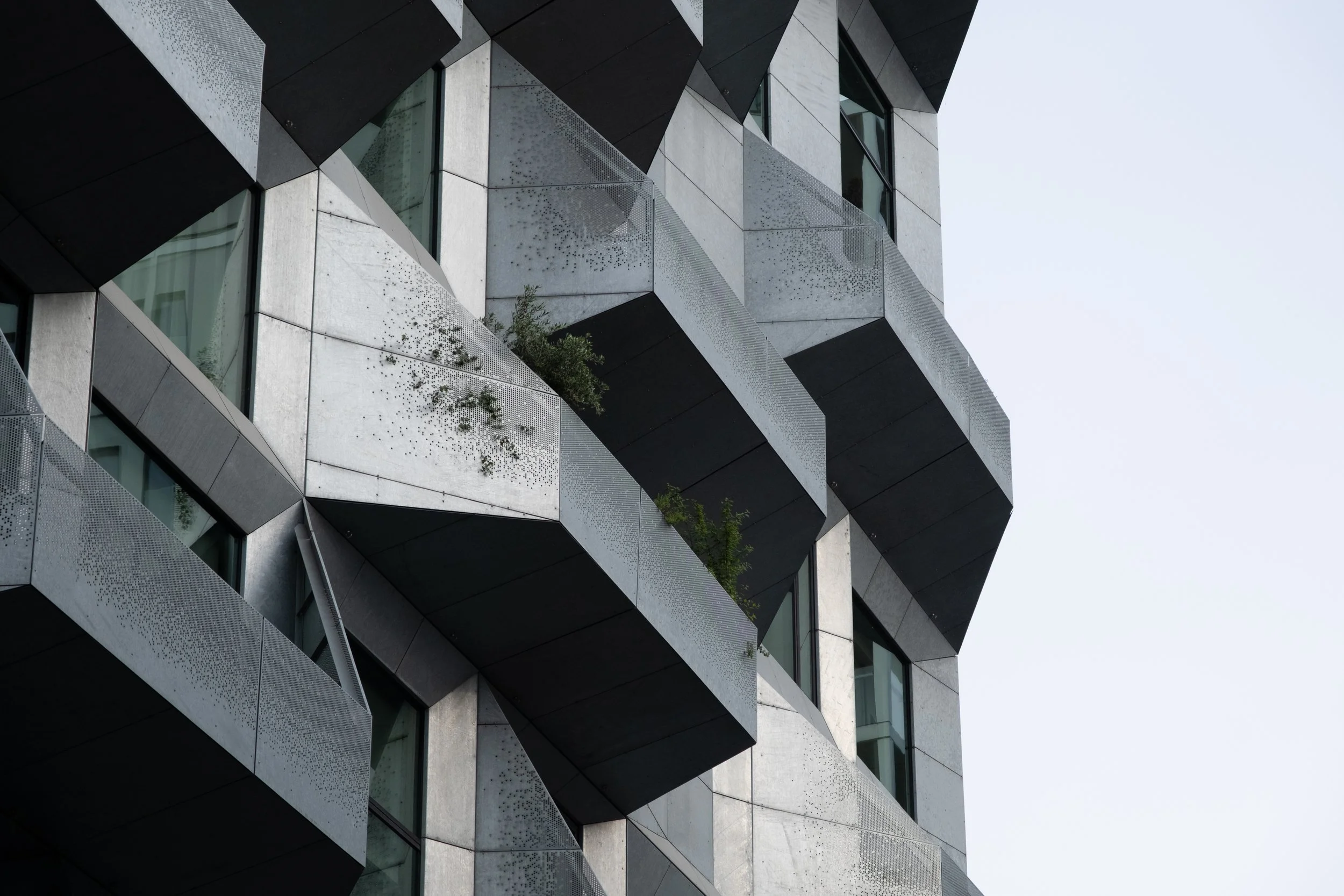
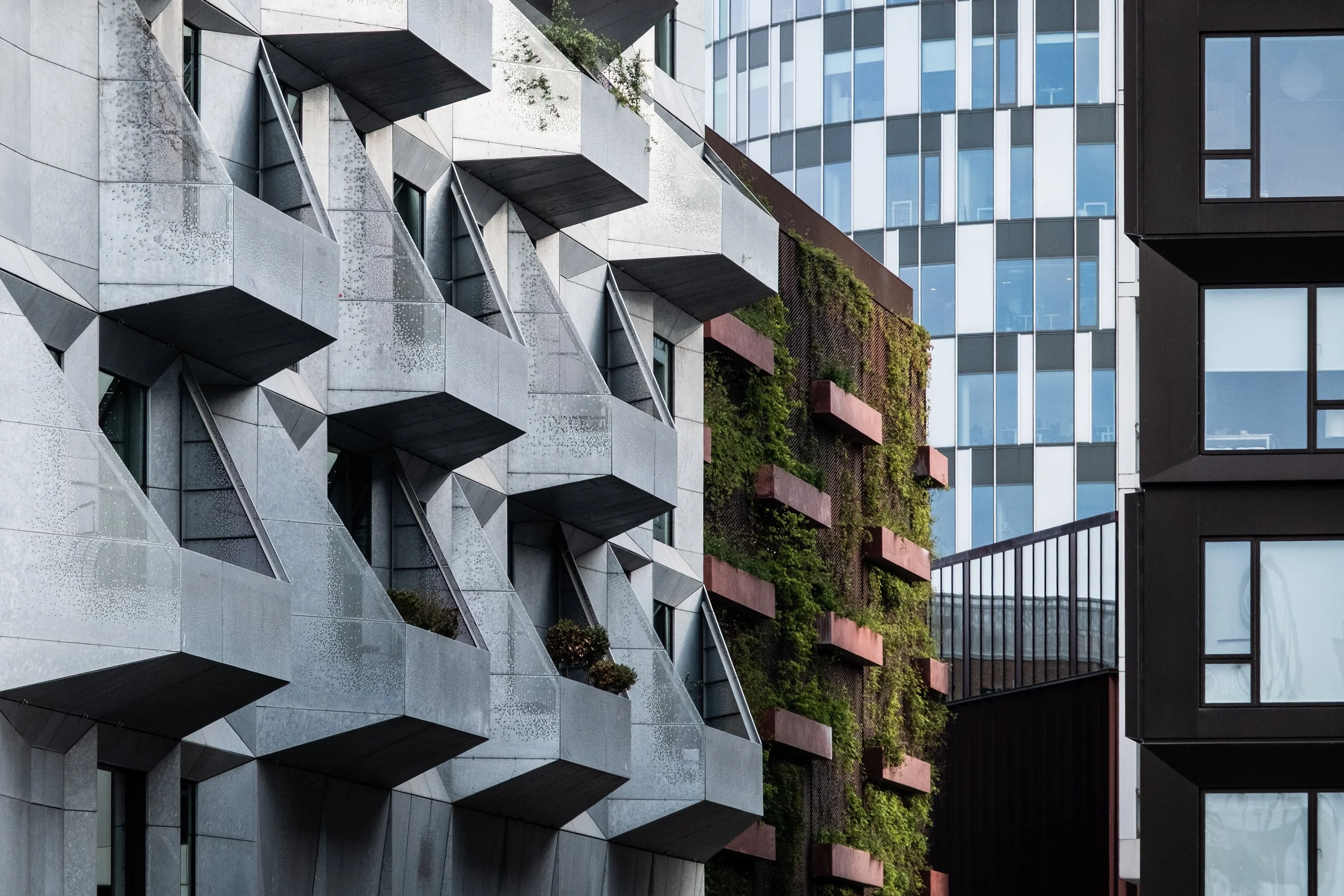
The Silo by COBE is a good adaptive reuse - the former grain silo is stripped back and then reclad in sharply faceted galvanized steel panels. Inside, the raw concrete structure is largely preserved, with apartments inserted into the existing volume. This leads to unconventional layouts and dramatic ceiling heights that register the building’s prior life. Photo: Dan Hogman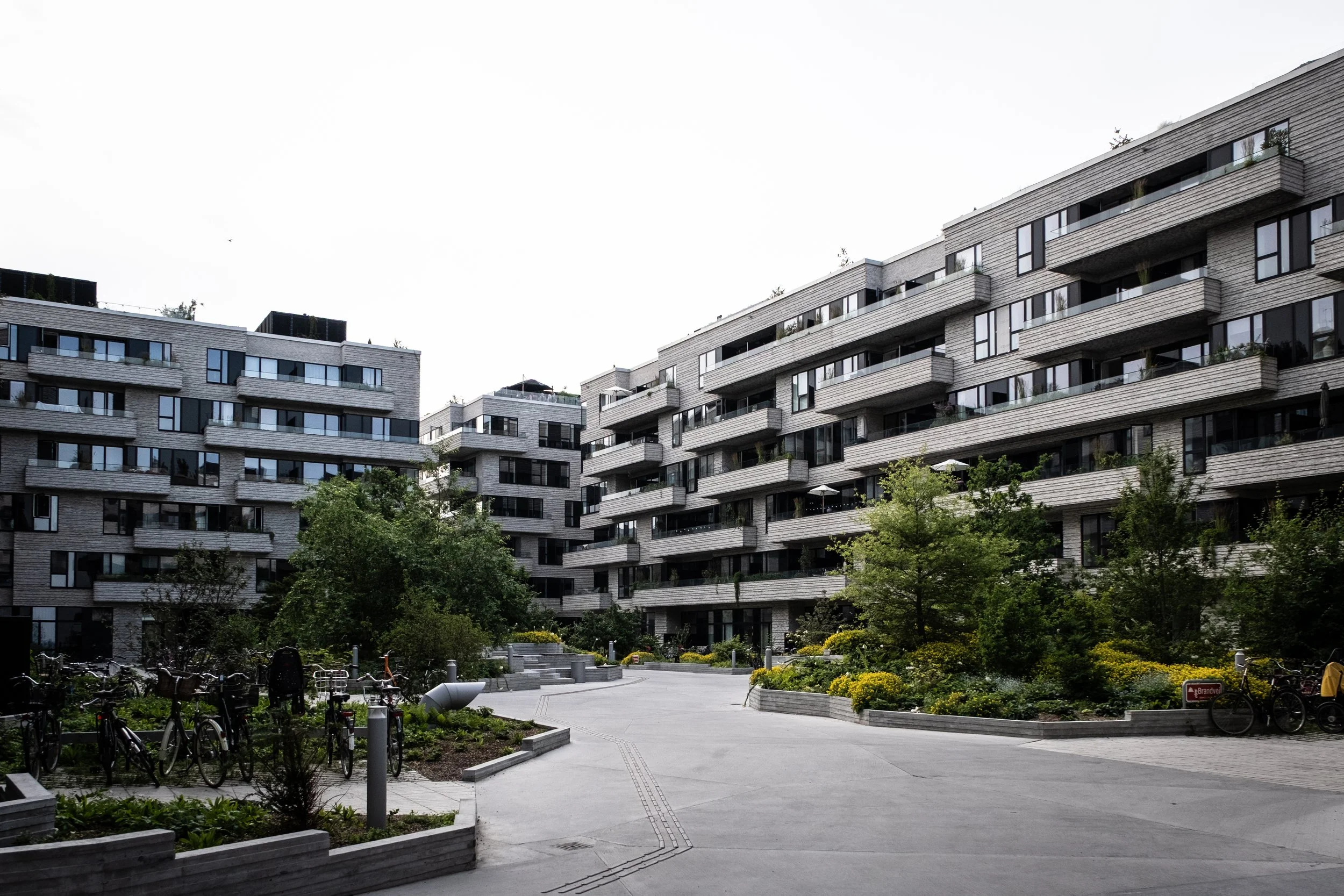
New housing development in Nordhavn - a dense aggregation of mid-rise apartment blocks, towers. The masterplan operates through a flexible grid that allows variation in typology, scale, and authorship. The highly planned area is deliberately open-ended, capable of evolving over time as each plot is developed independently.
Photography: Dan Hogman
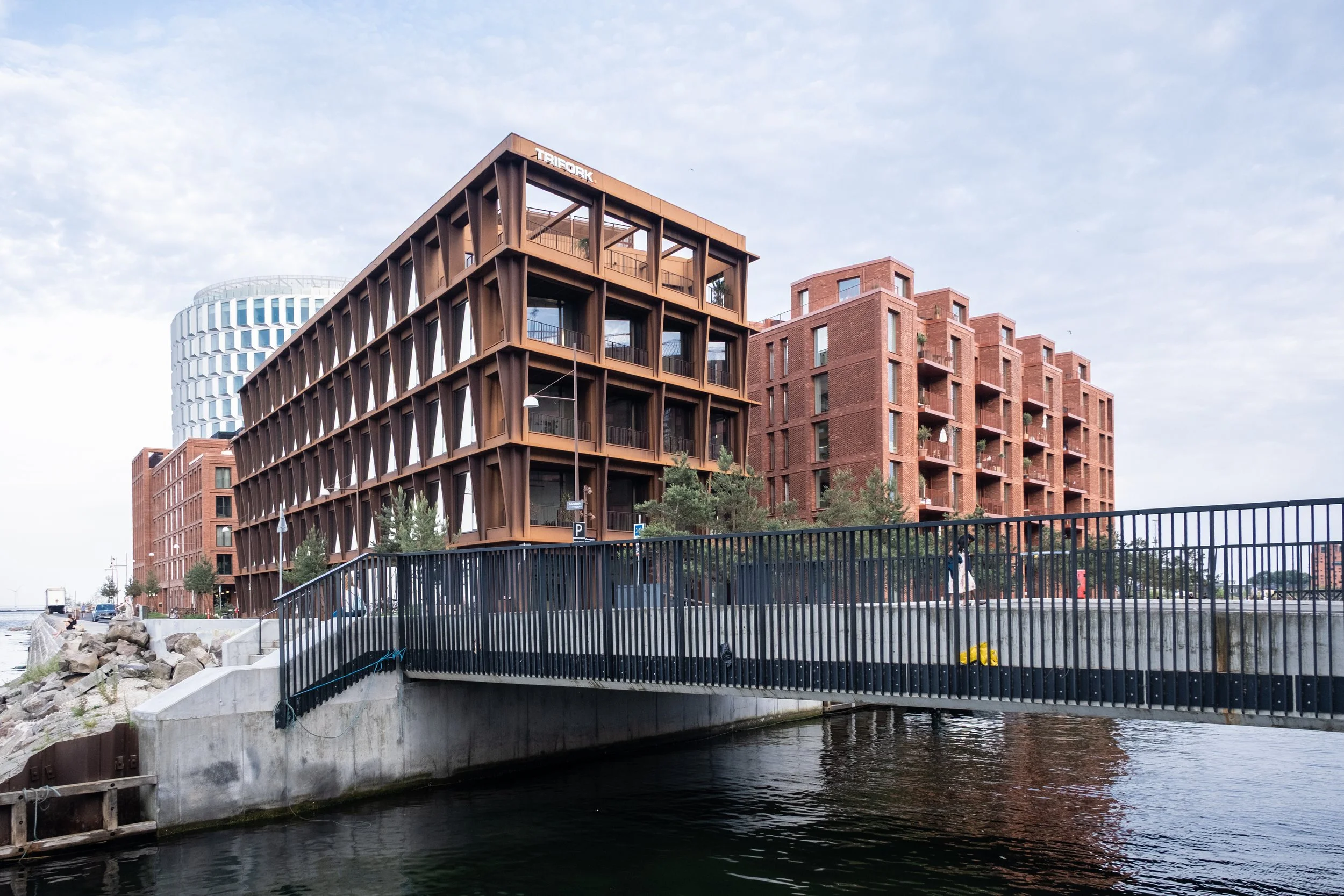
Materiality. Corten steel (real or imitated), concrete, and brick operate less as finishes and more as structural and atmospheric agents. Together, these materials establish a palette that is intentionally restrained yet performative, where good aging is the norm. Here, texture and materials articulate a built environment that feels both grounded in its context and resilient to change. Photography: Dan Hogman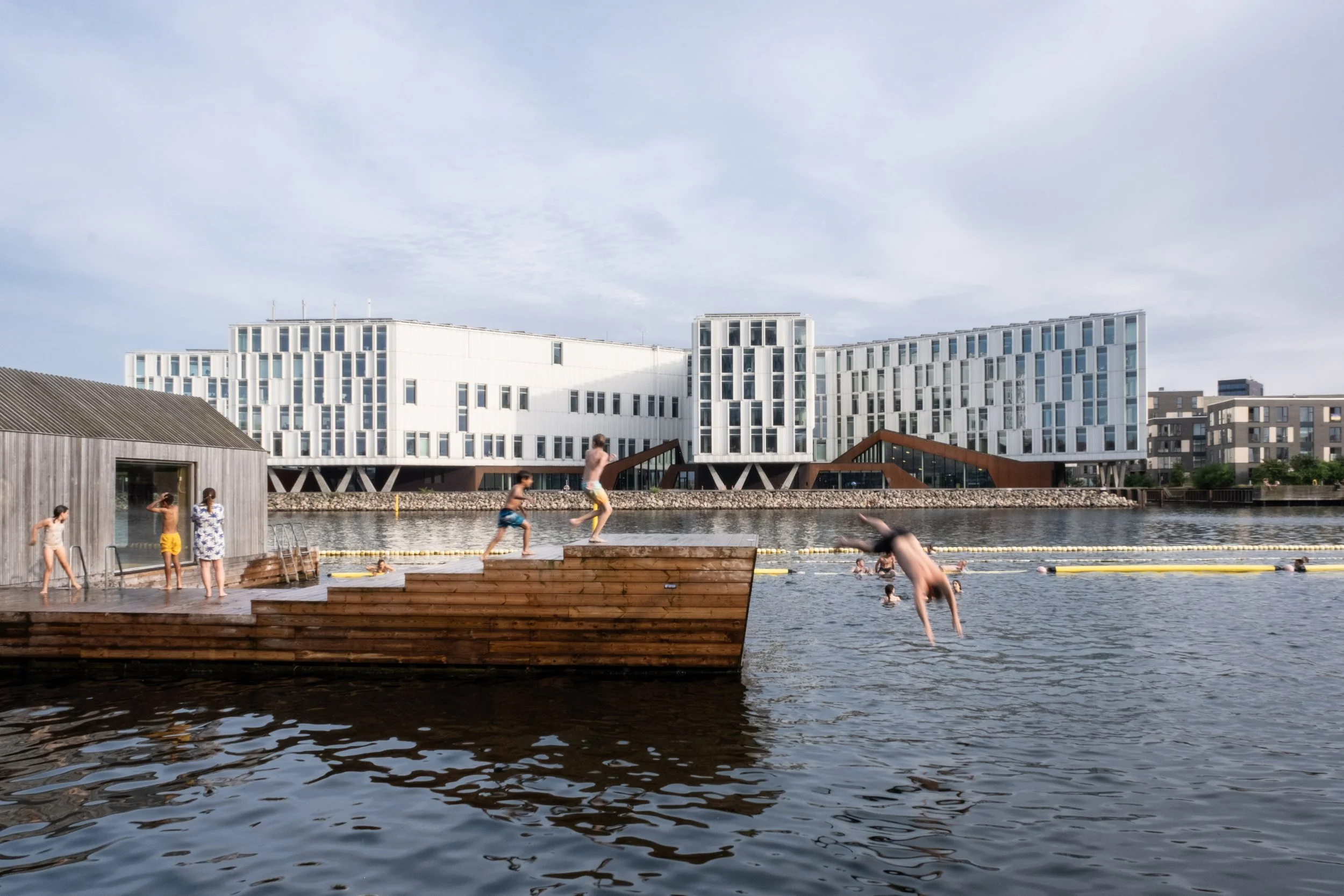
UN City by 3XN is conceived as an organizational diagram made spatial: an eight-pointed star in plan, where each wing houses a separate UN agency. There is a shared central atrium that physically and symbolically reinforces collaboration. The exterior is articulated through a luminous, permeable façade of perforated aluminum shutters - for daylight, views, and a sense of accessibility. Photography: Dan Hogman
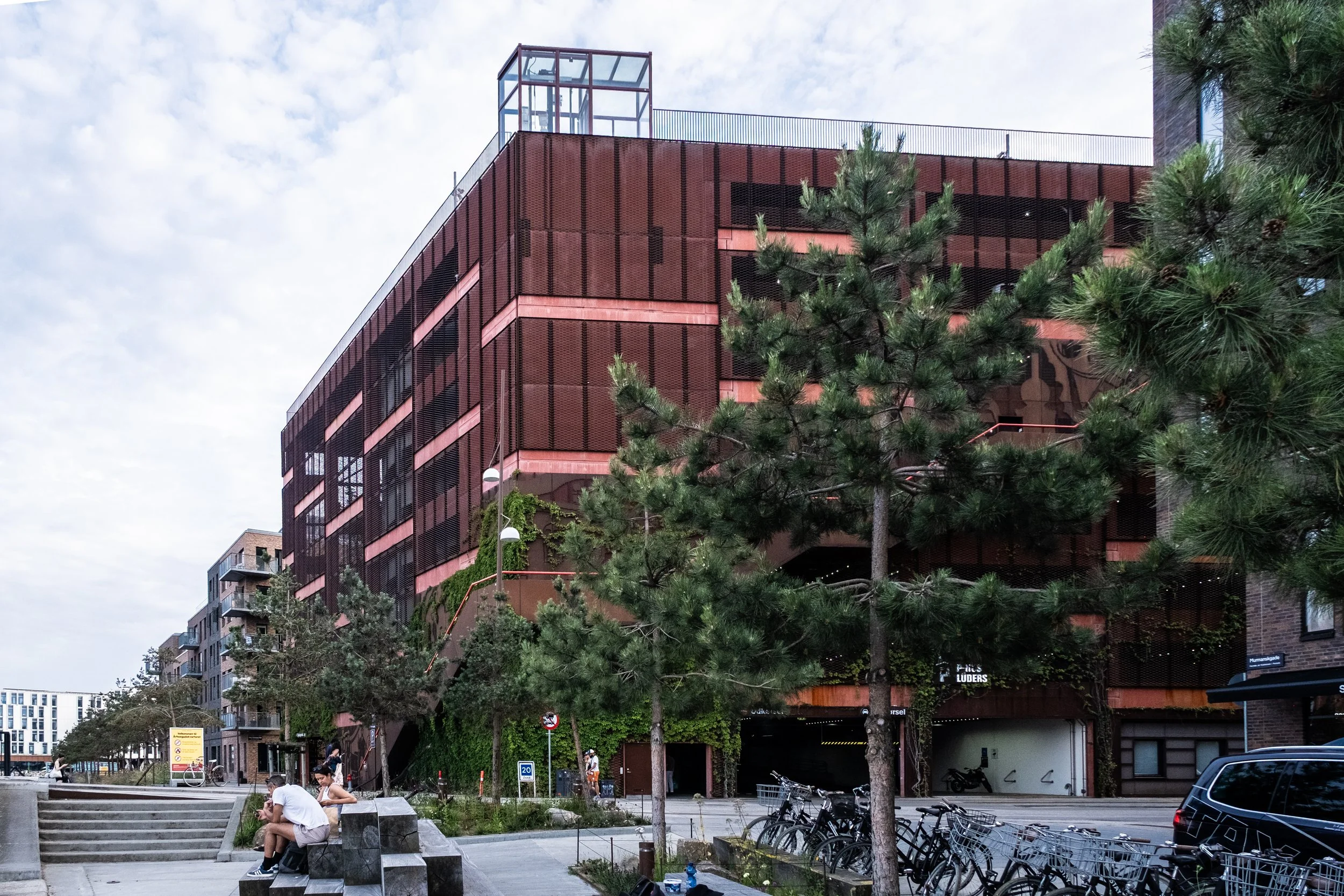
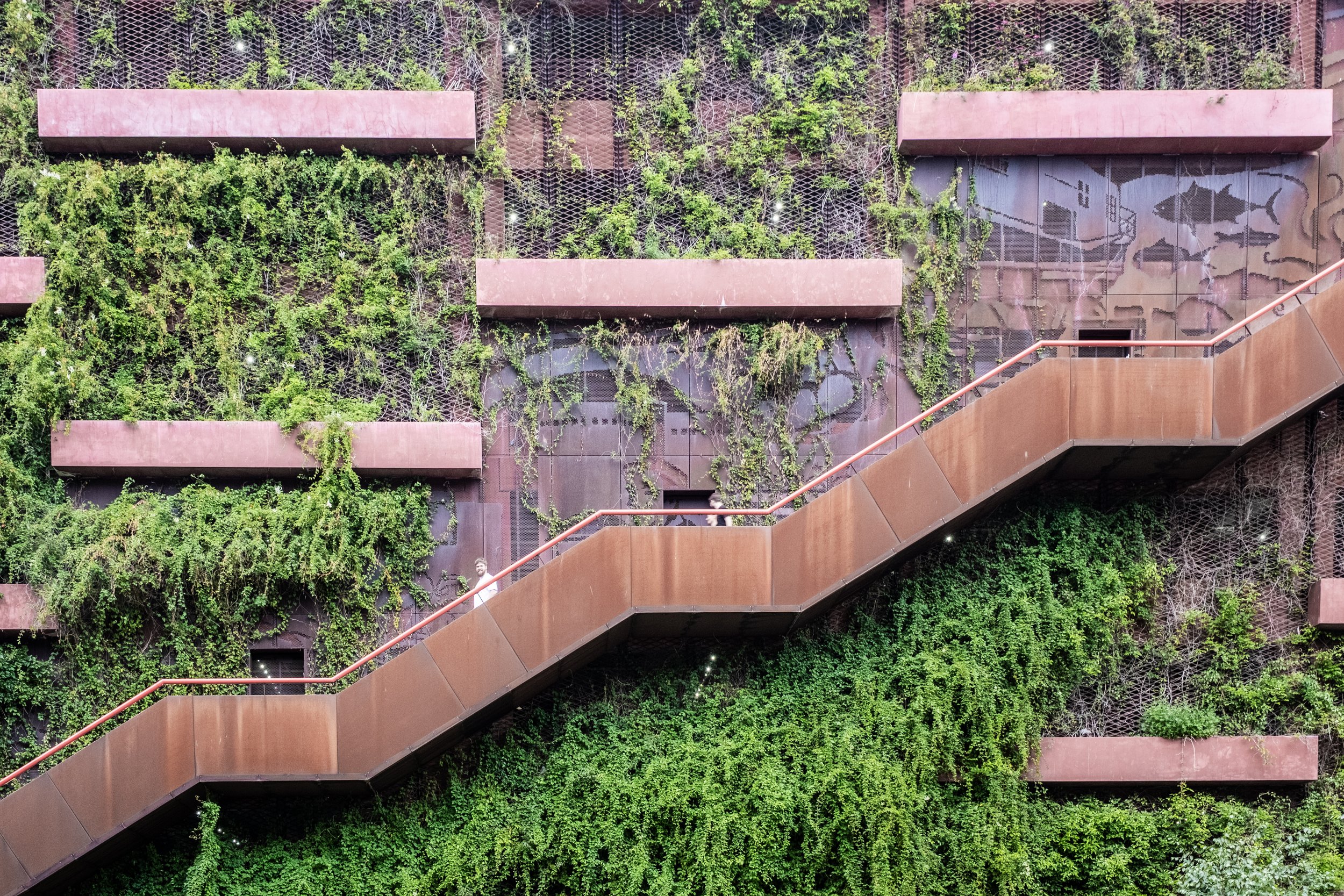
At the center of Nordhavn - the Parking House by JAJA Architects repositions a typically mute typology as civic infrastructure: wrapped in a porous skin of Corten steel. Climbing the exterior, a continuous stair doubles as a public promenade. The result is a hybrid object: part infrastructure, part public space, where circulation, landscape, and material weathering converge to make the everyday act of parking legible within Nordhavn’s broader urban narrative. Photography: Dan Hogman