The Museum as Third Space
Civic Permeability and Its Discontents
San Francisco, California
May 2016
< WRITINGS
< NEWS
Museum Architecture
Third SpaceThere is a version of the museum that belongs to the city, and a version that merely occupies it. The distinction is whether the building extends itself into public life or withholds itself from it. In urban sociology, the term "third space" describes sites of congregation that are neither home nor workplace — places where people simply gather without obligation. Very few museums qualify. The ones that do tend to share a specific architectural disposition: they are, in a precise sense, porous.
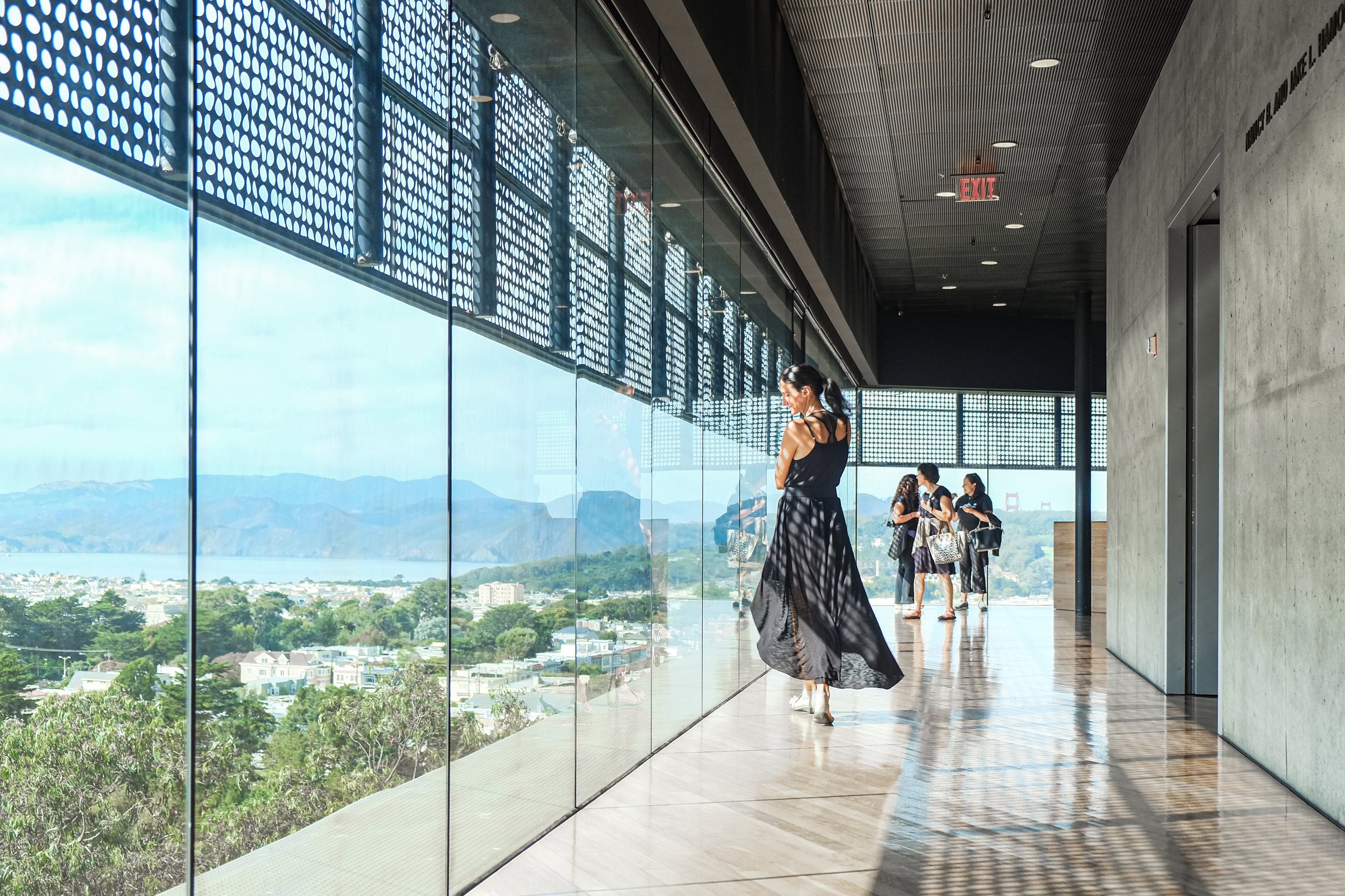
The Hamon Observation Tower, de Young Museum. Free to enter. The city as exhibit. Photography: Dan HogmanI first visited the de Young Museum around 2010, when I lived in San Francisco's Richmond District. I approached the building not as a destination but as a feature of Golden Gate Park. What registered to me most immediately was not the institution's cultural authority, but its permeability. The museum resists the conventional threshold of entry - that abrupt passage from public exterior to controlled interior, in favor of something more gradual.
The interior to exterior limits are fluid. Circulation is continuous and the building accommodates presence without commitment. The experience was consistently positive. This was precisely because it permitted casual, repeated occupation, rewarding familiarity rather than enforcing the logic of the singular, curated visit.
The observation tower (Hamon Tower) works explicitly accessible - open and free to all. It functions simultaneously as an architectural marker and civic amenity - a good reason to enter the building entirely independent of any exhibition. From its upper level, which clears the park canopy by several stories, the panoramic field extends from downtown San Francisco to Marin County, Golden Gate Park and Bridge. This elevated prospect reframes the museum not just as a container of art, but more. It is an instrument of orientation + collective viewing. This positions the institution within the larger geography of the Bay Area rather than apart from it.
At ground level, the openness becomes still more diffuse. The museum's gardens and circulation zones remain traversable without ticket or agenda. It is entirely doable to move through the space on a Sunday morning with coffee in hand, like I did many times while living nearby, engaged in no defined activity. In this sense, the de Young operates as a highly curated park: the landscape is deliberate, the objects are consequential, yet the mode of engagement remains informal and unprescribed.
Taken together, these conditions constitute a coherent model of institutional openness. The museum extends itself as a free and accessible environment. One can enter, occupy, and depart without transactional obligation, yet still derive spatial, visual, and social value. The building operates, in this respect, as more than a repository of curated objects; it becomes a civic infrastructure in its own right. It only shows how museums can support the routines of everyday life while exceeding the narrow definition of programmed cultural consumption.
The California Academy of Sciences, situated on the opposite side of Golden Gate Park, presents a sharply different proposition.
My repeated vistis at the institution have produced a persistent sense of closure. The building presents itself as a fully contained environment: access is tightly controlled, and even peripheral spaces—a gift shop, a cafeteria—remain inaccessible without full admission. There is no gradient of entry and no intermediate zone of casual occupation. There is little to no incentive for spontaneous engagement, a key element of good design.
The architecture does not signal openness; it does not cultivate curiosity through partial visibility or the possibility of informal use. Where the de Young extends itself into the public realm as a spatial and social invitation, the Academy operates as a closed system, prioritizing containment over permeability. This is not merely a difference in access policy; it represents a fundamentally different civic posture, one that limits the institution's role within the everyday life of the park and reduces its presence to that of a destination rather than an integrated public resource.
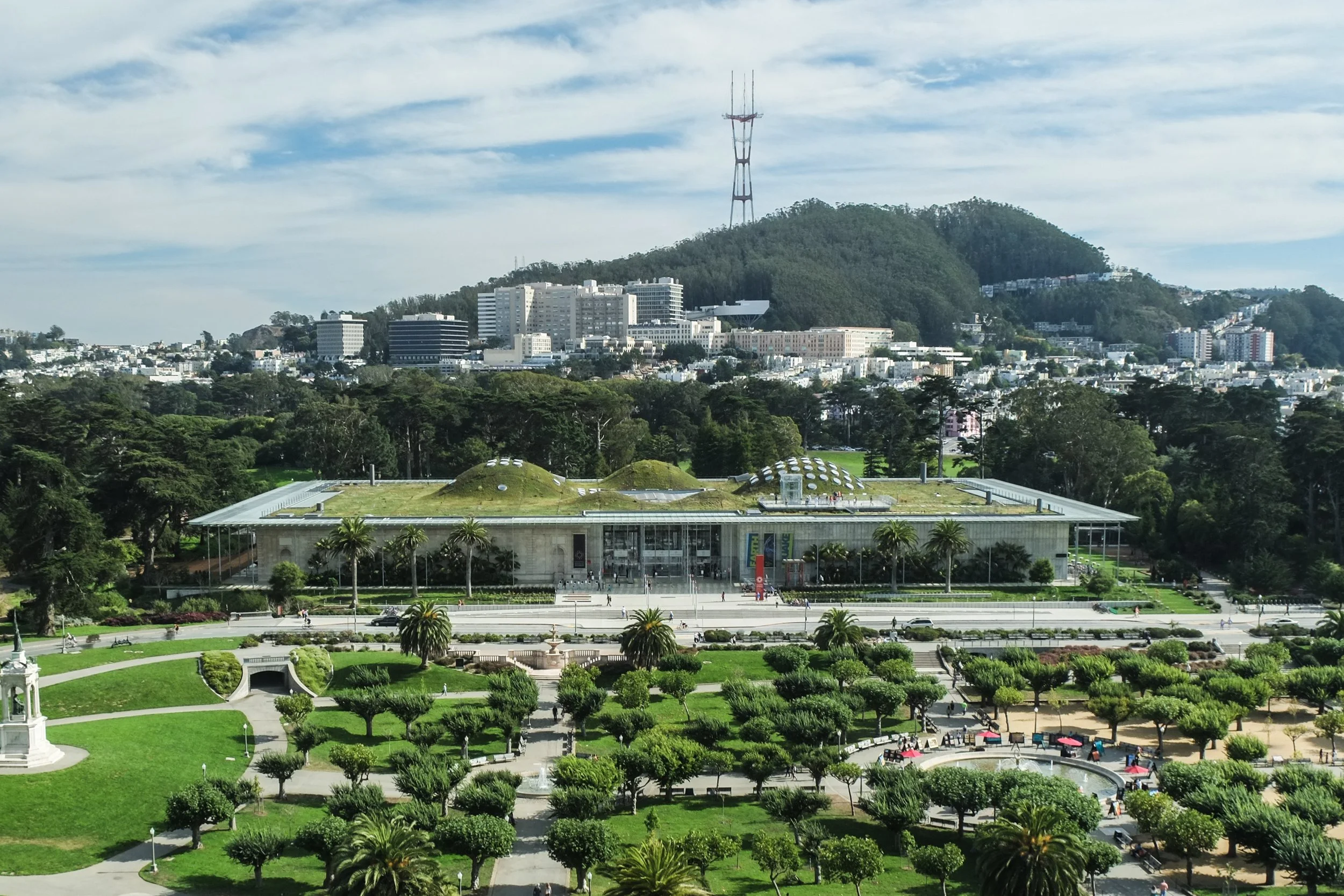
This condition of closure extends even to the landscape interface. The diners are visible behind a metal bar fence, yet the space is not enterable. Even the widely celebrated green roof—formally compelling and environmentally performative—functions primarily as an object to be observed from a distance, most legibly from the observation deck of the de Young across the park. The Academy's exterior landscape operates less as a public interface and more as a controlled display, reinforcing a broader institutional posture of separation rather than engagement.
These divergent civic postures are grounded, in part, in the architectural philosophies that shaped each building. Herzog & de Meuron's approach to the de Young centered on the concept of porosity. The building was conceived not merely as a container for art, but as a meeting/civic space woven into the landscape of Golden Gate Park.
The copper-clad facade is perforated to evoke the quality of light filtering through an eucalyptus canopy. This in itself is a story I am not really buying - one can take a random photo out of thousand with no merit other than depicting a local item – and this dictates the facade… but this aside, the designation of the tower and sculpture garden as free public assets was not incidental but integral to the design brief, explicitly rejecting the closed-box museum in favor of a graduated series of transitional spaces through which the visitor—or the non-visitor—could move as a matter of public right rather than private transaction.
Renzo Piano's design for the Academy of Sciences operates from a different set of constraints. Piano envisioned the building as "a piece of the park lifted up," embedding ecological integration into its formal concept through the living roof. Yet this ambition is counterbalanced by the operational demands of it’s exhibits - a functioning rainforest, a deep-water aquarium, and a planetarium - each requiring costly climate control, maintenance, and security.
The building's massive glazed canopy creates an impression of transparency, but physical access is strictly managed to protect both the biological collections and the economic model that sustains them. The architecture is open - visually, but institutionally closed. The distinction is important: transparency of form does not, in itself, constitute civic permeability.
Both models are legible within a broader international typology. The porous model finds its clearest expression in the Tate Modern's Turbine Hall - a free public interior that connects the river front to the city without ticketing, and in the Centre Pompidou's sloping piazza, which a public place before walking into the institution. The Metropolitan Museum's front steps constitute perhaps the most famous instance of institutional exterior functioning as urban furniture.
The consolidated model is evident at San Francisco's Exploratorium, where the operational demands of maintaining hundreds of interactive installations make free occupation fiscally untenable. Finally, at the Rijksmuseum, the amenity spaces have been drawn behind the ticketed threshold to manage visitor density and protect per-visitor revenue margins.
These comparisons clarify what is at stake in the distinction between the two models. The porous approach represents not merely a preferable option, but a more defensible understanding of what a public cultural institution is for.
The museum, as a building type, occupies a peculiar position in the civic landscape. It is simultaneously a specialized repository for objects of cultural and material value, and a structure funded through public subsidy, philanthropy, or charitable exemption, etc.
This dual character generates an obligation that the purely commercial institution does not bear: the obligation to remain, in some meaningful sense, open to the public it claims to serve. When an institution retreats entirely behind a ticketed threshold, it does not merely enact an access policy; it makes an architectural claim about the nature of its relationship to the city. It asserts that the building, its spaces, its views, its amenities, belong to those who pay for them—and that casual presence, partial engagement, or non-transactional occupation have no legitimate place within its walls. The de Young's model refutes this claim
The Third Space. By offering the tower, the gardens, and the circulation zones as genuinely free public territory, the de Young acknowledges that the building itself constitutes a form of value. This is, in the language of urban sociology, a commitment to the institution as a "third space": a site of congregation and encounter that is neither the home nor the workplace, neither entirely public nor entirely private, but available to a broad range of individuals pursuing a broad range of activities without the compulsion of consumption.
In a city like San Francisco, the free museum becomes a site of democratic surplus. It offers what the market cannot efficiently provide: access to architectural quality, to elevated prospect, to cultivated landscape, to the proximity of significant objects - without financial precondition. De Young’s offer is not trivial accommodations; they are the conditions under which a building becomes part of a community's life rather than an amenity available only to those with sufficient disposable income.
Porosity as Civic Obligation. A museum that draws all its amenities behind a single ticketed threshold does not merely restrict access to its galleries; it restricts access to its architecture, to its landscape, and finally to its presence in the city. And in doing so, it diminishes the very quality that distinguishes the museum from other commercial leisure institutions: its claim to serve the public interest.
The porous model is not simply more equitable than the consolidated model; it is more honest about what a museum is, and more faithful to what a public institution should aspire to be. Architecture that opens itself to the city - that allows the partial visit, the ten-minute encounter, the passage without obligation - is the type of architecture that takes seriously its role in the common life of the community it inhabits. That, rather than fiscal optimization, should be the governing principle of institutional design.
- dh, 2016
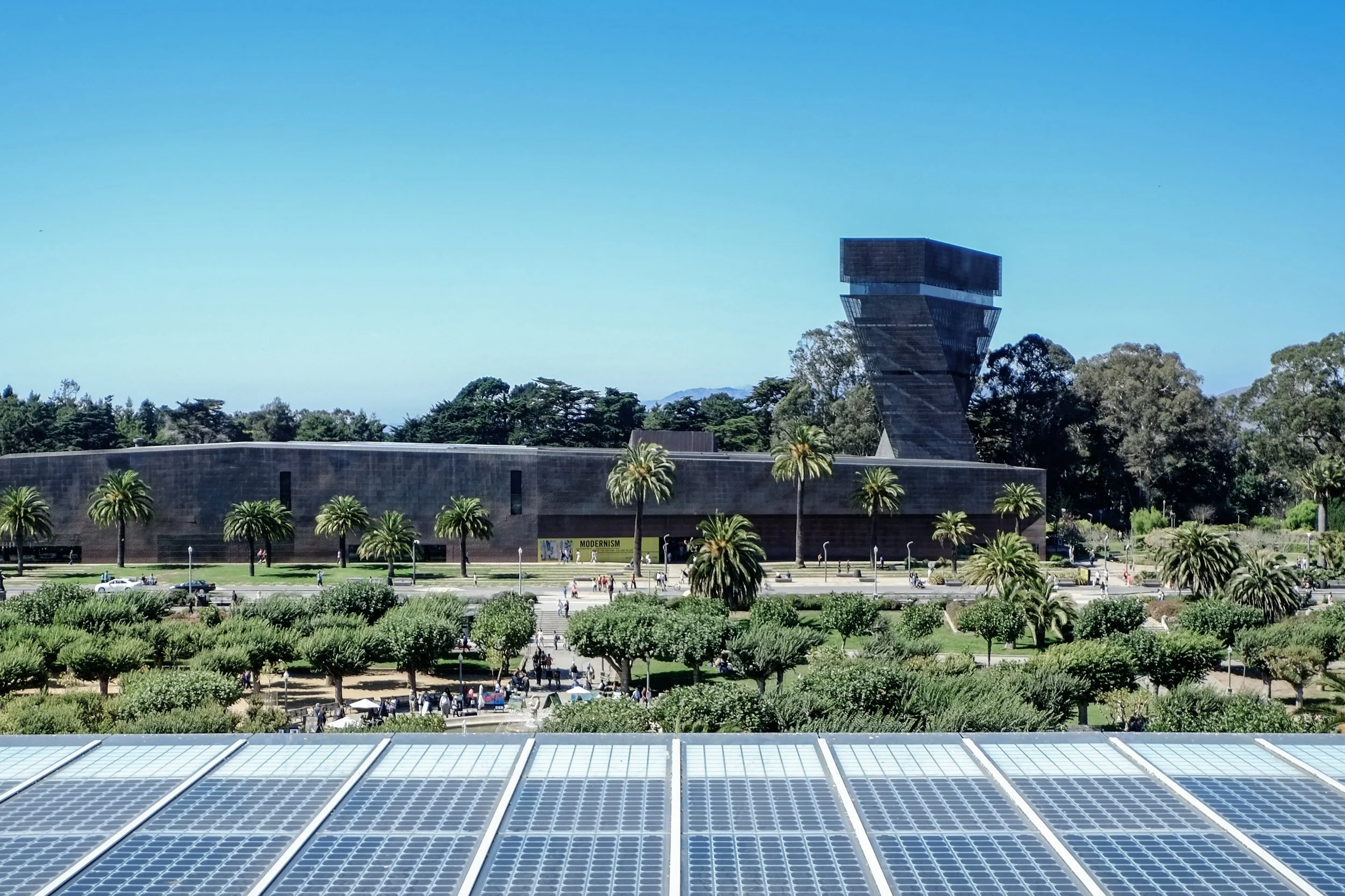
Face to face. The de Young is seen over the photovoltaic panels that surround the Academy of Science. Photography: Dan Hogman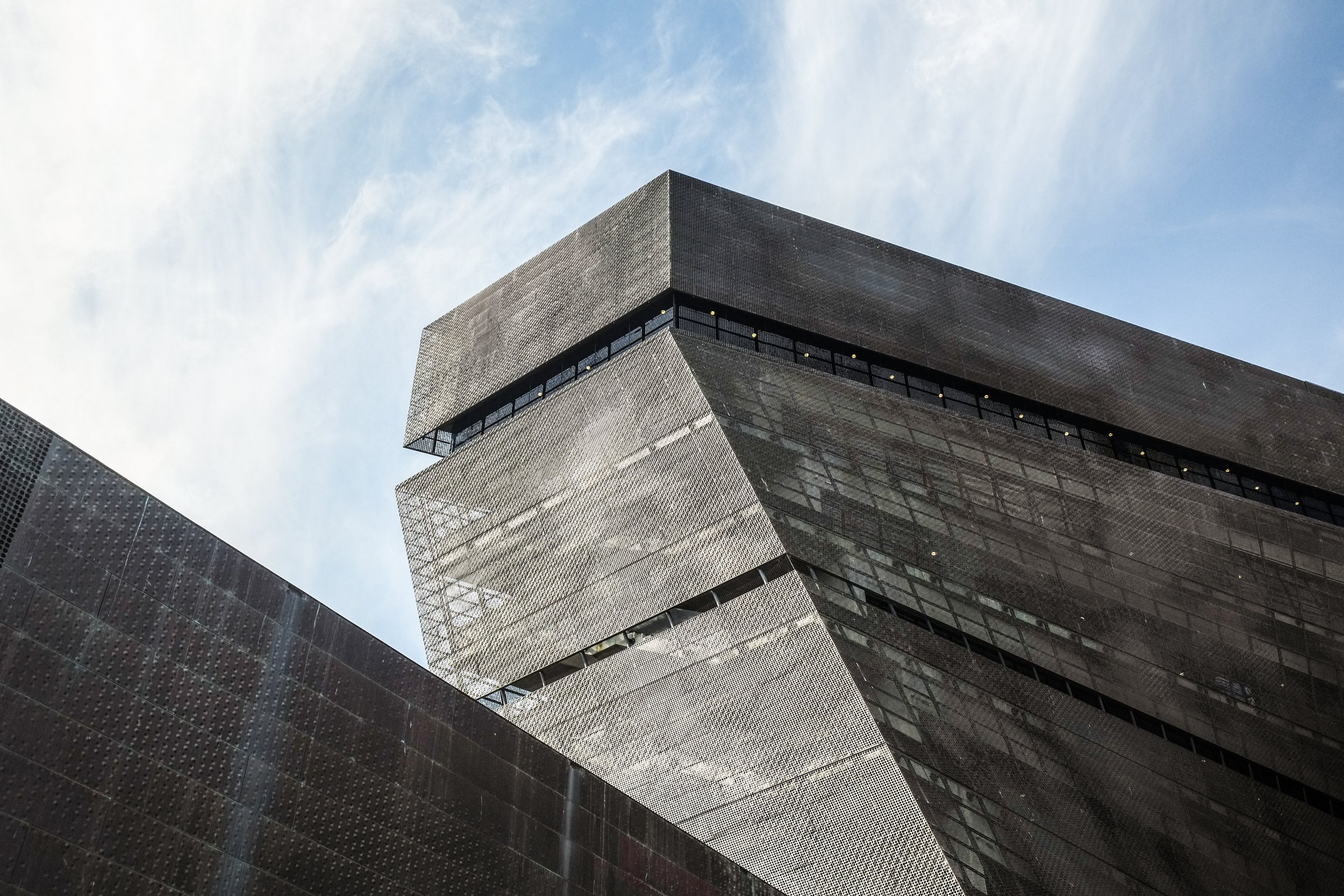
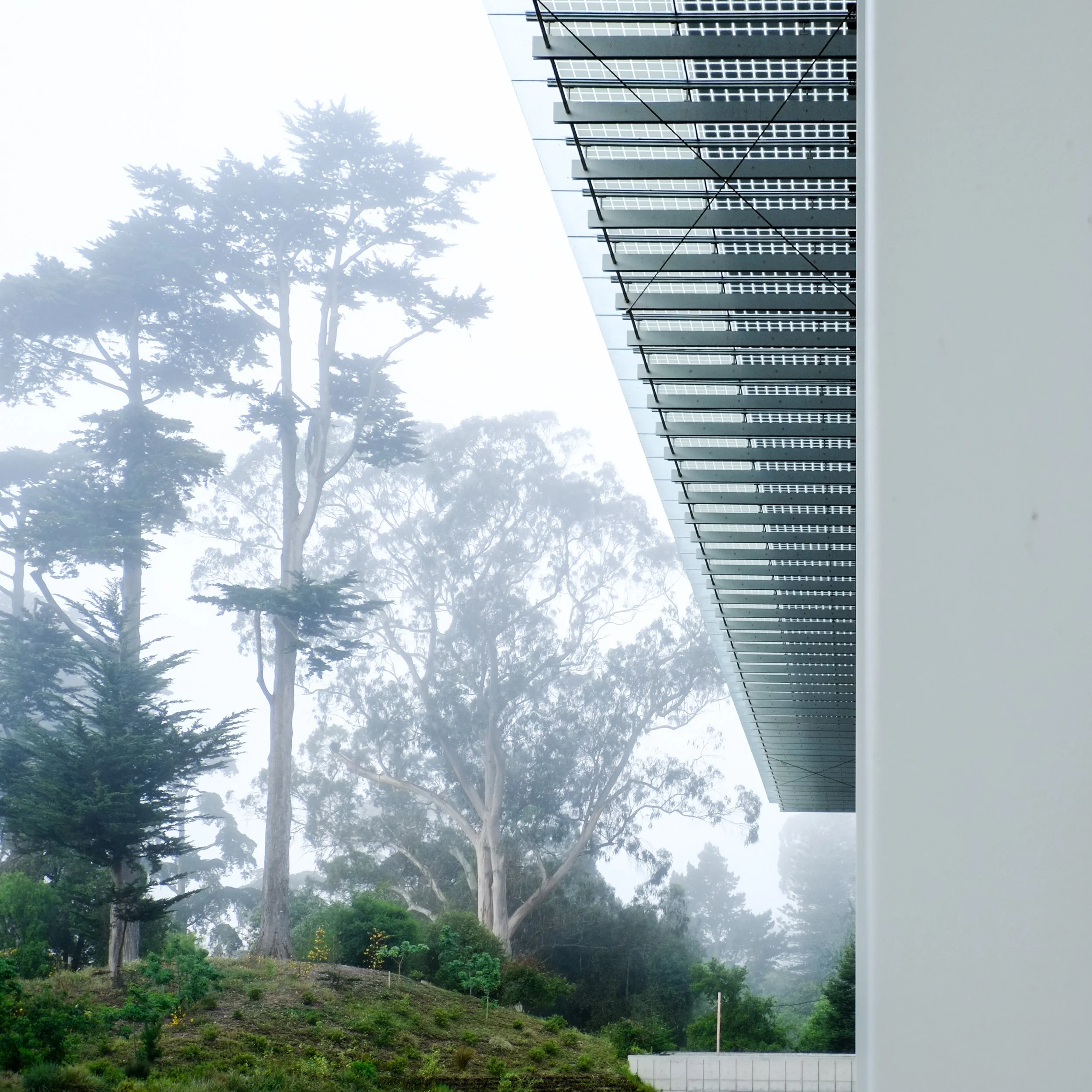
The two museums, side by side again. This time in detail. A completely different language and approach. Photography: Dan HogmanFurther Reading -
Giebelhausen, Michaela. The Architecture of the Museum: Symbolic Structures, Urban Contexts. Manchester UP, 2003.
MacLeod, Suzanne. Museum Architecture: A New Biography. Routledge, 2013.
Newhouse, Victoria. Towards a New Museum. Expanded ed., Monacelli Press, 2007.
Sandell, Richard, and Eithne Nightingale. Museums, Equality and Social Justice. Routledge, 2012.
Self, Ronnie. The Architecture of Art Museums: A Decade of Design: 2000–2010. Routledge, 2014.
Stead, Naomi. Architecture at the Edge of Everything Else. MIT Press, 2010.