San Francisco, California
September 2026


< WRITINGS


Architizer Vision Awards
Architectural visualization
Architecture jury
AI in architecture
Reflections on Judging
the 2026 Architizer Vision Awards
-

Can technology replace the designer’s eye?
Reflections from the 2026 Architizer Vision Awards jury demonstrate that while computational tools refine execution, human cognitive judgment is still what matters for architecture and the way to turn raw digital renderings into compelling, story-driven spatial experiences.
As a juror for this year’s Architizer Vision Awards, I consistently found myself evaluating entries far beyond their technical polish. I am searching instead for work that mastered the foundational disciplines of human scale, spatial proportion, and visual storytelling.
Across many submissions, the images that truly resonated were not those that simply showcased computational gloss, but those that placed the human brain - and its capacity for emotional judgment - at the absolute center of the creative process. I still believe that any software, no matter how sophisticated it is, remains merely an extension of the designer's intent - there is simply no replacement for the trained eye, the intuitive sense of composition, and the cognitive judgment required to turn spatial representation into a compelling, lived reality.
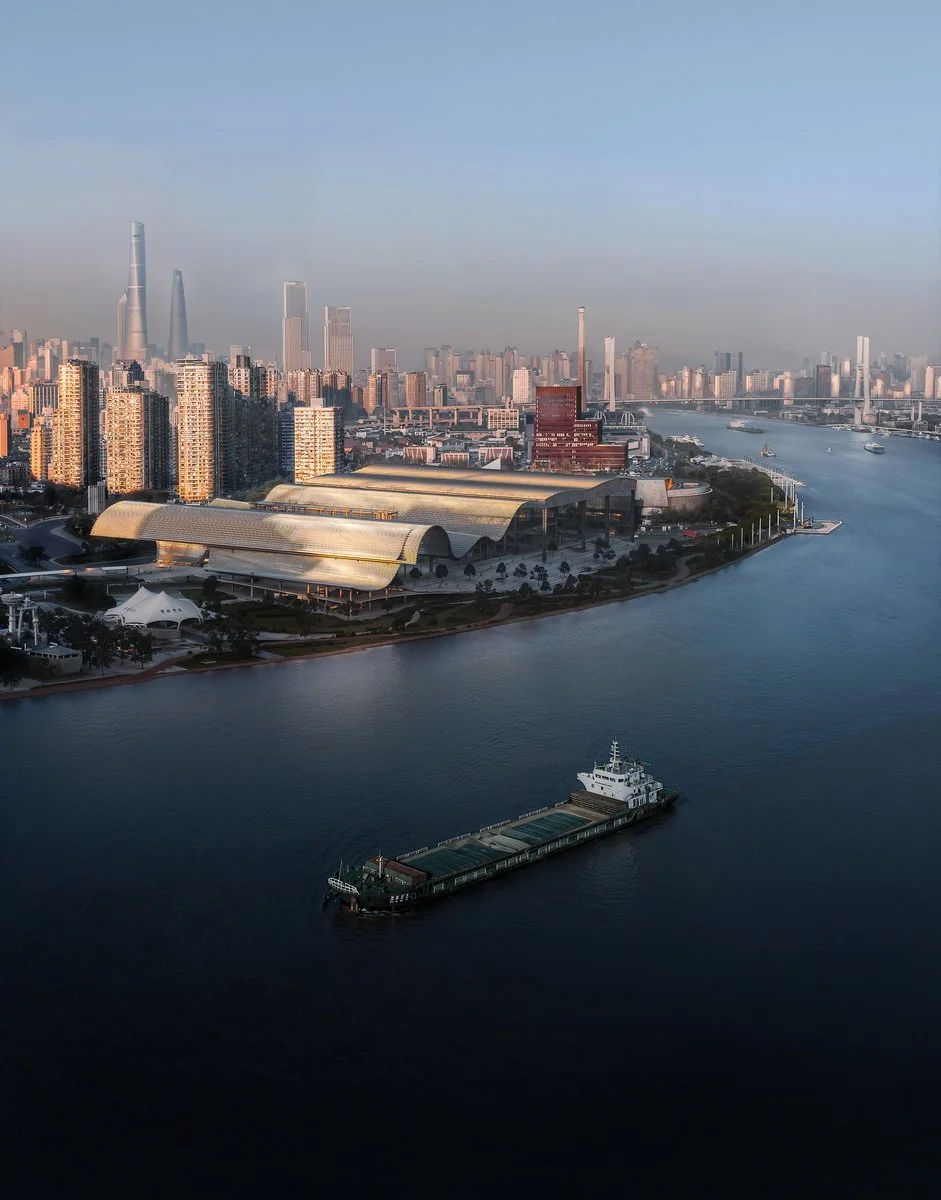
Shanghai Industrial Museum by Kengo Kuma - An expansive aerial perspective that juxtaposes the curved roofscapes against the dense Shanghai skyline, framing a dynamic diagonal along the river that draws the eye across the image.Contextual Narratives and Spatial Dynamics: Reviewing this work, "Pudong Modern & Cargo," my judging focuses heavily on how a visualization provides not just spatial representation, but a strong urban narrative. The choice to ground this perspective with the juxtaposition of the detailed modern architecture and dense residential blocks against the vast distance of the downtown skyline is masterful, instantly explaining the site’s metropolitan context.
The composition cleverly uses this wide-to-tight contrast to frame a powerful diagonal, starting from the iconic skyscrapers and leading the eye directly to the moving cargo ship on the dark water. This creates a dynamic, sweeping eye movement across the entire composition, compelling the viewer to read the scale of the city and its industrial life in a single glance.
The Mind Behind the Screen: We know, the lighting engines perfectly render the warmth of the setting sun hitting the golden facades is easy to get into a rendering too. Add the subtle atmospheric haze - now, the critical decisions that make this a narrative-driven success are purely human. It takes human artistic judgment to decide that the story of this building isn't just about its form, but about its position. We are now placing it as a key node between a distant center and an active waterway. In short - the essential cognitive judgment required to synthesize complex spatial information into a compelling visual story remains central here.

Al Ghurair - The Weave by Brick Visual Set within an intimate interior, this rendering uses a soft, human-centered moment—a mother wrapping her child in a towel—to intuitively communicate scale, warmth, and the quiet comfort of residential design.Human Scale and Narrative Placement: Reviewing Brick Visual’s rendering for Al Ghurair - The Weave was refreshing. The placement of human figures transforms a clean, minimal bathroom into a deeply emotional spatial experience. Positioning a mother wrapping a towel around her child directly in the path of soft, ambient light does far more than establish scale – it now injects a dynamic sense of lived life that articulates the room's true proportion and circulation far better than static geometry ever could.
The Mind Behind the Composition: the image's success hinges entirely on human artistic judgment. It takes a designer's eye to let the architecture step back into a supporting role, using a quiet, intimate routine to give the physical materials their purpose and warmth. The height of the camera position is clever - anything higher would make us look beyond the people and towards the background. What is remarkable is the ability to connect spatial vision with genuine human emotion - remains uniquely bound to the human brain - at least for now…
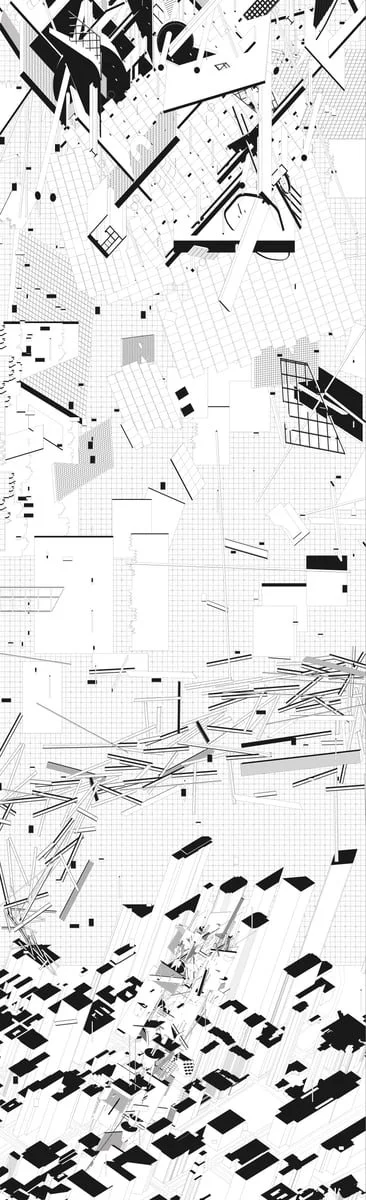
Anomalous Assemblages by Etulan A. Joseph - A highly conceptual black-and-white CAD. It speculatively reframes adaptive reuse beyond traditional ground planes.Compositional Tension and Tectonic Narrative: Reviewing Etulan A. Joseph’s drawing Anomalous Assemblages, I am struck by how masterfully the composition uses vertical linework, density, and spatial fragmentation to challenge our understanding of architectural permanence. The visual trajectory is critical – rising from a dense, shattered ground plane up through suspended grid networks and culminating in a dense cloud of structural fragments.
Tihs escapes traditional orthographic convention in favor of floating tectonic elements, intersecting linear profiles, and sharp tonal contrast. the drawing translates abstract concepts of climate disruption, material scarcity, and memory into a stark, compelling visual language.
The Supremacy of Human Design Judgment: here, the true power of this drawing lies in the deliberate artistic choices of the human mind. Software can execute infinite complexity, but it takes human judgment to curate this visual tension. The author balances dense clusters of linework against quiet negative space to evoke a lingering sense of historical weight and speculative optimism.
Ultimately, the future of architectural visualization will not be defined by the tools we adopt, but by the clarity of the vision we bring to them. No matter what the subject they were trying co capture, the submissions that defined this year’s awards proved that technology is at its best when it serves human narrative.
Algorithms can process all the technical elements needed - geometry, light and shadow, material, etc. WHat they fall short is the feeling of scale, understand comfort, or curate emotional truth. As we navigate an era of increasing computational power, these awards stand as a clear reminder that the soul of visualization remains distinctly human, and that the mind behind the lens will always be the true instrument of artistry - at least until proved otherwise…
Further Reading and Links
Official program - Architizer Vision Awards: About the program: categories, benefits, and timeline for the 2026 season
2026 jury - 8 Influential Voices in Architecture and Visualization Join the Vision Awards Jury: Architizer Journal
Partners From BIG, Renzo Piano Building Workshop and Stefano Boeri Are Judging the 2026 Vision Awards: Architizer Journal
A few links to past work with Architizer and media mentions
for Dan Hogman:
Architects Who Draw: The Vision Awards Jury for 2025: Architizer Journal, July 2025
Get Your Work In Front of the 6 Architectural Drawing Experts On the Vision Awards Jury: Architizer Journal, July 2023
Call For Videos: Enter Your Architectural Films and Animations for the 2023 Vision Awards!: Architizer Journal, April 2023, DH listed as a video juror
10 Artists Creating Extraordinary Architectural Drawings on Instagram: Architizer Journal, features DH ink sketches.