In Conversation -
Architect Dan Hogman on Sketching Urban Life (Renée Reizman)
New York, NY
October 2020


< WRITINGS
< NEWS


Drawing Process
Architectural Drawing
Conversations
This is an annotated and abbreviated version of the interview with Renée Reizman for LX. It was originally published here.
Architect, artist, and photographer Dan Hogman creates lively sketches of urban life in cities all over the world. When he’s not working as an architect or teaching drawing at the Academy of Art University in San Francisco, he’s catching a plane to Hong Kong or Paris to capture historical architecture.
Hogman has contributed drawings of the Crown Building, Lantern House, and Una Miami to LX Collection. Apart from architecture, he is better known for his sketches, which appear in daily vlogs on Instagram and YouTube. LX Collection spoke to Hogman to learn more about his sketching process and what draws him to cityscapes.
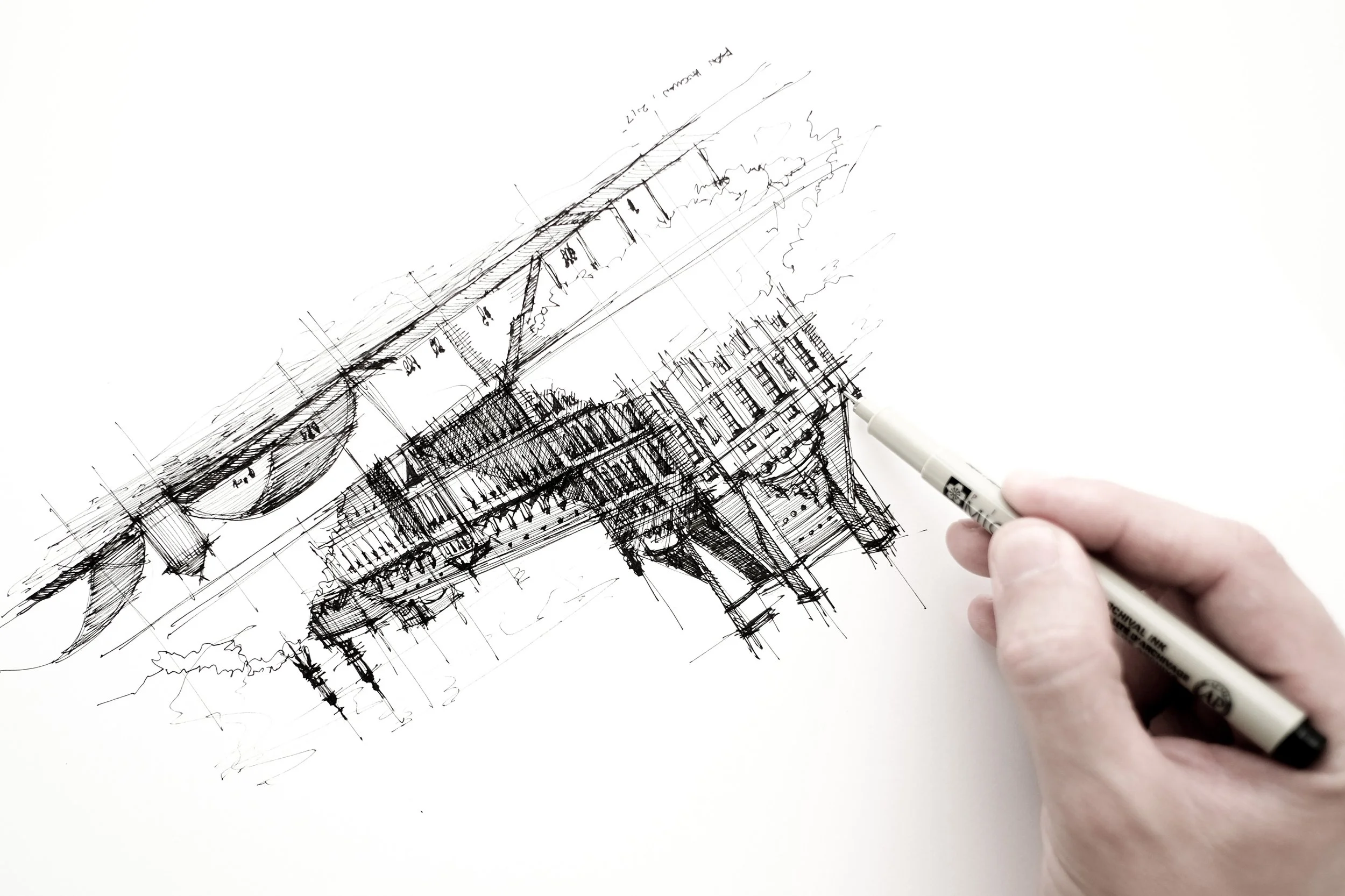
Drawing is not a means of representation but a way of thinking through space. It transforms looking into an active process, forcing decisions about what matters - edges, proportions, relationships. Doing so, reveals structures that casual observation overlooks. The hand and eye operate in a continuous loop of perception and correction, where understanding emerges through iteration rather than instant recognition. By sketching, one informally measures and tests spatial logic, grasping space as a set of relations and sequences rather than a static image. In this sense, drawing becomes a tool for entering and comprehending a place, not simply recording it.Renée Reizman: What attracts you to a building or a skyline?
Dan Hogman: My sketches on location are usually self-initiated, so I have the freedom to look at elements that I find inspiring. Architecture needs time to prove itself. I believe that value comes with time. Heritage architecture is designed for people and at a human scale, while contemporary architecture seems to lose this quality. In the US, there is a commercial aspect to most buildings, which somehow limit their attractiveness. If you compare them to places in Europe, it’s a whole different story. The vibe is special.
RR: Are there any cities that are especially inspiring?
DH: There is no place that is not inspiring. It all depends on how we analyze it. It’s about looking for the essence of the place, for those elements that make the city unique. It’s the process of finding those that is intriguing. The process of looking and observing is what gives any space a value. Do I have to mention one? Well, Paris, how can I not mention Paris? I tried to avoid it for most of my life because I always thought it’s really a touristy place. But I went there for the first time three or four years ago, and I was drawn. I go back every year now. So, definitely Paris, if I were to pick a specific place.
RR: When you travel, do you decide to go to places based on what you want to sketch or is it the other way around?
DH: Well, I think it’s a bit of both. There must be some particular buildings or architectural style that I am after. The vibe of the place can change, or rather, the space is perceived differently once I see it. The physical architecture is the same, but the vibe changes - relates to people, events, weather, and lighting conditions. Light hits differently in different seasons. The strong shadows add depth and texture to the structure, while an overcast sky tends to flatten the geometry. Then, we are talking about vantage points. Theory is one thing - on location observation can add or remove some interest, curiosity and the sense of discovery.
RR: One thing I noticed with your sketches is they have an animated, living quality to them. What are the different ways that you take a still life and make it come alive?
DH: One part would be showing elements that happen to be in motion, like people, cars, and landscape, around the building. Part of what makes a scene dynamic is the juxtaposition of elements and humans. Another aspect is using a strong and dynamic two-point perspective. There are ways to use specific vantage points to reveal specific angles or frame the drawing to create a particular composition.
RR: How long do the sketches tend to take?
DH: Most of them take under one hour. What also takes time is planning the sketch. It’s a little bit of debate in each case, and there are some questions I need to ask first - how to look at what to draw, from what angle, how to place the sun or the light, how to frame the drawing, what to leave out. Sometimes what I leave out, the blank spaces, the omissions, are telling. Recording the process takes additional time, especially if happening on-site, where I need a tripod and gear.
RR: Are you drawing exactly what you see or are you changing anything?
DH: I start with the building parts. One is the geometry, followed by entourage, then light and shadows. When it comes to geometry, I try to be precise. You notice I tend to keep the proportions true to life. When it comes to light and shadow, I have some leverage to emphasize part of if, accentuate contrast or add/reduce emphasis in some parts. Being accurate geometrically is one thing. When it comes to entourage, I think it’s ok to add entourage - people or trees, if they help with framing the subject better. You build it case by case. It’s never the same thing.
RR: I also saw you do a bit of photography. What draws you to photography, and how is that different from sketching?
DH: Photography goes at several different levels. There are professional commissions, documentary work that is usually self-initiated, or photography that is part of the architectural process documentation. I see photography as a parallel line next to my sketching, but they do inform each other. I can sketch from photographs, or I sketch to plan my next photography project.
RR: Why do you only sketch in black and white?
DH: It’s about limiting the information shown, so the essential information stays. When it comes to pure geometry, color does not necessarily add anything critical. Once you take the color away from the drawing, the geometry pops up. There are times and places for color - If you’re trying to sell a design to a client, you do color.
RR: Are there any sketching projects or professional work that you are particularly proud of?
DH: Many drawings are done for the simple purpose of seeing and understanding a place. These have personal educational value and helps with personal growth. A drawing is not just a representation tool, but a documentation of my observation, and implicitly, my growth. It’s a mental process. This is where I see the most value in my drawings. And yes, there are commissions. They come with exposure and financial gain. Different drawings for different purposes. But back to the question, I believe that my initial drawings are the most fundamental, since they were the worst, really, and showed the most growth potential. So it’s not how good the drawings is, as judged by others, but how much future potential the drawings have.
RR: Can you describe your approach to architecture?
DH: My approach to architecture is highly specific to the site, local conditions, and building typology. Architecture has to be innovative. It has the role to shape people’s activities and, eventually, their lives, so it has to really address end-user needs. I’ve covered a whole range of typologies for the past many years now. Probably most of my work deals with high-rise commercial and residential work but also some master planning and interiors. When looking at my project list, multifamily residential comes up the most, with many projects across the US, China, and parts of Europe.
RR: I noticed that your sketches are a mix of contemporary and classical architecture. Do you get to do any of that kind of mixing of modern and classical elements in your architecture job?
DH: The drawings are self-initiated projects, where I can represent anything inspiring to me. Architectural work is always commissioned. Architecture needs to respond to the time and place it was built. This is why I’d never design a classical building today. Concept apart, we’ve lost the means and methods to build those buildings. Even if we could, in theory, duplicate anything classical, it would not be true to the essence of that design, being done in a time when modern building techniques would be employed. In short architectural design is contemporary, drawings are free exploration and a trip to anyplace in time.
RR: What’s your favorite design element in your own home?
DH: I made the mistake of designing my own home. I call it a mistake since I believe architects should not design their own homes. It’s too personal. There are some interesting moments in my current house: the way it receives light, the way it opens to the outdoors, the way the air flows passively, and so on. The heart of the house remains the fireplace. This is true with my house as well as most houses I’ve seen or designed. It’s a functional, a social, and an aesthetic piece.