In Conversation with Ren Takahashi
A Documentary Approach to Architectural Photography
New York, NY
July 2019
< WRITINGS
< NEWS
Architectural photography Documentary photography
Architectural processPhotographer and architect Dan Hogman is working across documentary and architectural practice. His work resists staged compositions and polished representations, favoring instead the contingent and unplanned moments that occur when people occupy space. This conversation explores his approach to photographing architecture as lived experience rather than idealized form.

A Small Gathering. Santiago Calatrava's World Trade Center Transportation Hub. New York, NY, 2016. Photography © Dan Hogman
Ren Takahashi: How did you first get into photography?
Dan Hogman: I don’t have a romanticized story about it. I always wanted a camera but did not want to get into the hassle of developing film. I knew all about it as I remember assisting my dad in developing his in a little closet in our apartment. I liked playing with the red light and collecting all the failed prints into books. I bought a digital camera after college, as soon as I was able to afford one.
RT: How did you find your way into architectural photography?
DH: I was always surrounded by architects, being one myself. It was only natural to start photographing what we were doing, for the design process or documentary purposes. I was assigned as the in-house photographer in my early architectural internship days and being in constant dialogue with the architects, at both levels, helped. Both levels I mean as a junior team member and documentary photographer. So it was never by “accident” - it simply evolved naturally. Later, I was commissioned to do the “glossy” type of magazine covers on several occasions, but never found myself particularly patient to do that type of work. It takes quite a bit of staging and post-processing for these postcard-ready prints, and I rarely find the time and patience to do it well.
RT: How do you define yourself — are you an architectural photographer?
DH: I would not lose the title architect or artist. But photography is an integral part of what I do. But when it comes to this aspect, don't consider myself an architectural photographer. I see myself as a documentary photographer who uses architecture as a backdrop.
RT: Where would your interest lie in documenting architecture?
DH: My interest has always been in the visual story of people and places — in why a building is in a specific location and how people use it, as opposed to the abstract details of the design itself. The eye for documentary storytelling, the interest in people and place, hasn't changed. Only the subject matter has probably moved back and forth between documenting my own or my own team work to documenting commissions from others.
RT: What is your core philosophy when photographing architecture?
DH: I am not trying to create timeless architectural images or stylized compositions. What interests me most is the story — the specificity of a place. Traditional photography often treats buildings as isolated, sterile objects, but for me the most interesting moment is when the architects leave and people take over. That friction between the "ideal" vision and lived reality is where the truth is. There are a series of unplanned moments that anchor a building to its specific location. A building photographed empty could be anywhere — the people and the context make it unique. Architecture is always the background of everyday life; it's never the main character in my photographs.
RT: What is your process when you arrive at a new place or building?
DH: I try to arrive with a completely blank slate — as little prior information as possible. I don't go to a site with a strict agenda. I walk around, spend time there, and let the story develop intuitively. I get a cup of coffee nearby and observe. Maybe I do a sketch or two - hand drawings. The important things always stand out on their own. I approach projects very intuitively and try to be fully present and ready for the unexpected. For me, a good building works in any kind of weather or circumstance, so it's really not about the conditions — it's about being receptive.
RT: It must take time to photograph a building, right?
DH: It's always these puzzle pieces falling into place. It takes some time to observe an activity, if this is what I want to capture, to juxtapose the architecture. Sometimes I have just a day; sometimes I have three or four days or a week, especially when shooting a book. Either way, I like to travel light and stay agile.
RT: Do you collaborate with architects on what to shoot, or do you work independently?
DH: I usually refuse shot lists. Architects have often been with a project for five or ten years and know every corner — but that familiarity can sometimes make them overlook what someone with fresh eyes immediately sees. It’s somehow similar to having someone write your bio. I am curious to see what they come up with, as I already know my side of the story.
RT: Does this work as a relationship based on trust?
DH: Yes, there is generally a mutual trust between architects and me; they invite me to bring my own vision to the space, and I develop the narrative on site. That said, some commissions do evolve into genuine long-term collaborations. I return quite often to an architect. That kind of sustained relationship is something I find very valuable.
RT: Why do you work handheld and alone, without a crew or tripod?
DH: That would be counterintuitive in the effort to “capture the moment”. If you arrive with a large crew, heavy gear, and a tripod, you become too visible and the spontaneous life of a place disappears. I want to be as light and mobile as possible so I can react to unexpected moments. I usually take just one camera. Modern digital sensors are now so light-sensitive that I can work in near-total darkness handheld — something that would have been impossible a decade ago. I also try to get the image finished in the camera and keep post-production to a minimum — usually only colour corrections, done right after the shoot. I avoid heavy processing or filters. I want the photographs to feel natural.
RT: How do you approach light and time of day?
DH: I deliberately try to avoid the typical "golden hour.", even if that have a value of its own. I work throughout the day and let the available natural light dictate the image. Daily activities are an integral part of the story are essentially given by the time of the day.
RT: What would be an ideal time to work with?
DH: Morning and evening light has a softer, special quality — but during the middle of the day, when the sun is directly overhead, you can work with shadows and contrasts that create interesting effects with negative space and high contrast. Each place in the world has its own distinct quality of daylight, and that directly affects how people live, how they interact, and how they build. I've learned to work with whatever is there. The best architecture is beautiful under any condition — pouring rain, midday sun, or near-total darkness. Some of my strongest images came from the most difficult lighting conditions.
RT: Are there places where you've encountered especially interesting or memorable light?
DH: Everywhere is really so different. The long summer days in Scandinavia have some warm light that contrasts with relatively chill temperatures. The photography runs past 10pm and people are still there. The time in Nordhavn in Copehnagen comes to mi mind. It’s somehow warming to see the effects on a particular weather in a contrasting climate and what people choose to do about it.
RT: Why is the aerial perspective so central to your work?
DH: Architects always design from above. We look at models, site plans, and bird's-eye renderings yet the finished photographs of their buildings are almost always taken at eye level and tightly cropped. This is not wrong - you design for people, at street level. But many building, especially in tight urban contexts, are seen from above quite often. I bring up the concept of “the fifth facade”, essentially the roof, quite often in my writings and this side of the building cannot be overlooked.
RT: You made a significant switch from Nikon to Fujifilm. What prompted that?
DH: It was more of a move from digital SRL to mirrorless. The size of the equipment matters. Its cliche, but the best camera is the one in your pocket - whatever that is. I missed many shots simply because the bulk of the camera limits me from taking it with me all the time. So the Fujifilm X is the daily, while I still keep the Nikon for more formal assignments or commissions.
RT: Why do vernacular building traditions matter today?
DH: Since we started to build “shelters,” the architecture across the world was based entirely on what material you could take from the ground or find in your immediate surroundings. There was no way to import materials from across the world, so building was directly linked to climate, local knowledge, and craft. That produced an location-specific range of solutions, something that I decry as architect. Today, technology has levelled the playing field — and building materials are becoming uniform everywhere. Everything is starting to look the same.
RT: Is there an urgency to this documentation work — places and ways of life that are disappearing?
DH: Yes, a real urgency. There is quite a variety of spaces to be documented. Historic places are being protected better and better, but some of value, but not considered of historical, are disappearing. Like the industrial places in Eastern Europe - relics of the Soviet years, which have their own value. It’s a social tension - locals try to demolish them and erase the negative legacy or memories they bring.
RT: Do you use your iPhone for professional work?
DH: Yes, but there is a need to clarify what “professional work” means. There are commissions where quality is critical. There is no match to what a real camera can do. But there is a need to use photography as part of my design process. It’s still photography. Documentary photography of some sort. For this need, the phone is all I need. Accessibility is key here… And no, the phone will never really replace a professional camera. It’s not the image sensor, which is always evolving, but the glass and the physics that govern it. Physical size matters.
RT: How do people factor into your photographs? Do you direct them?
DH: No. It's a purely documentary approach. I capture moments. I am present in a place, I observe what happens there, and the stories start to develop on their own. There are some questions I need to ask: Why is this building here? What is its purpose? How do they enjoy it or struggle with it? Does it fit in the street or city? It is only through people that you can answer those questions visually.
RT: What makes a place particularly challenging to shoot?
DH: The most challenging environments are not the ones with difficult conditions, like rain, darkness, heat, since these aspects tend to help. The most difficult are my own buildings - either direct or via teams I’ve been working with. I know the building, I have the keys to the door, so I become complacent. There is no pressure or client or time, so I tend to slow down. Then, thre is the design, which quite often, turns as documented, but feels foreign… It’s something similar to reading a book, then watching the film made on that book. You form an idea on what the characters look like when reading, but the visuals of the movie differ. The story can be faithful - that is not an issue at all…
RT: Who are your main photographic influences?
DH: This is a tricky one. I never studied photography formally, even though I took a class in Photojournalism as an elective at Harvard. I used Iwan Baan as a case study in one of the assignments, so yes, there is an influence. I like Helene Binet and in general, photographers who use film. It’s the nature of the film that adds some character, but the fact that film and old school gear come with the limitations created some tension, or pressure in the work. And this shows. Film comes with struggles, limited resources, and this results in a deeper thinking process, which lead to more impactful images. We cannot go back to film for practical reasons, but the benefits are real.
RT: How do you mentor the next generation of photographers?
DH: This is an aspect that is difficult to cover directly. I don’t work with assistants and I do not teach photography. The philosophy on how to approach visual arts is something I cover indirectly via the classes I teach, either as drawing classes or architectural design studios. The way we look at architecture, sketch or photograph, is common across the board. The documentation of the design process is a key aspect of design studios, which is often overlooked. Not the process, but the documentation of it. We need to maintain photography as a recurring activity while an architecture student documents his/her work. This is applicable while in design school, documenting the work, but also in office work. Mentoring in architecture is directly tied to mentoring in photography, as the two fields overlap significantly and cannot be separated.
RT: What advice would you give to someone who wants to turn a passion for photography into a profession?
DH: These days, everyone is walking around with a camera in their pocket and the results are instant. My advice in photography is the same advice I give to drawing or architecture students - start producing work. Start shooting. One step informs the next. There is a value on doing what feels right - that might be the only way to be truly original, that “feel” is not something that one can tell or teach. It comes from practice.
RT: What is the most difficult part of your work, after all these years?
DH: Counterintuitively, what remains difficult is capturing environments I am very familiar with. My hometown is probably a good contradiction - where I spend the most time and where I photograph the least. Cities change and I’d normally be best placed to walk around the neighborhood more, but I don’t. A sense of newness is what awakens ideas and stories and this is not present if you are in the same place all the time.
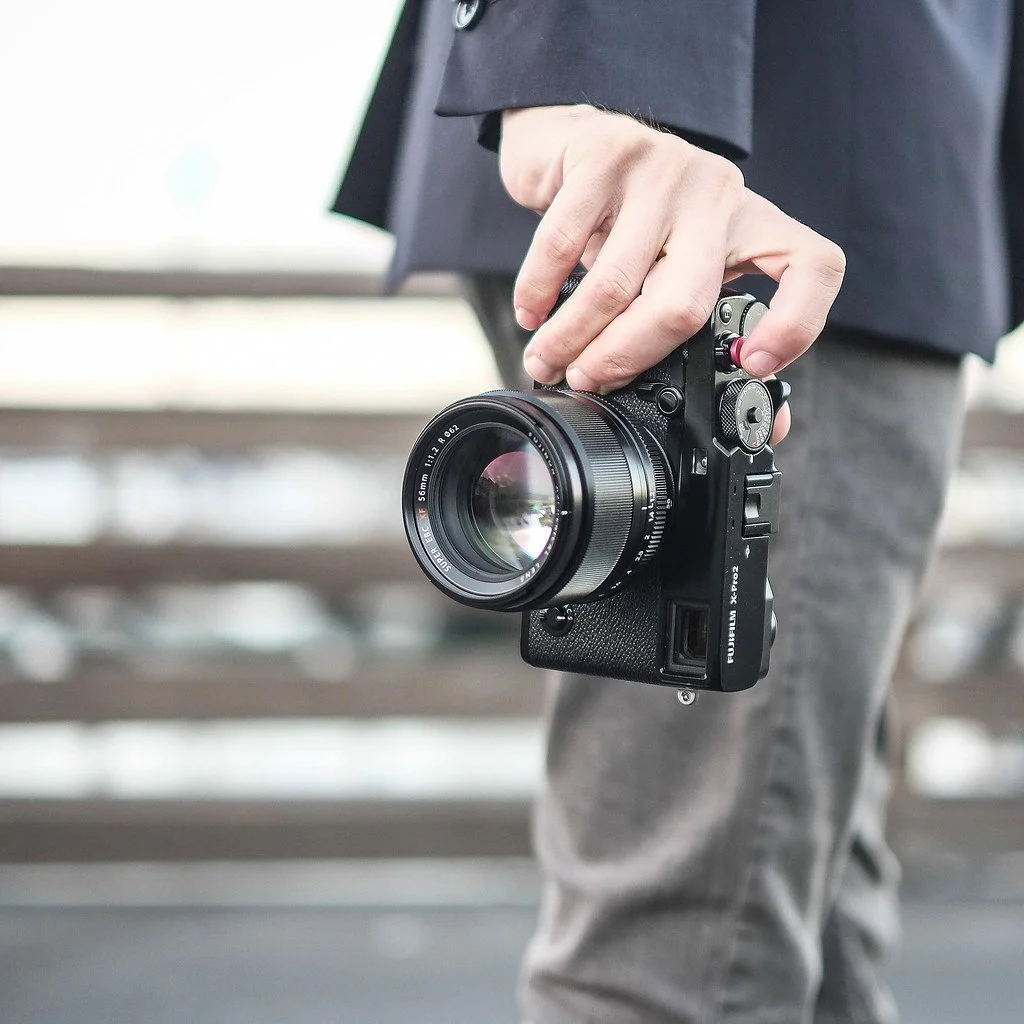
Portability over technical perfection. Medium format or full frame Nikon have all the thechnical advantages. Having the gear with you at all times is critical. Photography © Dan Hogman