Budapest, Hungary
March 2026
< WRITINGS
< NEWS
Generative AI, AI-free art
AI and creativity
Human-made work
Analogue drawingHire Me, I Am Human
On Creativity, Authorship, and What Machines Cannot Make
Is this a selling point now?
The fact that a human — and not AI — is producing the work you are paying for is becoming a selling point.
When it comes to handmade artwork, no further evidence is required.
This is 2026. Chances are, I will be proven wrong soon…
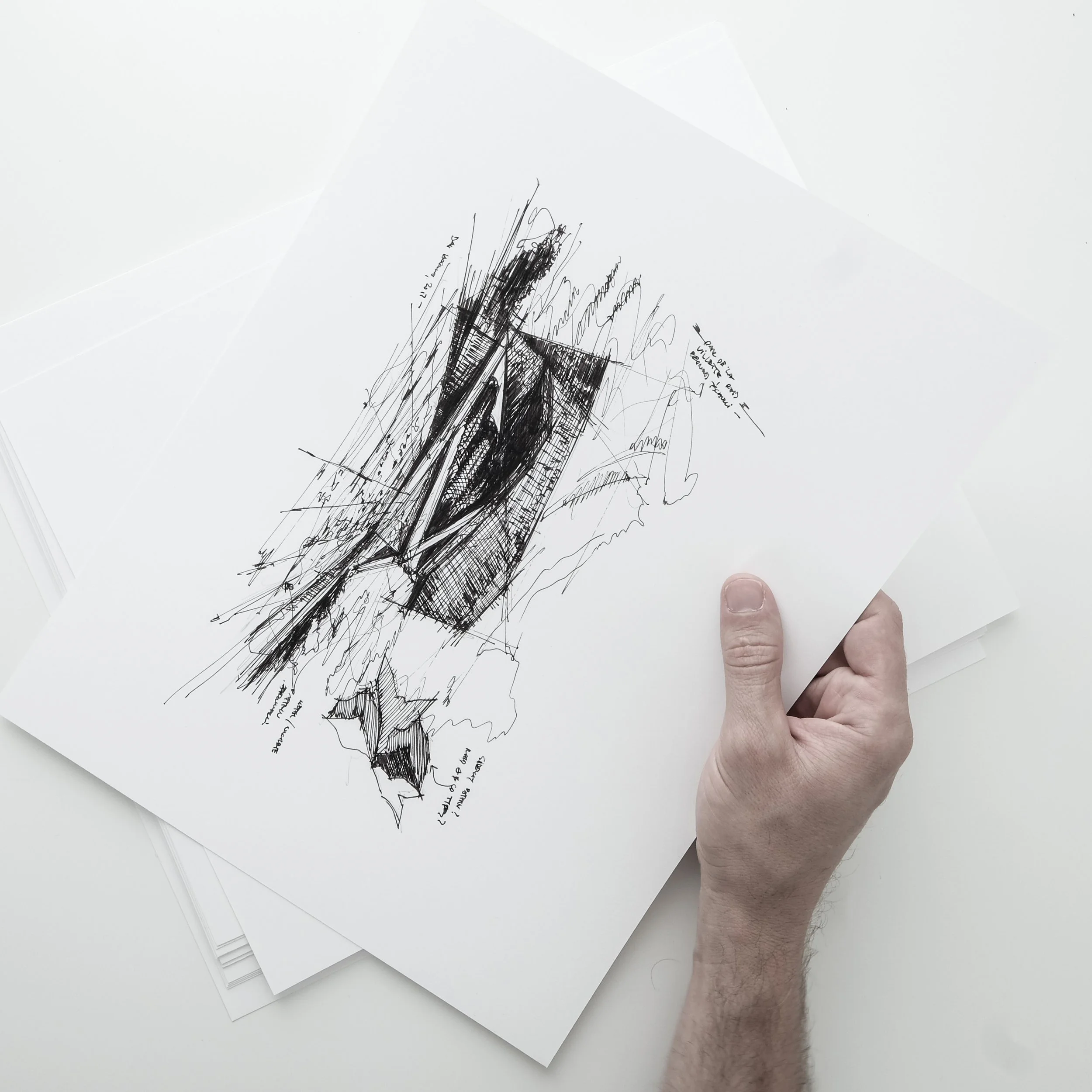
From mind, through hand, onto paper — uninterrupted. No machine and no algorithm making any decisions on my behalf… Drawing by Dan Hogman.
We are already sick of AI taking over the creative work. Not because I am afraid of losing work, but because the loss of human touch — in the most literal sense of the word.
Hand drawing stands apart as perhaps the clearest case where no “human-made certification” is needed. Every line, every stroke, every mark on the paper is the direct physical trace of a human hand and thought. There is no algorithm involved, no prompt, no model trained on someone else's work. It is analogous in the most complete and literal sense: the artist's hand is the tool, and the result is an unbroken physical record of a human being thinking through their hands.
When you hold a hand-drawn piece, you are holding evidence of a person — their decisions, their imperfections, their presence. Ink smudges? Maybe an actual fingerprint from an ink spill? No label is required.
But the visual result is only part of the story. A hand drawing is not merely an image — it is the direct manifestation of a person's thought process, transferred onto paper without any intermediary. When a human artist draws, their ideas, observations, and emotions travel an unbroken path: from mind, through hand, onto the surface.
There is no machine to interpret the intention, no algorithm to translate the concept, no tool to make decisions of any sort. The thought is purely human, and so is its expression. What you see is not a representation of an idea that passed through a system — it is the idea itself, raw and unfiltered, exactly as it emerged from one person's mind.
You can't fake that.
Not everyone, however, works in a medium where the distinction is so clear. Across creative industries more broadly, the question of what counts as human-made work has become urgent enough that formal answers are now being proposed.
Generative AI spreads rapidly, and many creators and organizations worry that audiences can no longer easily tell the source. Was something was made by a person or produced largely by machines? In response, several groups are proposing certification systems or logos that would signal that a work is "AI-free" or primarily human-authored. The idea is similar to labels such as "organic" or "fair trade" — the intent is to give consumers a quick visual cue about how a product was made. (BBC)
Different initiatives are emerging in parallel. Writers' organizations have begun offering a "human-authored" logo for books, allowing authors to register their works and display the label to reassure readers that the creative expression comes from a human author rather than AI. In film and other media, companies are experimenting with certificates that verify the degree to which AI was — or was not — used in production. (The Guardian)
However, creating a universal "AI-free" standard is technically and conceptually difficult. Many creative workflows now involve AI tools for tasks such as editing, translation, or research, making it unclear where the boundary between human and machine authorship lies. We probably all recognize by now that AI use exists on a spectrum rather than a simple yes-or-no situation. Verifying compliance would also be challenging, since it often relies on creators honestly declaring how their work was produced.
Despite these complications, supporters argue that such labels could help protect human creativity and give audiences the option to seek out work made primarily by people. The movement reflects a broader cultural debate about authenticity, authorship, and the role of AI in creative production.
The world of architectural drawing offers a useful parallel. A few decades ago, the shift from hand drafting to CAD was significant in terms of method and tooling. However, the fundamental nature of the work remained inherently human. A drafter still drew line by line, made deliberate decisions about every element, and retained full authorship over the result. The tool changed; the thinking did not.
The move to BIM brought a greater degree of automation — more information was generated from fewer inputs — yet the human designer remained in control, defining the parameters and validating every output. You moved from using lines to using objects, or “families” - still human made elements.
Then we have Grasshopper, the visual programming environment that brought parametric and algorithmic design into mainstream architectural practice. Here, automation reached a new level — complex geometries, repetitive structures, and entire systems could be generated from a defined set of rules and parameters. A single change could ripple through hundreds of elements simultaneously. And yet, crucially, the human was still the author of the logic. The designer wrote the rules, defined the relationships, and understood the system they had built. The machine executed — but the thinking, the structure, the intent, all of it remained human. Automation had arrived, but authorship had not left the room.
The leap was larger, but authorship was never truly in question.
Generative AI is a different matter entirely. A few words typed into a prompt can produce a substantial body of visual or technical information — far more than any individual could consciously control or deliberately author. And this is precisely where authorship begins to dissolve. Authorship is not simply about having the initial idea; it requires being present in the making, exercising judgment at every step, controlling the individual elements — even if partially, even if assisted.
When that control is gone, so is the author. Generative AI does not assist the hand — it replaces it, along with the thought behind it.
Let this be stated clearly. Generative AI has its place. The speed at which Midjourney can spur out iterations cannot be matched by humans. And there is a need for that. Additionally, there is the production of technical drawings, construction documents, or the automation of repetitive drafting tasks. For these purposes, it is a legitimate and useful tool.
But a tool does not hold authorship. And it probably does not need to, when it comes to technical, non-creative tasks – and if you look at the construction drawing set, this is where most of the work goes…
Hand drawings are irreplaceable. Not because of nostalgia or tradition, but because they carry something that cannot be generated: the full emotional and intellectual presence of a human being. Every hand-drawn line is a decision. Every mark is a feeling made visible. The hesitation, the confidence, the doubt, the joy — all of it is encoded in the work in ways that no prompt can summon and no model can replicate. These are not aesthetic preferences. They are the very substance of human creative expression.
A human line is a response to a specific spatial problem or emotional state; an AI "mistake" is a statistical probability. %.This is where authorship with AI is never applicable - the “authorship” is most fit to be defined as curation of the likelihood of taking a certain action. % Probability.
In hand drawing, the intent is refined during the execution (the "feedback loop"). With AI, the execution is outsourced to a black box.
Generative AI can produce images. It cannot produce authorship, although some can argue otherwise. It can simulate style. It cannot simulate thought. It can approximate the appearance of emotion. The subtleties of human thinking — the contradictions, the intuitions, the deeply personal way each person sees and interprets the world — remain entirely beyond its reach.
Authorship isn't just "having an idea"; it is the thousands of micro-decisions made during the process that AI skips.
Human-made work is not a niche, but a necessity. In a world where machines can generate images, text, and drawings, the work that carries a human hand and mind behind it becomes more valuable, not less.
This is not despite the existence of AI, but precisely because of it. We must treat it as such.
The warning, however, is real. If we stop demanding human authorship — if we accept generated work as an equivalent substitute simply because it is faster or cheaper — we do not just lose certain types of work. We lose the habit of human thinking that produces them. We lose the practice of translating thought directly into making. And once that practice fades, it does not return easily. The hand needs to be used to remain skilled. The mind needs to make to remain alive to the world.
This is not about fear of technology. It is about understanding what is irreplaceable, and choosing to protect it — consciously, deliberately, and without apology.
—
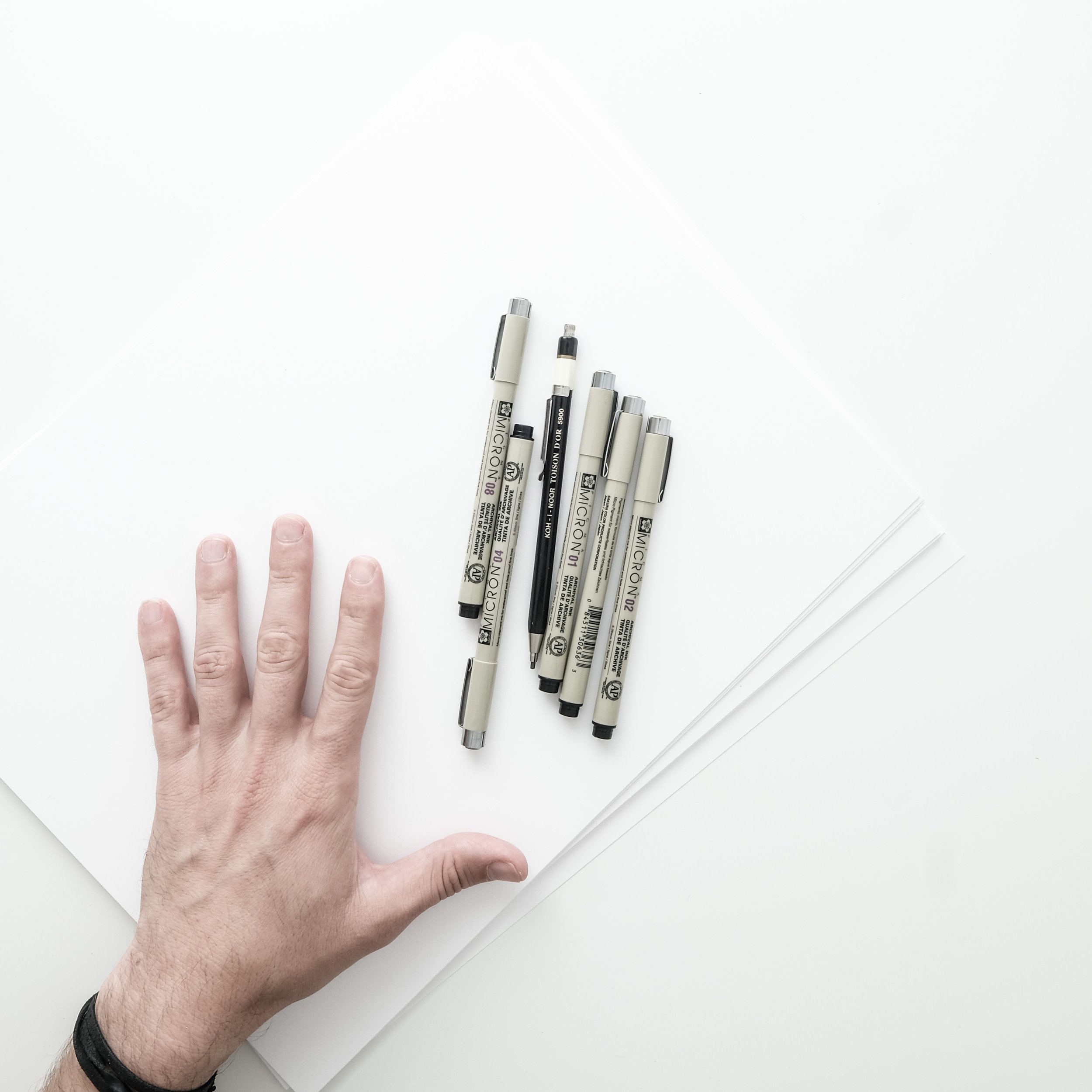
The hand is the author. Every line on this page was a decision made by a person — not generated, not prompted, not automated. (Future!) drawing by Dan Hogman.