Budapest, Hungary
June 2021
< WRITINGS
< NEWS
Architectural design process
Hand drawing in architecture
Analog drawing vs digital Drawing and cognitionDrawing as Process
Where Architecture Reveals Itself
Drawing is not how architects record ideas. It is how ideas are developed.
The act of drawing sustains ambiguity in the early phases of design — holding possibilities open before form is required to justify itself. It provides a visual medium through which generative thinking becomes legible, and a means by which thought is translated into spatial communication. When drawing functions as a thinking tool rather than a representational one, it is indispensable to the architectural design process. When it is reduced to documentation — a byproduct of software rather than an act of inquiry — a crucial layer of architectural intelligence disappears.
This article examines what drawing actually does in architectural practice, and what is at stake when it is displaced from the centre of the design process.
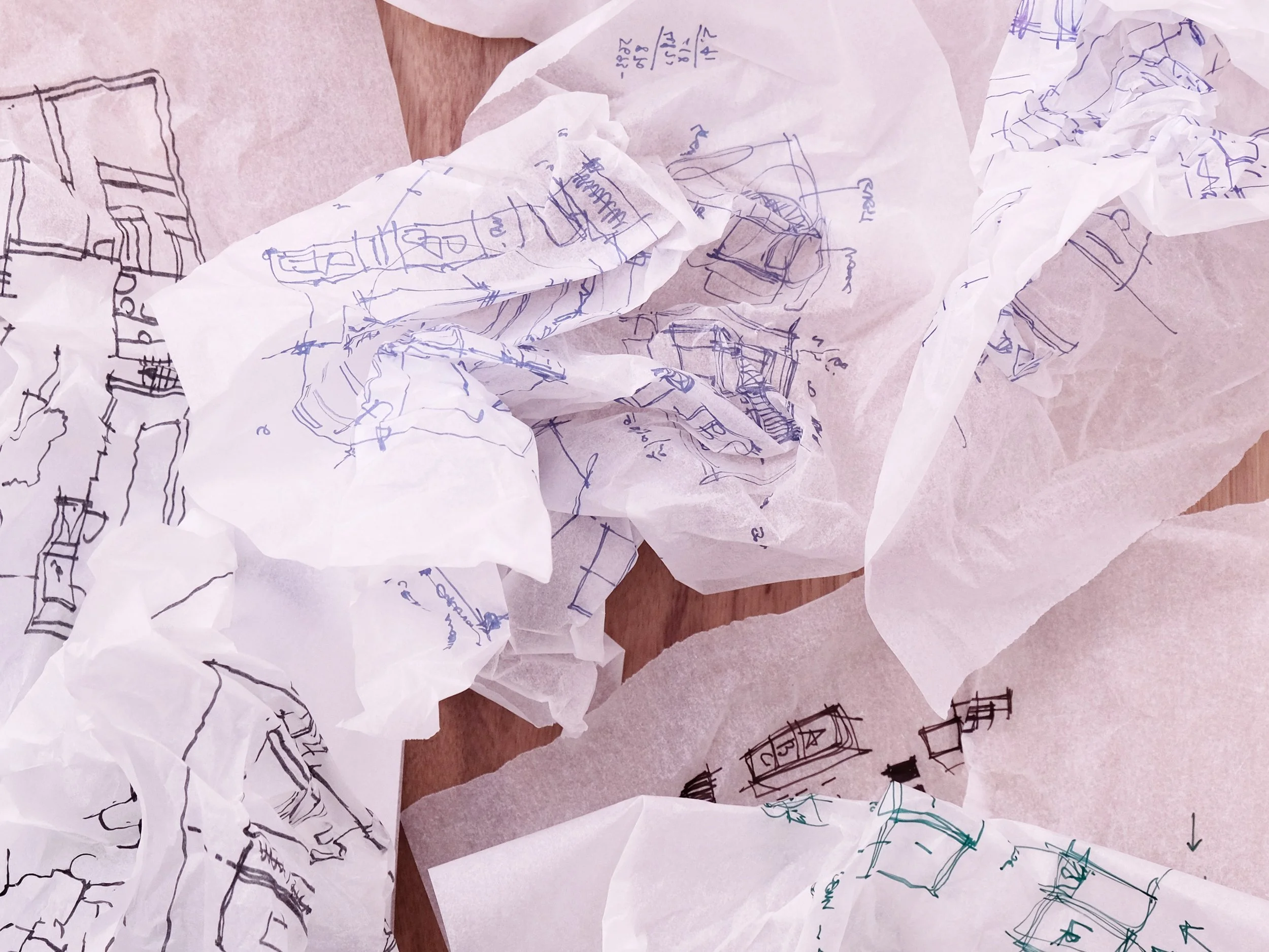
From mind, through hand, onto paper — uninterrupted
Drawings/photo by Dan Hogman.
The wrong assumption
There is a belief in the design industry that the right sequence in a creative process starts with the idea, then the drawing. You need to have an idea first - this way, you know what to draw… The drawing, in this view, is a recording tool - a way of externalising what has already been decided. It follows thought rather than participating in it.
This sequence might hold in practice, where we differentiate - the architect vs “drafter”. Maybe in small-scale offices, where one founder is working with some helpers - a setup I remember back from my internship years… But it does not work when the design is process-driven and where hand drawing is a critical part of the process.
At the outset of any design process, the problem is not simply unsolved - it is not yet fully understood. To assume that ideas exist in a stable, fully formed state before expression is to misread what the early phase of design actually is. It is not the execution of prior thought. It is the construction of understanding itself.
Drawing is the medium through which that construction happens. It externalises partial thoughts, making them visible just long enough to be inspected, compared, and revised. Without this externalisation, thinking remains internal — compressed, self-referential, and difficult to interrogate. The drawing does not follow the idea. It enables the idea to take shape.
This distinction matters practically. When drawing is reduced to a representational role, or used only to communicate decisions already made, the feedback loop that drives design thinking weakens. The process either stalls in abstraction or commits prematurely to a form or a function that has not been tested. The deeper cost is harder to see, because it is immaterial - a whole layer of thinking disappears.
Drawing is where thought forms
The work begins before anything can be clearly said. An impression appears - partial, unstable, not yet an idea. Rather than forcing it into language or resolving it too quickly, the incipient ideas need to form something visual. Lines emerge without certainty - this is the most direct way to “visualize the thoughts”. This is not to describe something already known but to discover what is there. Each mark stabilises a fragment of thought, making it visible just long enough to be questioned, adjusted, or abandoned.
This is not a representation. It is production. Not production in forms of “documentation” as largely defined in the corporate architectural practices where I used to work, where documentation meant sheets after sheets of detail views of every joint of the building, but rather as production of thoughts.
The distinction is more than semantic. Representation assumes a prior content - something already formed that the drawing moves on to transcribe. “Production” assumes the opposite: that the content does not yet exist, and that drawing is the act by which it comes into being. The thought cannot yet be articulated, but the visual starts to emerge. Ambiguity is not the problem to be overcome at the start of a project. It is the condition that makes genuine enquiry possible.
It’s this ambiguity that leaves room for exploration. Ambiguity is key to any design process. Ambiguity tells us that there is something more to find. Nothing is set, nothing is certain, but there is quite a lot more to reveal.
Method, not expression
Bruno Munari frames design as a method of progressive clarification — not the imposition of form, but its gradual uncovering through disciplined engagement with materials and constraints. Ideas do not precede construction in a finished state; they are tested and corrected through physical iteration. Each material introduces its own logic, resisting certain intentions while enabling others. It is through this resistance that clarity begins to emerge. Design, in this view, is not an act of invention so much as a process of refinement — bringing form into closer and closer alignment with what the problem actually requires.
What both positions share is a rejection of the drawing-as-record model. The sketch is not a thumbnail of a finished thought. It is where the thinking happens.
The Body as Instrument - Not Revit
Thinking does not begin in abstraction. It begins in contact.
When drawing by hand, cognition is distributed across eye, mind, and movement — each adjusting in real time to the others. The slight resistance of the surface, the pressure of the line, the speed of the gesture: these are not incidental conditions. They are active participants in how an idea unfolds. The hand does not execute decisions made elsewhere. It participates in the act of thinking itself.
This has consequences for how we understand intelligence in design. If thinking is something that happens only in the mind, then the hand is merely a delivery mechanism — a tool for outputting what cognition has already produced. But if cognition is distributed, then the body is not peripheral to the process. It is part of the system.
What the hand registers through friction, drag, and resistance feeds directly back into the decisions being made. Intelligence, in this sense, is not confined to the mind. It is embedded in muscle memory and tactile feedback.
The implications extend beyond the individual gesture. Sustained practice reshapes perception itself. What initially appears ordinary begins to disclose structure, rhythm, and nuance. The architect’s role shifts - from someone who imposes form to someone who has learned to recognise it via repeated iterations and eye training. Invention, when it occurs, is grounded in this trained attention.
In this light, drawing by hand is not a lesser precursor to more sophisticated work. It is a different mode of intelligence altogether — one that resists finalisation, remains open to the unexpected, and keeps the designer in direct negotiation with the physical world they are trying to “feel” and understand.
Form as residue
Peter Märkli's practice makes this visible at the scale of an entire body of work. His drawings do not function as representations of buildings-to-come. They operate as independent spaces of inquiry, where proportion, geometry, and spatial relations are repeatedly recalibrated. Forms appear simple — even inevitable — but they are the result of prolonged adjustment rather than immediate invention. Each project holds traces of earlier versions: decisions removed, rebalanced, absorbed into quieter resolutions. What remains is what has withstood revision. What disappears is what failed to hold under scrutiny.
The final form, in this sense, is less an invention than a residue. Architecture understood not as the expression of a concept, but as the outcome of sustained attention — where drawing, thinking, and making remain inseparable until the design gets digitalised.
A structural difference
The persistence of analog practice in design is not nostalgia. It answers a structural need.
Revit and Rhino, or digital tools in general, operate through clarity. Everything must be specified to exist when building a model. This is not a limitation so much as a disposition: digital tools are powerful once direction has been established, but less accommodating when thought is still forming. They tend toward precision, control, and resolution. They operate best when the idea is already stabilised.
The analog works differently. Multiple possibilities can coexist in a single mark without any of them being committed to. This tolerance for imprecision is not a deficiency — it is the condition that allows exploration to happen before ideas are required to justify themselves. The hand remains open to fluctuation, capable of holding ambiguity without forcing closure.
The two modes, then, do not compete. They occupy different phases of thinking. Analog work sustains the early, indeterminate stage, where the value lies precisely in keeping options open. Digital tools consolidate, refine, and execute once coherence has emerged. To rely exclusively on the digital is to compress this sequence — to force resolution before the problem has been fully inhabited.
At this point, the industry admits that the digitalisation in architecture is not an option. In fact, this is not new, but decades in the making. It’s a must-have and probably the only option to deliver a design, timely and efficiently. The key here is maintaining the human thought active in the design process, via a continuous feedback loop between the hand, eye, and the computer screen.
The Intelligence of Friction
Drawing on a tablet introduces a subtle but persistent separation between action and response. The surface offers uniform resistance. The line appears through mediation. It’s not the results of anything physical, but rather a preset, a presentation on what the software was trained to think that a hand-drawn line looks like.
What is gained in control and reversibility comes at the cost of variation.
On paper, the contact between tool and surface produces immediate, specific consequences - a result of the physical friction between paper, ink, or graphite. Without this tactile exchange, the act becomes more abstract — not in the sense of conceptual abstraction, but as a distancing from physical reality. The hand no longer adjusts to the unpredictability of material. Fewer unexpected conditions arise to influence the outcome.
In real-world making, form is not only conceived but physically confronted. When that confrontation is removed, so is much of the intelligence that depended on it.
Drawing as Situated Action
Everything argued so far has treated drawing as a cognitive instrument — a way of thinking, perceiving, and forming. But there is a further claim embedded in the practice, one that concerns not only how designers think but what they are responsible for.
Samuel Mockbee's work makes this explicit. His notebooks are not preparatory artifacts. They are direct records of a way of working that collapses the distinction between thinking and making — and between making and consequence. Architecture, in this framework, is inseparable from context: economic, cultural, environmental. Limitation is not a constraint to overcome abstractly. It is the primary generator of form. Found materials, local labour, and improvised techniques are not secondary considerations. They are the drivers of design intelligence.
This is the furthest reach of the argument. Drawing is not only how designers think. It is how they remain answerable to the world they are working in. When drawing is reduced to a representational role, when it becomes a means of communicating decisions rather than forming them, this answerability weakens. The designer moves further from the resistance of material, the specificity of place, the pressure of actual conditions. Design risks becoming detached authorship: the imposition of form from a distance.
The Specifics…
Muscle memory is critical. Visual memory, including the paper/ink interaction, line weight, ink density, is informative. Decisions on how paper and ink work lead to three-dimensional decisions in architectural design. The proportions of a room tell how it is to be furnished. The proportions of a facade inform the sizing of an opening. The size of the external openings lead back to the interior, to inform the repositioning of the furniture or internal circulation. The process continues - the external opening might have a vertical or accentuated vertical expression, affecting, once inside the space, the perception and connection to the outside.
Here, design emerges as a felt experience, where the human intuition guides the decisions, rather than an analytical software telling us how large the windows should be to optimize exposure or limit the solar intake.
This is just a snippet of the feedback loop that revolves and repeats multiple times in the design of my current multifamily residential project in NYC. The intent is to “manually” explore options in a less mechanical, more personal way, where human thought trumps Revit in deciding key elements of a building - thresholds and passages - as an example.
The argument continues - who controls Revit? While there is still human intent in inputting data, there needs to be an intentional process in deciding that is “right” - not based on catalogue specifications, cost, energy models (which do have a role, eventually…) but based on what human intuition suggests we do, as architects.
Ambiguity, iteration vs the Inherent Rigidity of CAD
Form does not arrive intact. It begins as a loose configuration — an arrangement that suggests itself without fully resolving. Early attempts are partial, often inconsistent, carrying traces of competing directions. This is not a failure of method, but the actual method.
Each sketch captures a fleeting configuration of thought that would otherwise vanish, fixing it just long enough to be reconsidered, altered, or extended. What matters at this stage is not accuracy but accumulation. Through repetition, fragments begin to suggest direction. What emerges is not the execution of a predefined idea but the gradual construction of one — form discovered in the act of making rather than imposed at the outset.
This means that ambiguity is not an obstacle to be cleared before serious work begins. It is a resource. The tolerance for imprecision in the early phase is precisely what keeps possibilities open. Imprecision leads to more precision via iteration. Trace paper is the tool. Overlapping and layering thoughts leads to more and more refined versions of the original ideas, while still keeping a record of the initial thought in the lower, initial layers.
The thought process can be traced back to the initial sketches. All we need to do is peel the top layers to see the “base”. The progression is there - all we need to do it line up the multiple versions of the sketch and compare them.
Revit forces you to alter the current version to make room for the newer version (unless you use “design options” - good for client presentation). Drawing options, on paper, stay. Hang them in the office and talk about them at will…
Once you move into Revit, you are forced to decide on key aspects that can be transferred. What is the righ time and what are the parts that can be moved? They need to be defined first. To define too early is to narrow prematurely — to collapse the problem before it has been fully understood. The quicker we move to computer models, we are, even involuntarily, setting a definition. The rigidity of a Revit or Rhino drawing is often perceived as a “sold” item - “done deal” situation. Whether this is the case or not, it is irrelevant. A client perceives it that way, even if as a small hint. The design team’s perception is somehow locked on what is in Revit - the creative act is somehow hindered at this point.
Why hindered? It’s part mental. There is a practical aspect to it as well. There are teams of architects working together, where the question of “ownership” is always present. Who owns what piece is clear to some extent in smaller teams. But in teams, often as large as 10 in the early stages (concept or schematic design) or up to 50 in the documentation phase (construction documents), the extent of scope among team members is vague. This is not a result of poor management, but a side effect of developing large and complex projects, particularly healthcare or transportation hubs.
I fact, this is not necessarily linked to a building typology, but rather to the scale of projects. As we build larger and larger, the team size increases. The building codes evolve. More and more consultant teams are needed - new trades are added constantly. The “all hands” meetings now include, in some cases, a dozen trades.
Here, the ambiguity of the early exploratory phase has been replaced, often prematurely, by the organized rigidity of the BIM model, where seamless execution of the design is key. This is measurable. The loss of the authorship and thinking process is a known casualty, with no solution in sight.
-
Architecture — and design more broadly — begins not with a concept but with an act of attention directed outward. The hand does not follow the mind. It extends it, challenges it, and sometimes redirects it. What results is not the execution of a predefined idea but the gradual emergence of understanding through sustained engagement with form, space, and material. That engagement is never purely intellectual. It is always, at some level, physical — a negotiation between intention and resistance, between what is imagined and what the world will bear.
Drawing is where that negotiation begins. It is also the space where dialogue exists and where the process solidifies. Both, in my mind, are key components of the architectural process.
- dh, 2021
Further ReadingsHara, Kenya. Ex-formation. Lars Müller Publishers, 2015.Märkli, Peter. Studio Works. Harvard University Graduate School of Design, 2002.Mockbee, Samuel. The Notebooks of Samuel Mockbee. Princeton Architectural Press, 2014.Munari, Bruno. Design as Art. Translated by Patrick Creagh, Penguin Books, 1971.Pallasmaa, Juhani. The Thinking Hand: Existential and Embodied Wisdom in Architecture. Wiley, 2009.