Was It Worth it?
The Architecture of Cinematic Destruction
Boston, Massachusetts
April 2022


< WRITINGS< NEWS


Film
Special Effects
Visual Drama
This is a rewrite of a paper I wrote while in graduate school at Harvard. Among several off-topic electives, I took a journalism class for multiple reasons, including experimenting with critical thinking and testing the art storytelling and persuasion.Did the buildings have to fall, or could the story survive without it?
Iconic architecture makes destruction meaningful. Its collapse signals stakes, creates drama, and evokes recognition. The result is visceral, immediate, and psychologically compelling - proof that spectacle and empathy can coexist in blockbuster cinema.
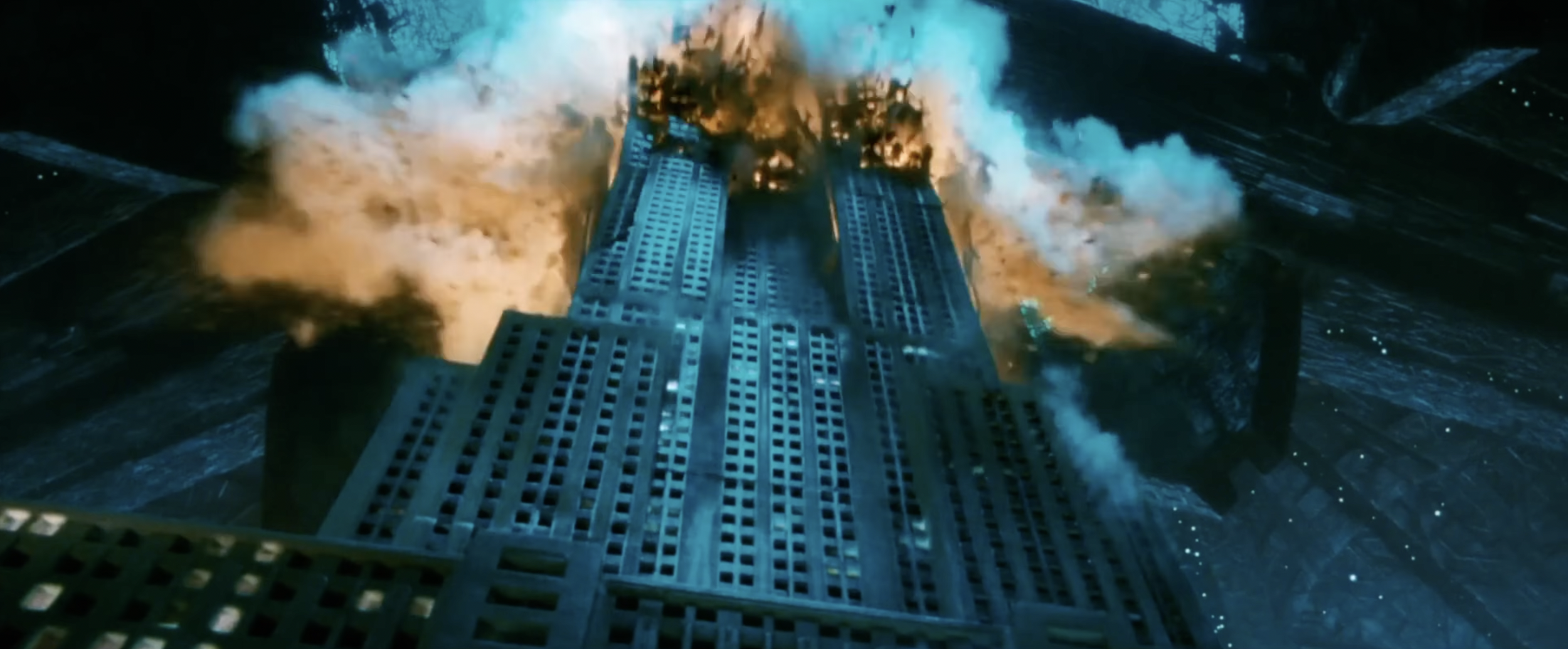
A moment of profound professional grief; the Art Deco spire, a pinnacle of 20th-century verticality, is gone. From an architectural perspective, there is a sickening vulnerability in watching the structure buckle so effortlessly - yet one has to admire the visual effects. This was done with the use of hand-crafted miniatures and practical pyrotechnics. It’s a visceral shock of urban collapse. Odd contrast between such a visually beautiful execution of total structural failure.
Image Credit: 20th Century Fox / Centropolis Entertainment (Movie Screen Grab)
Few cinematic moments capture attention faster than the destruction of an iconic building. Watching the glass dome of the Grand Palais in Paris shatter after a character crashes through it may feel shocking—even unsettling—unless the culprit is Tom Cruise in a Mission Impossible film. In that case, the moment becomes part of the spectacle.
The destruction of architecture has become one of cinema's most reliable emotional shortcuts. Filmmakers routinely rely on recognizable landmarks to signal danger, power, and loss. When a building falls, the audience instantly understands what is at stake. Yet as cinematic spectacle escalates and violence becomes routine, the emotional meaning of such destruction may be changing. What once shocked audiences now risks becoming just another visual effect.
But the destruction of architecture in film is rarely random. Specific buildings are chosen precisely because they carry symbolic weight. There is no faster way to signal the arrival of a villain than by destroying a beloved landmark such as the Eiffel Tower, the Golden Gate Bridge, or the Sydney Harbour Bridge. Likewise, when filmmakers want to suggest that a nation itself is under threat, they often target the physical symbols of political authority: the White House, the Kremlin, or the Palace of Westminster.
Whether the president is actually inside the building or directing a counteroffensive from elsewhere is irrelevant. The symbolism does the work. Audiences instinctively understand what these structures represent. When the White House collapses on screen, viewers immediately grasp the message: the center of power has fallen.
Architecture, therefore, functions as narrative shorthand. Certain landmarks appear again and again in scenes of destruction because their cultural meaning is universally recognizable. In London, Tower Bridge or the Palace of Westminster is likely to be the first casualty. In New York, the Empire State Building remains a perennial target. "You cannot underestimate the effect of putting Godzilla on the Empire State Building," notes architect Jacob Irwing, who specializes in high-rise design. "We can always build taller, but we cannot replace the iconic status of that building." Newer structures, he argues, lack the accumulated symbolism that gives older landmarks their emotional impact. "Godzilla would probably not care much about the Freedom Tower (just yet…). Architecture needs time to establish itself."
Yet not all landmarks carry the same kind of weight. Few structures have suffered more on screen than San Francisco's Golden Gate Bridge, which collapses in films such as Rise of the Planet of the Apes (2011), Pacific Rim (2013), and San Andreas (2015). Unlike symbols of government power, the bridge represents something more personal—a beloved civic landmark rather than a seat of authority. Watching it fall, therefore, produces a different kind of emotional response. For viewers familiar with the city (I was a San Franciscan for about a decade), the moment feels oddly intimate, as if part of the collective landscape of memory has been erased.
The effectiveness of these scenes also depends on psychology. Spectacle alone can shock an audience, but emotional impact requires identification. Film scholar Torben Grodal argues that viewers must understand a character's position to fully experience a dramatic situation. He writes more broadly about film and emotion rather than landmarks or architecture specifically, but there are some parallels. He suggests that as films front-load spectacle and reduce character depth, they are essentially bypassing the very mechanism that makes destruction emotionally resonant. You get the biological spike — the gasp, the adrenaline — but none of the lasting impact. When destruction affects a character with whom audiences identify, the emotional response intensifies.
There is a psychological dimension to this that matters beyond identification. Freud observed that confronting imagined fears can produce genuine stimulation — a controlled encounter with danger that generates excitement rather than panic. Cinema has always exploited this. But stimulation, by its nature, requires escalation. What excited an audience in 1996 barely registers today. The brain adjusts. The threshold rises. And so the buildings get bigger, the collapses more elaborate, the devastation more total — not because filmmakers have run out of ideas, but because the audience has quietly been trained to need more.
But that stimulation is not universal. The cultural context in which these images appear matters enormously. When Godzilla first premiered in Japan in 1954, the destruction it depicted felt painfully real. Tokyo had vivid memories of wartime devastation, and the film's scenes of urban destruction reportedly moved many viewers to tears. In the United States, however, audiences largely received the film as a campy monster movie—another entry in a genre already popular in Hollywood.
Part of that gap is simply distance. As a technology-obsessed high school student, I watched and rewatched Independence Day (1996) more times than I care to admit. The film was innovative for its time, relying on detailed scale models, carefully controlled miniature explosions, and a great deal of technical ingenuity. The result was mesmerizing. Many viewers, myself included, returned to the theater not for the story but for the sheer thrill of watching cities collapse under alien attack. There was no grief in that experience — only spectacle.
Over time, the threshold for cinematic destruction has risen dramatically. What once shocked audiences now often feels routine. According to communication scholar Amy Beakley, studies of high-grossing films show that roughly 90 percent of major characters engage in violence or destructive acts. Filmmakers themselves acknowledge this cultural shift. Director Quentin Tarantino has famously argued that violence is an essential part of cinematic storytelling: "In movies, violence is cool. I like it." For Tarantino, depicting violence is simply part of portraying characters truthfully.
Though not architecturally linked, Tarantino work is relevant on a parallel path. His arrived at exactly the right cultural moment. The early 1990s were hungry for a filmmaker who treated violence as an aesthetic rather than a moral problem, and he delivered. What's interesting now, three decades later, is how thoroughly Hollywood absorbed that lesson and ran with it, often without the craft that made his version of it work. Tarantino's violence had rhythm and wit. What followed in his wake was largely just volume.
The numbers back this up. Research from the American Academy of Pediatrics shows that depictions of violence in media have more than doubled since the 1950s, while gun-related violence in films has tripled over the past four decades. Attention spans, meanwhile, have shortened considerably — and filmmakers know it. In a media environment where audiences scroll past catastrophe in seconds, destruction is no longer just a dramatic choice. It is an attention mechanism. The spectacle has to grow because the competition for sustained attention has never been fiercer. Buildings fall not only because they carry symbolic weight, but because nothing else cuts through the noise quite as fast.
That said, destruction can still land. When it is earned — when it is tied to something a character has specifically lost rather than something the audience generically recognizes — the effect holds. The collapse of a family home in a film like Parasite carries weight not because the house is famous but because we have spent two hours inside it. The building has become personal. This is perhaps the real distinction: not between old landmarks and new ones, or civic structures and seats of power, but between destruction as spectacle and destruction as consequence. The films that still manage to make a building's fall feel like a genuine loss are the ones that made the building mean something first.
Clearly, an alien invasion remains unlikely, though natural disasters such as earthquakes, volcanoes, or tidal waves remain genuine possibilities. Cinema transforms these distant fears into vivid spectacles, allowing audiences to confront catastrophe within the safe confines of fiction.
That safety may be the key to the appeal. The thrill of destruction exists precisely because viewers know it is temporary. When the film ends, the theater lights come on, and the world outside remains intact. The skyline still stands.
The destruction of architecture in movies works because buildings carry collective meaning. They embody power, identity, and memory. When they fall on screen, audiences instinctively understand what is being lost. Or they used to. The evidence now points in one direction: the escalation is real, the desensitization is real, and what was once a genuine cinematic shock has largely become a production value. The skyline still stands when the theater lights come on — but so does the suspicion that nobody in the audience was really worried about it in the first place.
-dh
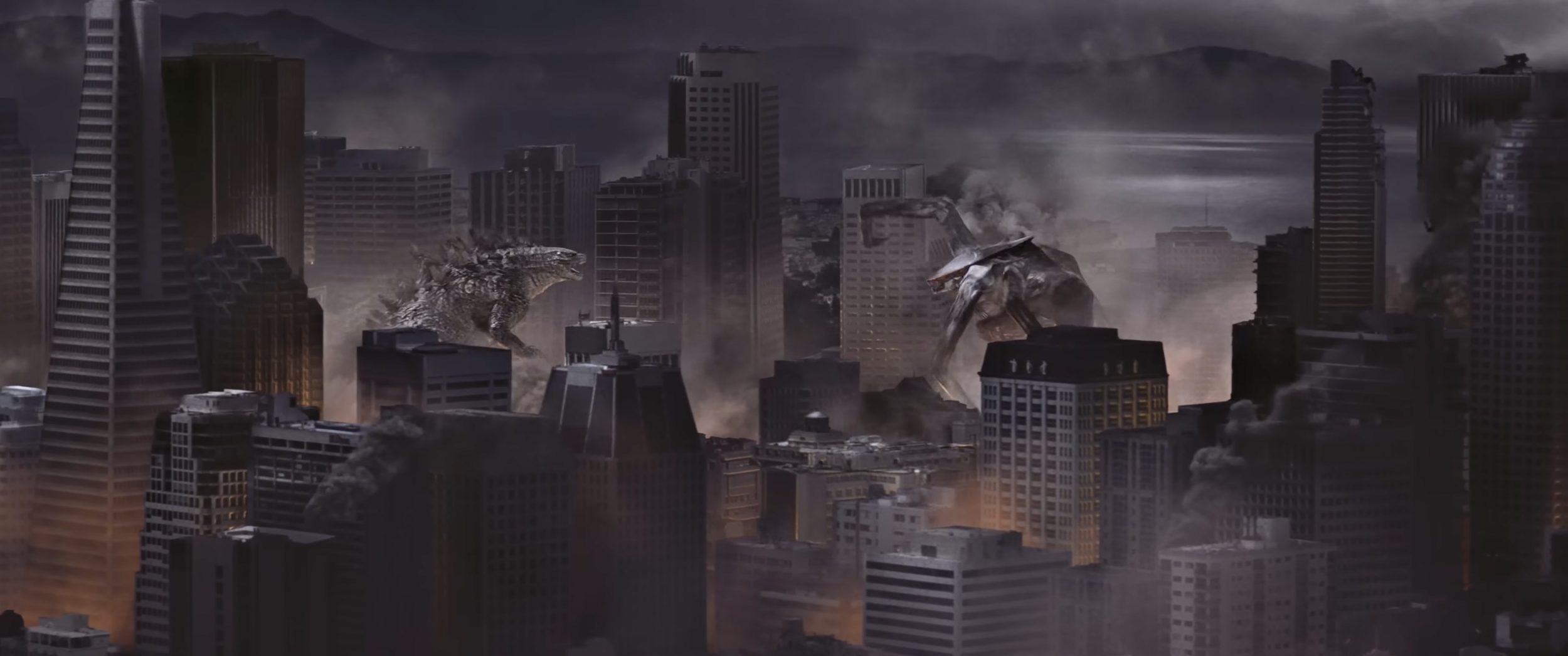
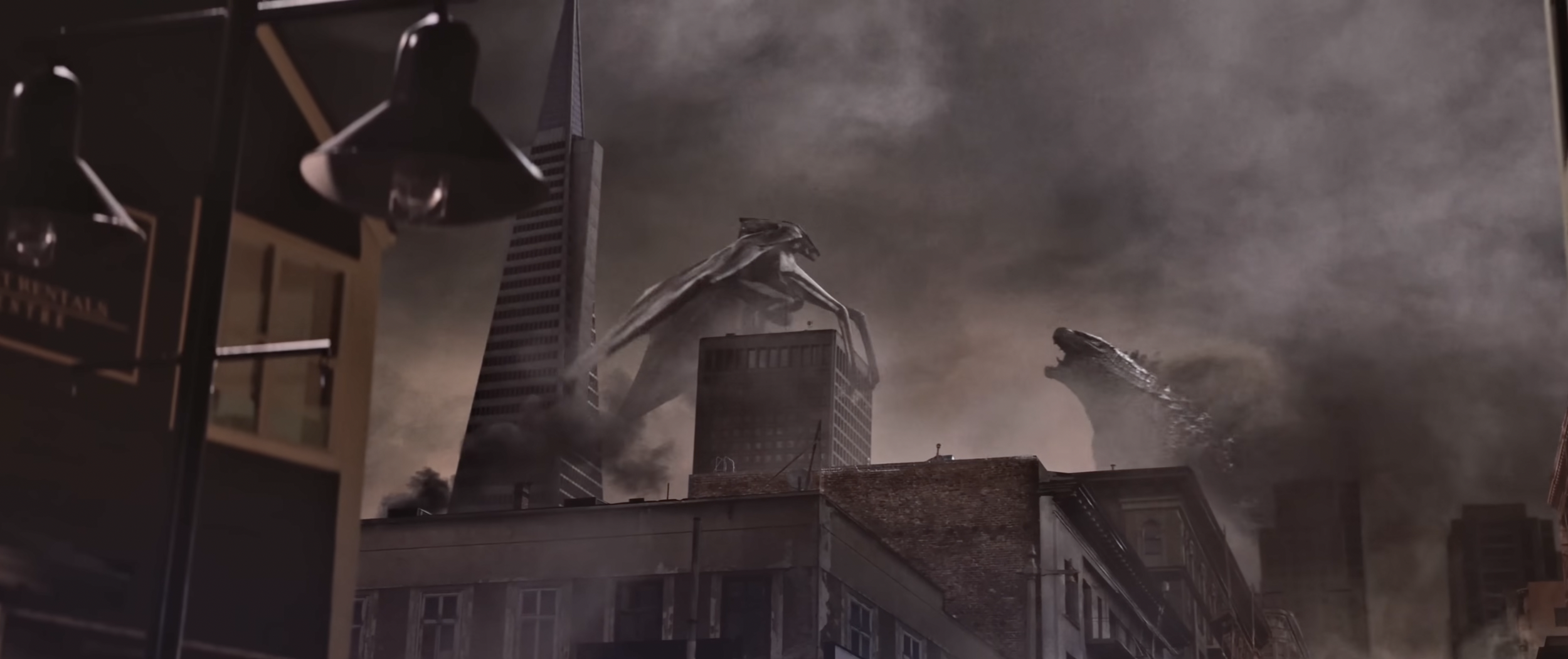
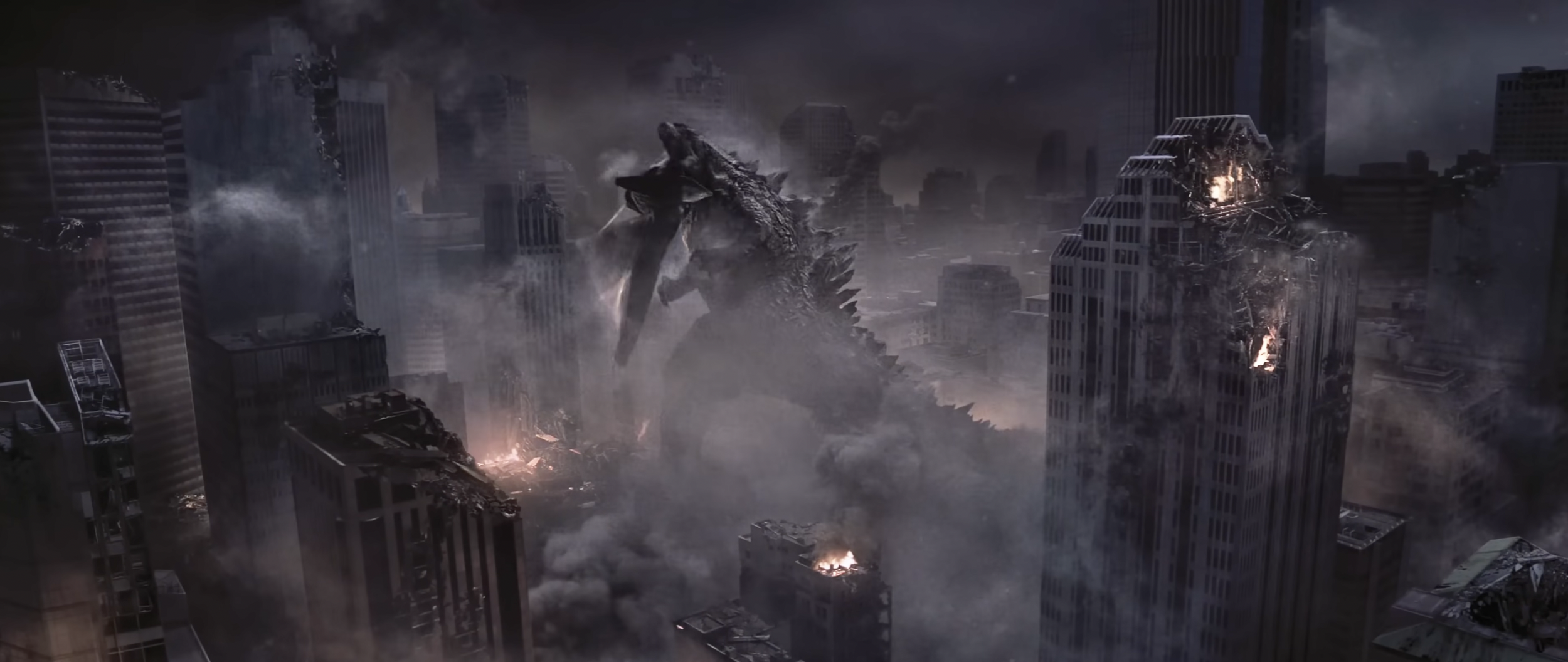
San Francisco in Godzilla (2014). The Titans collide, while the San Francisco financial district -a dense tapestry of structural engineering and civic history - is ablaze. There is a sharp, professional ache in watching the glass curtain walls of the city’s high-rises shatter. The unique silhouette of the Transamerica Pyramid looms like a gravestone over the fog of war. This only underscores the fragility of the built environment. Decades of design, planning, and constructio are erased in a single stroke.
Image Credit: Warner Bros. Pictures / Legendary Pictures (Movie Screen Grab)
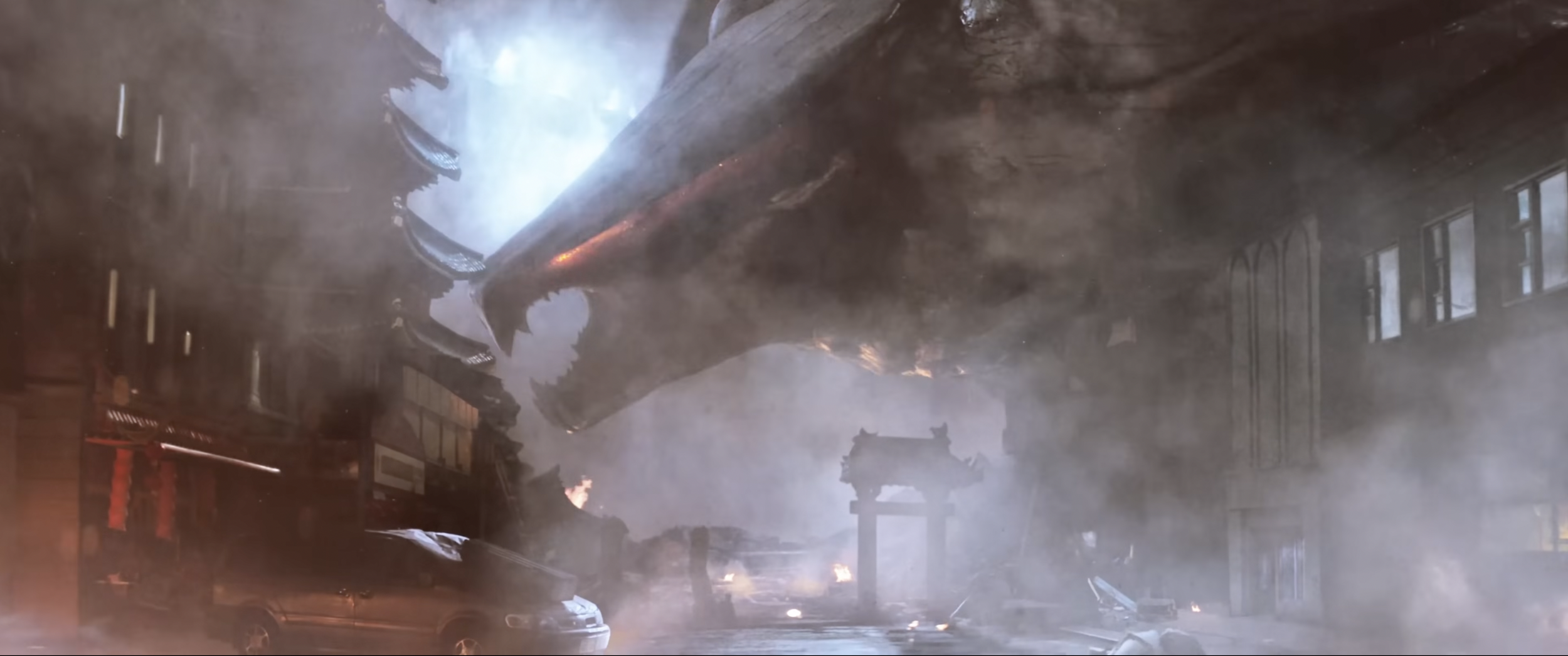
The Dragon Gate, every point to the San Francisco’s Chinatown and the Bank of America Tower. Not illustrated quite as built, but the effect is real.
Image Credit: Warner Bros. Pictures / Legendary Pictures (Movie Screen Grab)

Finally, in the background, The Bank of America Tower in San Francisco at 555 California Street, completed in 1969, by Skidmore, Owings & Merrill (SOM) and Wurster, Bernardi & Emmons, along with consulting architect Pietro Bellusch.Image Credit: Warner Bros. Pictures / Legendary Pictures (Movie Screen Grab)