The Practice of Architecture
in the Age of Corporate Capital
Basel, Switzerland
July 2022
< WRITINGS
< NEWS
Corporate Architecture
Architecture and Capitalism
Architectural PracticeArchitecture built the physical infrastructure of capitalism — and capitalism, in return, remade architecture as a corporate practice. This essay traces that exchange from its origins in industrial modernity, through the progressive financialization of the built environment, to a present in which large architectural firms operate with the same hierarchies, metrics, and service logic as the institutions they design for. The arc is a closed loop: architecture shaped the rise of capitalism, and capitalism shaped what architecture has become.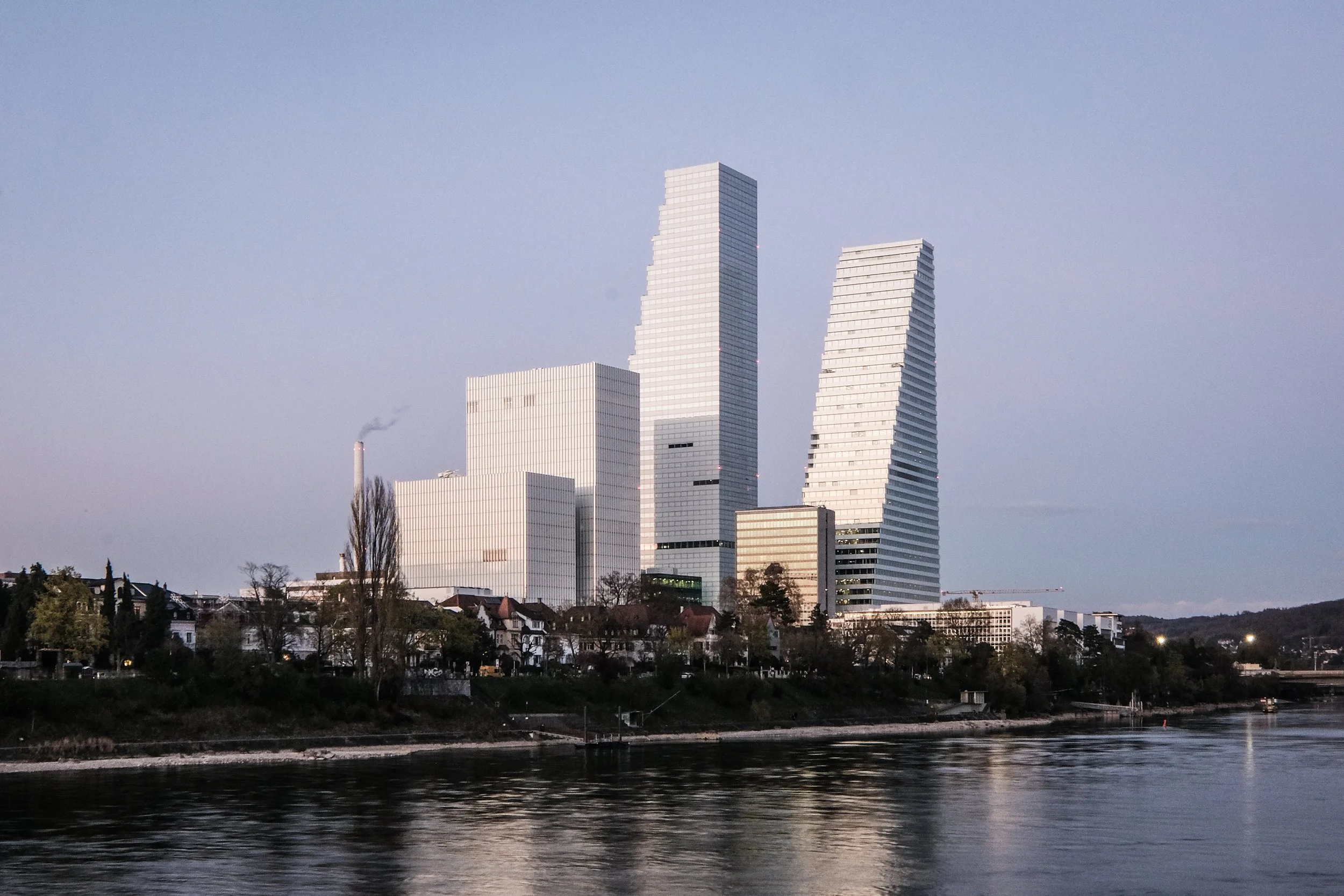
The evolution of Herzog & de Meuron exemplifies the profound shift from the radical, material-focused "laboratory" of its early years to the highly organized global entity it is today. It was once the quintessentially boutique practice. Their reputation was built on an artisanal obsession with skin and texture—exemplified by the Dominus Winery or the Tate Modern—where every project felt like a bespoke philosophical inquiry. However, the scale of their commissions shifted toward massive urban developments and corporate headquarters like the Roche Towers. The firm’s internal structure has necessarily adopted a corporate logic - a staff exceeding 500 and a global footprint across multiple continents, the "experimental" output is now balanced against the demands of high-volume project management and standardized delivery. Photography - Dan HogmanArchitecture begins as a necessity. Before it established itself as a profession, it served the basic need of shelter. The first built structures ask no theoretical questions. They respond to climate, to available material, to the immediate conditions of survival. There is no client beyond necessity itself.
Form follows constraint in its most literal sense, and what matters is whether the structure holds. This is not a romantic origin myth. It is a baseline against which everything that follows must be measured. Because what architecture has become is almost unrecognizable against that baseline. Architecture today is, in the majority of its practice, a service industry operating in the shadow of financial capital.
Its projects begin not with spatial questions but with investment models. Its buildings are valued not for what they enable but for what they yield. And its practitioners, trained in the language of authorship, civic responsibility, and cultural production, spend most of their professional lives doing something completely different - optimizing within financial models and parameters they did not set and cannot change.
This is not a crisis the profession is approaching. It is a condition already fully arrived.
Architecture as Instrument
To understand how architecture arrived at this condition, it is necessary to understand the period in which it exercised genuine agency — and to be precise about what that agency actually consisted of.
As societies organized, architecture took on roles that extended far beyond shelter. Temples, palaces, fortifications, and civic spaces encoded hierarchy, belief, and political authority. The built environment became the medium through which power was made visible and maintained. It ordered collective life. Architecture gave physical form to what a society believed about itself and its values.
The more significant turn came with the rise of industrial capitalism. Here, architecture did not merely reflect economic transformation. In fact, it enabled it. Factories are the clearest example. The early industrial factory was not simply a container for machines. It was an organizational technology. Its spatial logic enabled whatever was produced. The long floor plates, centralized supervision, controlled circulation was all optimized for output.
The same logic applies to the office building, which organized administrative and managerial hierarchies into legible spatial form. The modern corporate tower, as developed by SOM and others in the mid-twentieth century, concentrated capital, decision-making, and real estate value in dense urban cores. It was not a building that responded to capitalism. It was a building that made a particular form of capitalism operational.
Retail architecture extended this logic to consumption. The department store, developed in the nineteenth century, created a new spatial experience of commercial exchange. Victor Gruen's shopping mall went further, engineering an enclosed environment designed to eliminate distraction, maximize dwell time, and systematically move bodies through sequences of spending. These were not passive vessels. They shaped behavior. They restructured the relationship between people and goods. They produced, in spatial form, a new kind of subject: the consumer.
Urban planning participated in the same project. Ebenezer Howard's garden city concept, however benevolently framed, helped establish spatial patterns aligned with emerging middle-class consumption and property ownership. Le Corbusier and Walter Gropius proposed standardized, industrially scalable housing and urban schemes that embedded architectural thinking directly into the logic of mass production.
The point is not that these architects were complicit in some simple or cynical sense. The point is that during this period, architecture shaped the system it served. It provided tools that capitalism required but did not yet have. Architect and clients invented the spatial types through which production, consumption, and administration became organized. This was architecture as an active participant not directing capital, but shaping the conditions of its operation.
The discipline had leverage because capitalism needed what it could provide. That leverage is now gone.
How the Approach Has Changed in the Age of Corporations
The transformation did not happen overnight. It accumulated through the second half of the twentieth century. The shift can be described precisely: architecture moved from being a shaping force within capitalism to being a shaped one. The discipline no longer sets conditions. It receives them.
The evidence is visible at every level of practice. Projects today begin not with a spatial brief but with a financial model. The initial discussions that we, as architects, have, revolves around themes that are not design-specific - return on investment, risk distribution, exit strategy. These items are established before any architectural question is asked.
The program is defined by feasibility, while density is determined by what the market will absorb. Aesthetics are filtered through what can be financed and what can be sold. By the time the architect enters the process, the fundamental decisions have already been made by developers, investors, and financial institutions. What remains is a narrow band of optimization: adjust the envelope, refine the unit mix, manage the cost-per-square-meter. What presents itself as design is, in most cases, calibration. This is architecture, today.
Real estate is now one of the primary vehicles through which capital is stored, circulated, and leveraged. Buildings are evaluated on yield, occupancy rates, and projected appreciation. A residential tower is not primarily a place for people to live. It is a stack of investment returns: pre-sold units, rental income, capital appreciation, and collateral for further borrowing. An office building is underwritten based on rental income projections and occupancy models.
As an owner, the viewpoint is different than the pactitoner. The building's use, who inhabits it, what happens inside it, what it means to its surrounding urban context, is secondary. That matters is its performance as a financial instrument.
Design decisions, including materiality, layout, and density, are not made independently of these calculations. They are derived from them.
The Profession of Architecture Still Makes Big Claims…
What makes this situation particularly acute is the gap between what the profession claims and what it produces.
Architecture maintains, with remarkable persistence, a self-image organized around authorship, cultural significance, and social responsibility. Professional discourse, academic culture, and the architecture press continue to operate within a framework that treats the discipline as exercising meaningful autonomy over the built environment. Awards are given for formal innovation. Monographs celebrate individual vision. Architecture schools teach students that design can change the world. The language of the profession is the language of agency.
These are hollow claims. The actual outputs tell a different story. Luxury residential towers displace existing communities. Speculative office developments produce spatial monocultures that hollow out urban neighborhoods when market conditions shift. Corporate campuses externalize their costs onto the cities that host them, as a negotiated situation on what the campus brings back.
Global development produces similar typologies, similar materials, similar envelopes, repeated across geographies, not because architects lack imagination, but because capital selects for reproducibility. Difference persists, but within limits defined by market segmentation.
Architects operate within frameworks that are not of their own making, including financial, regulatory, and institutional. Still, the profession continues to describe its work as if those frameworks were either irrelevant or malleable. The result is a form of self-mythology that is not merely intellectually dishonest but professionally damaging. It prevents the discipline from accurately assessing its own position, which is a precondition for any meaningful response to that position.
The critique is not that design lacks value. Technical expertise, spatial intelligence, and the capacity to give coherent form to complex programs are genuine contributions. I was part of large design teams designing some of the most technically challenging buildings we have created. Hospitals, laboratories and research facilities, with all the systems they include, are a marvel of technical integration and team coordination. Quite often, are talking about dozens of highly qualified individuals on the architect side alone. Combined with the rest of the design team - structural, MEP, landscape, communications, security, etc, we are in the hundreds. These qualities are not to be ignored, but it’s a subject large enough to warrant a separate essay.
However, the critique goes another direction - the profession overstates the autonomy within which these contributions operate. What appears as creative freedom is, in the majority of practice, constraint management. The architect makes choices, but within a space of possibility defined entirely by others.
Architects take the Corporate Turn
Large architectural practices have internalized this condition, and their organizational structure reflects it. Firms like Gensler, Foster + Partners, and SOM now operate as global corporations. They each manage thousands of employees across multiple offices.
Their internal hierarchies mirror the corporate clients they serve. Design is one function within a broader organizational system oriented toward service delivery. The architect, in this context, is not an author. They are a component within a coordinated production apparatus.
This is not a lapse from some prior ideal. It is the logical outcome of an architectural practice that has been progressively subordinated to capital over several decades. As projects scale in complexity and financial value, the organizational form that can deliver them converges on the corporate model. The discipline becomes what the system requires it to be: efficient, scalable, reliable, and responsive to client priorities.
The romanticism of the individual architect as autonomous creator survives primarily in small practices operating at the margins of the development economy, and in the self-presentation of large firms whose principals have learned that the language of authorship sells.
From Architecture to Corporations and Back to Architecture
The arc is clear and is worth stating. Architecture provided the spatial tools that allowed capitalism to organize production, structure consumption, and extend itself across territories. It built the factory, the office tower, the shopping mall, the planned suburb — the physical infrastructure through which capital took operational form.
Capitalism, in return, did not leave architecture unchanged. It remade the discipline in its own image. The profession that once gave capitalism its spatial grammar has been absorbed into the system it helped construct, and it now operates with the same organizational logic, the same performance metrics, and the same structural priorities as the corporations it was once shaping environments for.
Architecture did not simply serve capitalism. It was, over time, corporatized by it.
What Remains — and What Does Not
The question of what remains — what architecture can still claim — is not a comfortable one, but it is the only honest place to end.
What remains is technical capacity without systemic leverage. The discipline can still produce “buildings” - much needed in today’s corporate environment, whether office, production, retail, transportation, datacenters, etc.
What does not remain, or at least not in any form that corresponds to the profession's self-description, is genuine autonomy. Architecture no longer initiates. It responds. The terms under which buildings are conceived, financed, and evaluated are set by capital, and architecture works inside those terms. The discipline claim to autonomy does not stand when the primary conditions are externally determined. This is not pessimism. It is accuracy.
How Should We Go About It?
The profession must choose between two responses.
One is to continue performing independence — maintaining the language of authorship and cultural agency while accommodating the actual conditions of practice. This is the current default, and its cost is credibility. A discipline that claims to shape the environment, culture, social functions, while functioning as a downstream service provider for financial systems is not convincing at this point.
The other response is to confront the reversal directly. There is a need to acknowledge that architecture no longer sets the terms. To address this, architects need to enter the process earlier, where financial models and program briefs are defined, and engage with those decisions rather than inheriting their consequences. Architect need to build the profession's ethical commitments into its actual points of leverage. We need to redefine what counts as architectural success in terms that extend beyond formal achievement to include long-term social performance, access, and resilience. This is not to say that such arrangements do not exist, but they need to be scaled up to a larger % of practices.
Neither response recovers the agency that architecture once had. The conditions that made architecture an active shaper of capitalist systems were specific to a period of expansion in which capitalism needed new spatial tools. That period is largely over. Capital now operates within spatial and institutional systems that architecture helped establish, and it no longer requires architectural innovation to expand or reproduce itself. The spatial innovations at this point are probably better seen and served into non-physical form - virtual spaces - but this is yet a separate topic in itself.
-
What architecture must reckon with is not how to recover lost influence, but how to practice honestly within its actual position. But there is hope - the space to operate is limited in some typologies but still with some room to have a say in limited areas - culture, exhibitions and museums being one - the less corporate and the more “non-profit” domains.
Architecture began as shelter. What it has become is a service. The distance between those two conditions is the most important architectural problem of the present. The profession has not found the honesty to name it clearly - yet…
Further Reading -

De Graaf, Reinier. Architecture Against Architecture. Verso, 2017.

Koolhaas, Rem. Delirious New York: A Retroactive Manifesto for Manhattan. Monacelli Press, 1994.

Florida, Richard. The Rise of the Creative Class. Basic Books, 2002.

Sudjic, Deyan. The Edifice Complex: How the Rich and Powerful Shape the World. Penguin, 2006.

Aureli, Pier Vittorio. The Possibility of an Absolute Architecture. MIT Press, 2011.