In Conversation -
Architectural Photography as Design Process
New York, NY
August 2023
< WRITINGS
< NEWS
Architectural photography
Architectural design process Photography as design tool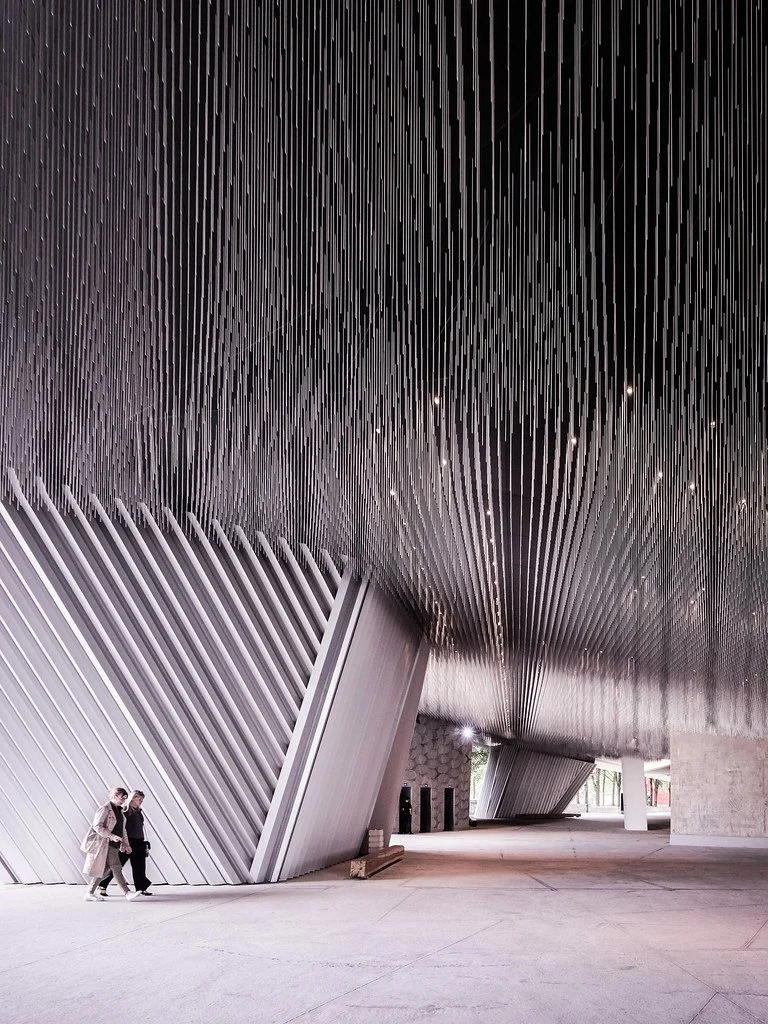
Silhuettes by Jean Nouvel’s Philharmonie de Paris. 2019. Photography © Dan HogmanBlurring the boundary between architect and photographer, this conversation explores a practice that treats photography as an extension of design thinking. The camera becomes a means of analysis, allowing for selective framing, iterative evaluation, and the capture of architecture as lived experience rather than static form. Moving from controlled commissions to uncommissioned exploration, the discussion challenges conventional expectations of architectural imagery and repositions documentation as a form of investigation.
By Jonas Weber.
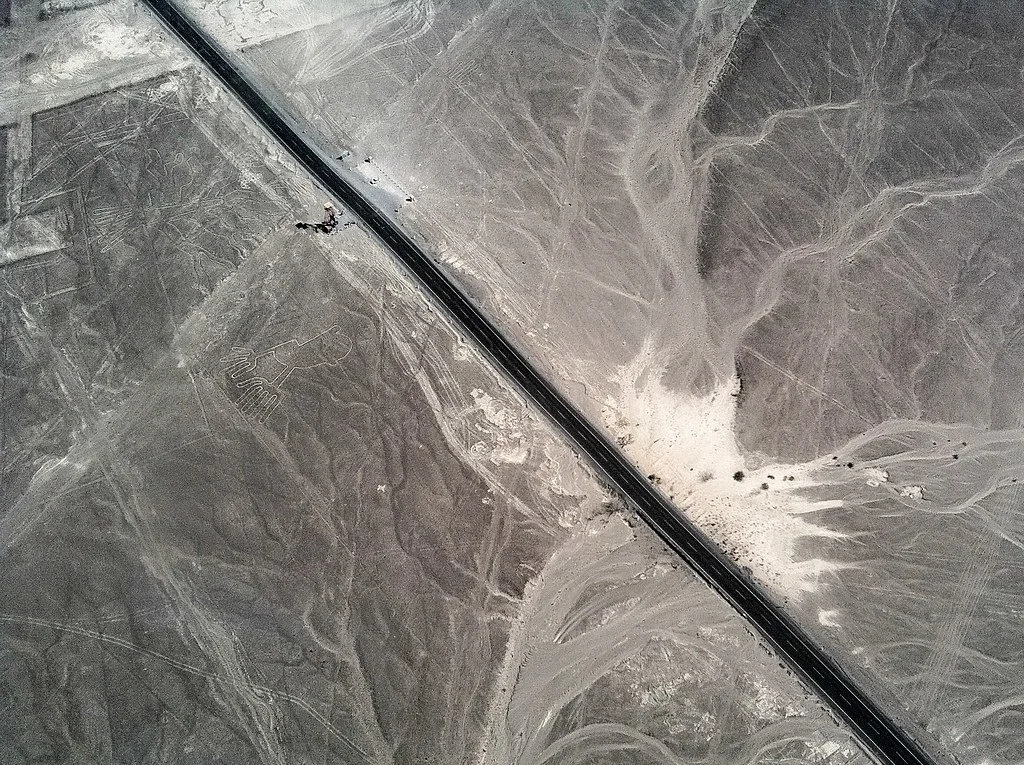
His well received documentary photography covered the Nazca Lines in Peru and the Tiwanaku culture in Bolivia. All taken with iPhone 4 at that time, as the main, "pro" gear was stolen. The gear helps, but does not condition creativity or artistic value. Photography © Dan Hogman, 2012Jonas Weber: You have a very specific take on photography in your design process. What is your core philosophy?
Dan Hogman: There are many ways to look at photography. This is an "instrument of perception" that is intellectually equal to the architecture itself. You can look and analyze a model directly, or set up a camera and capture a specific view for the same purpose - analyze, rethink. You frame a specific vantage point that is a given and fixed evaluation criterion. You set this up as a reference point on how you perceive the design and adjust the process accordingly.
JW: In a dual practice of architecture and architectural photography, what distinguishes the "Work Process" - the studio work, compared to standard commercial photographer?
DH: It’s a clear distinction in my mind. There are two separate processes. We have the option to take photos of whatever we see and experiment, or collect data, as part of the design process. There are different processes for two different needs. The camera is a common tool, but the thinking process and the purpose can be totally different. This being said, lines can blur sometimes.
JW: Specifically, what is studio work with the photography component, compared to standard commercial photography?
DH: The distinction goes at many levels. One separation would be the time of the photography in the timeline of the life of the building. You can document the model-making process while in schematic design as an architect, the construction stages while building, or the status of the building as the turn-key object. Then there is the post-occupancy level, when I’d be looking at the building as a "stage" of human activity to form, prioritizing the building's social life over its physical form. There are forces and tensions to be looked at given the stage we are at.
JW: It’s noted that many top photographers are actually former architects. How does that background change the way they look through a lens?
DH: It does change. Not sure if for the better. There might the tendency to overanalyze the scene. Knowing too much does not help. Some element of surprise goes away, understanding what the design principles are. On the other hand, an architect can read the "section" and "plan" of a building while looking at the facade, so I’d have specific vantage points to select to capture the building or space.
JW: Conversely, how does a photographer from a documentary or journalism background approach a building differently?
DH: My background in photojournalism is minimal - I only took one elective class while at Harvard, but it was formative. The thinking process shifts even if only discussing the topic with an influential group. We learned how to prioritize the "narrative" over the "structure." We discussed the idea of bypassing the search for a perfect geometric alignment, instead of looking for the "decisive moment" - the way a shadow hits a face or how a child interacts with a concrete wall. No matter what the background is, the goal is to evoke how a space feels rather than just explaining how it was built.
JW: There is a trend to imprint a photo on a building. The photo becomes architecture. How is this concept present in your architectural work?
DH: It is not present. I dislike the direction. There are ways to evoke an image indirectly without turning the building into a billboard. Yes, there are some well-documented examples, like The Mountain, Copenhagen - Julien De Smedt and Bjarke Ingels - which I photographed extensively - that might be a neutral example. I dislike the concept, but it works for the time and place it was built. Doing the same building today would be cliché.
JW: If there is no assigned commission, what is the "best" approach to documenting a new site or building?
DH: I find myself doing more of that than actually paid commissions. With no client in mind, I hae the freedom to explore my own visual language for the site before it becomes a cliché in the media. I have the freedom to focus on the "blind spots", the thresholds, the weathering, and the "ugly" light that commercial shoots avoid. What is life one block away from the shiny new museum?
JW: Why is the ability to walk around freely so vital when there is no pressure of a commission?
DH: Freedom allows for discovery. This time, a path is dictated by curiosity rather than a marketing checklist. There are more items to look at, apart from the money/cover and corner shot that need to go on the marketing brochure. No commissions allows you to document the messy vitality of a structure, or how it actually performs in the real world when the architect isn't looking.
JW: You advocate for traveling with a "small mirrorless kit" for this kind of work. Why not use a large-format technical camera?
DH: In fact, I use both. But the small mirrorless is always with me. It’s practical, and the advantage of having access to small but good gear exceeds the megapixels count. A small kit allows for stealth and fluidity, moving at the speed of human intuition. It facilitates an eye-level, handheld perspective that mirrors the genuine experience of a pedestrian, which is inherently more honest. With medium format, there is a large kit. This announces a professional intervention; it creates a set of conditions that alters the environment. There is a time and place for each, just like there is a good reason to just use the phone at times.
JW: What is a good example of when minimum gear, like the phone, went on to produce good photography?
DH: Yes. I took many personal trips worldwide and decided to travel very light. In some cases, I had no option to show gear, as I was traveling solo and the danger is real in some countries. I documented the favelas in Rio and some of my favorite shots are of the brutalist structure of the Museum of Modern Art, Rio de Janeiro. Documenting Tiwanaku in Bolivia is another good example. I am still puzzled by the technical achievement of the Tiwanaku culture, and the pre-colubian architecture and technical achievements in general. In fact, I took an entire road trip from California to the bottom of the Americas, Ushuaia, using my phone as the main camera. In a way, we had to - we had our gear stolen, but worked out just fine in the end…
JW: Is "honesty" in architectural photography actually possible?
DH: Yes, depending on what the requirements are. Commercial photography si by nature, at least part staged, even if at a minimum. Or, at least, curated. Honesty in this context is the shift from ataged perfection to documentary performance. Using a small kit to capture the blur and grit of reality acknowledges that buildings exist in time and chaos, not just in a vacuum of perfect light.
JW: What is the "75/25 Rule" you suggest for documenting a new place?
DH: Not applicable. Essentially, this states that the building should occupy 75% of the frame to show its architectural logic. The remaining 25% should capture the context - the neighboring structures and street life, to ground the building in its actual urban dialogue. The math is not helping. Rules do not help, they restrict. Yes, there is a time for context. You need people to tell the story on how the place is occupied, just like you also need people to tell the scale of the architecture. But the split is nowhere near this number and is meant to be fluid.
JW: How does the choice of tripod (or lack thereof) define the photographer's school of thought?
DH: I don’t use it most of the time. Handheld shooting is the tool of the storyteller. The capture is about reaction, energy, and the kinetic experience of space. When you add a tripod, you introduce gear to the scene, which changes the ease of life. But there are times when I could have used one, if I only had it with me… Yes, some of my photos do show some camera shake. The image is not poster-clear-sharp. But it’s ok. Not all images are meant to go on the cover. This adds some specificity to the image that we lost now, with the gear being able to produce images close to perfect every single time now.
JW: You are walking away from producing the perfect cover photography. Isn’t that counterintuitive as a business?
DH: It might appear that way. There is a great pool of talented photographers that are specialized in creating the perfect cover shot. The core of the commercial photography business looks that way, and I appear to walk away from that group. But that is not really the type of work that I am looking for. In fact, I only take a small number of commissions per year (if any…), as I want to put most of my time into my own photography, uncomissioned, or architectural design.
JW: What is the ultimate goal of "uncommissioned" documentation?
DH: The idea is to create a social document rather than a promotional one. It’s an investigation into whether the architecture succeeds as a habitat, not just as a sculptural object. This is the time when capturing the people and their activity takes precedence over the building. This is when architecture is just the backdrop. This is not for the magazine cover, but for documenting life and activity, which is at times, the focus.
JW: In your work, you often speak about "The Shadow as a Material." How does your process change when a building’s skin is designed specifically to manipulate light, like a perforated facade or a glass curtain wall?
DH: The process shifts from capturing a static object to documenting a light event. I look at the the shadow not as an absence of light, but as a structural element that defines the building's geometry. The shadow defines changes in the facade plane. You can’t read the geometry well without shadow. It’s an essential ingredient. Like salt in food… yes, poetically, you call it "dialogue with time" - how the sun’s movement creates ephemeral architecture on the surface of the permanent one, but I like simple words.
JW: You’ve mentioned that "The Architect is the first viewer, but the Public is the final judge." How do you balance the architect's desire for "Clean Geometry" with the reality of a building's "Social Performance"?
DH: It is a constant negotiation. The architect wants the pure idea, illustrated, but most people are interested in the lived reality. I do take the hero shot to satisfy the design intent, but I spend the rest of the day looking for that subversive moment, when a silhouette appears against a pristine marble column or in the precise ray of light. Good documentation must show that the architecture survived the transition from the drafting board to the street.
JW: Many photographers fear "Visual Noise" (traffic, signs, weather). Why do you argue that these elements are actually essential to a "World-Class" image?
DH: The reality is, architecture does not exist in a vacuum. It’s never as clean as we see it on magazine covers. A building without its "noise" is just a render. You always have light polls, cables and trash cans… it rains… The weather is a collaborator; a rainy day or a gray sky can reveal the texture of concrete or the reflectivity of glass far better than a perfect blue sky. The noise provides the friction that makes the image feel authentic and grounded in a specific geography.
JW: When you are documenting a site that is "new to the Western world," do you feel a responsibility to avoid "Orientalism" or "Exoticism" in your framing?
DH: Yes, absolutely. It’s not about not being authentic, but rather capturing the essence of the place, which is specific to the place and by extension, new to the Western world. The trap is to look for the "Exotic" rather than the "Universal." My approach is to apply the same rigorous, analytical eye to a remote structure as I would to a museum in London or New York. The focus is on the local intelligence of the design and shows a sophisticated response to its specific environment, not just a visual curiosity.
JW: You use a small mirrorless kit for your personal documentation. Does the lack of a "Technical Camera" (with its bellows and shifts) ever feel like a compromise in quality?
DH: On the contrary, the compromise is often in the "Energy" of the shot. A technical camera is an anchor; it forces a certain formality. A small mirrorless kit allows me to be fluid. The quality these days are far beyond any obstacles. Every picture can be technically perfect for most photographers. Quality has a different meaning in my mind. "Quality" is now in the timing and the perspective, not just the pixel count. I would rather have a slightly distorted but lively, handheld shot than a perfectly rectilinear but inactive, static tripod shot.
JW: Finally, if you could only take one image of a building to summarize its essence, would it be an Interior, an Exterior, or a Detail?
DH: It would be the threshold. This is a place where an occupancy shift occurs. The space where the public becomes private, where the street meets the interior. This is where human behavior changes. That transition is where the architect’s true philosophy is tested. It’s where the building greets the world. There is a lot that photography can tell about that moment…