New York, NY
December 2025
< WRITINGS
< NEWS
Affordable Housing
Multifamily
Community BuildingWhat Happened to Affordability in Housing?
Revisiting the Principles That Once Made Housing Work
/or - how gentrified neighborhoods quietly raised the bar — and the bill — for everyone.
Housing today increasingly absorbs the expectations of the market-rate sector. Amenity packages, architectural branding, and lifestyle programming - features designed to attract affluent buyers - are gradually redefining what “good housing” looks like. As a result, affordable housing is pressured to respond to a new set of standards - shaped by gentrified markets rather than by the fundamentals of affordability.
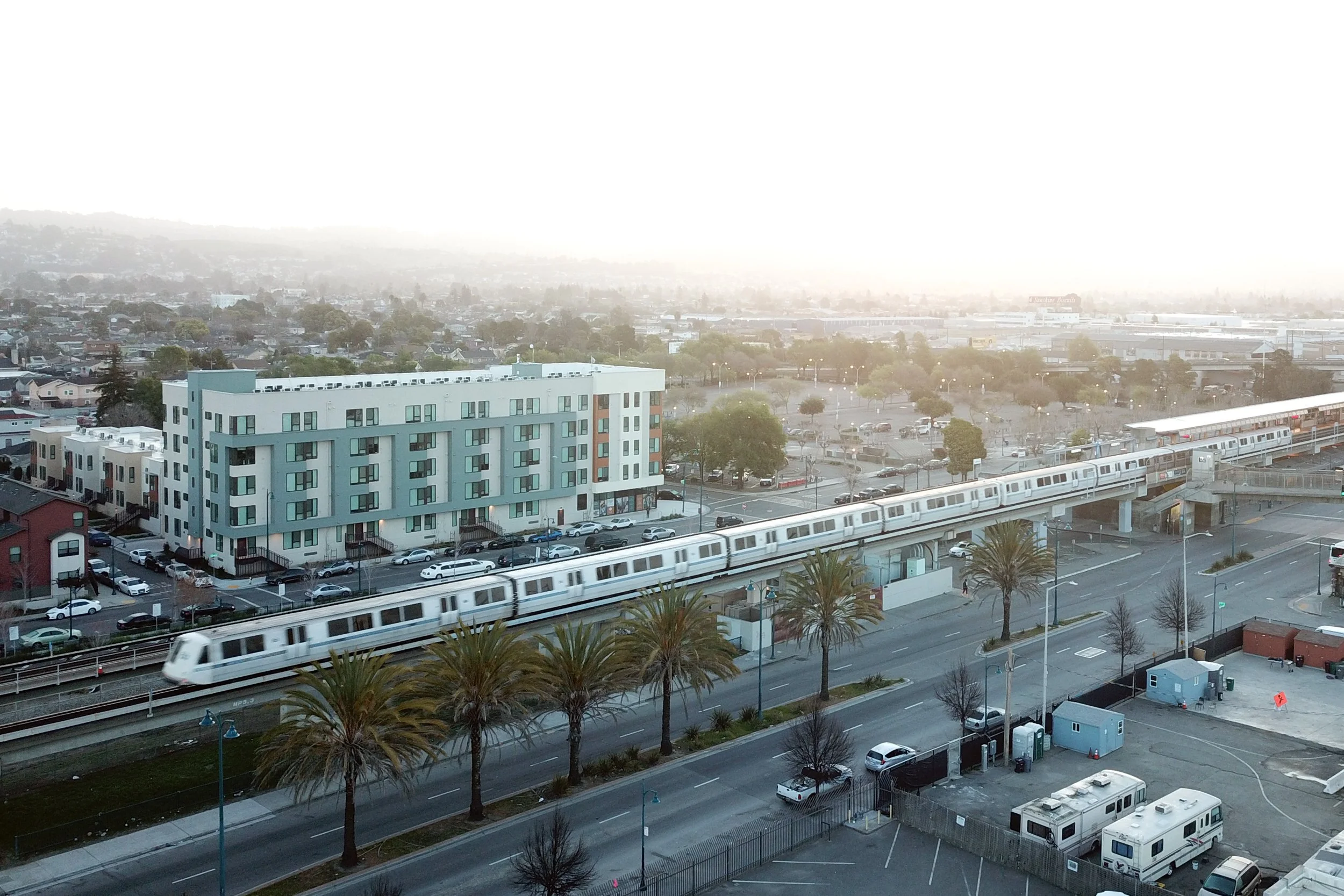
Sunrise over Coliseum Connections, designed by Mike Pyatok. Housing is organized around communal courtyards with direct street engagement, and a material palette chosen for durability rather than spectacle. A true transit-oriented development, as it sits right across the street from a BART station. Photo credit: Dan Hogman.I met Michael Pyatok in December 2025 in Oakland, over a bowl of ramen not far from his office. I’ve worked in his office for several years and have listened to many of his lectures, some at UC Berkeley or the AIA. But sitting across from him, I realized I'd never quite understood where it came from. He kept returning to the New York tenement. Not fondly, exactly, but with a kind of respect that surprised me.
Those buildings were bad in a lot of ways. They were overcrowded, poorly ventilated, and with a level of sanitation that would horrify anyone today. But they worked, socially. The stoops, the dense blocks, the fact that you could walk to a dry cleaner or a daycare — all of it created conditions where people actually knew each other. It as a place where street life was real. The irony is that postwar public housing — built with vastly more resources and genuinely good intentions — often destroyed exactly that. The superblocks, the towers, the severed street grid. Communities that had been functional, if uncomfortable, got replaced by environments that were cleaner and lonelier.
Working with Mike over the years, I came to understand something he rarely states directly: good design and cheap design are not the same thing, but they're not opposites either. Bad planning is expensive. Confusing layouts waste space. Poor relationships between units and shared areas make buildings feel institutional. Thoughtful architecture — clear plans, rational structure, simple materials — doesn't cost more. It often costs less.
But here's what's actually happened, and it's worth being direct about it: gentrification has quietly colonized the standards by which we judge all housing, including affordable housing. As neighborhoods have become more upscale, as market-rate development has become more amenity-heavy and brand-conscious, affordable housing has been pulled along in the same direction. This is not because anyone mandated it.
Cities require income thresholds and unit counts — they don't require rooftop decks, co-working lounges, or boutique lobbies. Those come from developers competing in a gentrified market, and affordable housing, increasingly built inside or alongside market-rate projects, has absorbed those expectations almost without noticing.
The result is housing that calls itself affordable but is priced and designed against a baseline that has drifted dramatically upmarket. There are underground parking structures or complex façades that exist to photograph well. There are also amenity packages assembled that include dog wash station or maker spaces, all assembled by marketing departments. None of this serves low-income residents. All of it inflates cost. And because these additions accumulate gradually — each one justified by some planning requirement or competitive pressure or design aspiration — nobody is clearly responsible for the outcome. The affordable unit at the end of the process is a fraction of the cost of a market-rate unit, technically. But it's a fraction of something that has already been made far more expensive than it needed to be.
A quick walk through some of these newer developments clarifies the picture. Polished concrete lobbies, curated murals, fitness centers - are all amenities that few have asked for. Some bike storage rooms with better finishes than the apartments themselves. Package lockers, pet washing stations, "maker spaces" with exposed ductwork and pendant lighting. Each individual item seems defensible in isolation — modern, even thoughtful. Taken together, they represent a fundamental confusion about what affordable housing is supposed to be. This is not amenity. It is costume. It is the visual language of gentrification applied to buildings that were meant to house people who have been most harmed by gentrification. The irony would be funny if the consequences weren't so serious — because every dollar spent on the lobby is a dollar not spent on an additional unit, or on keeping rents genuinely low, or on maintenance that residents will actually need ten years from now.
And then there is the architect - maybe not all of them, but enough to notice. Affordable housing has become, for a certain kind of practice, an opportunity for architectural statement-making. A chance to get published, to win awards, to demonstrate formal ambition on a project that carries the moral weight of social purpose. The clients are often nonprofits with limited leverage. The residents have no seat at the table where design decisions are made. And so the building ends up serving two agendas simultaneously — housing people who need it, and advancing the career of the firm that designed it. The second agenda is rarely stated out loud, but it shows up in the budget. Expressive façades that require specialist contractors. Unconventional geometries that complicate construction. Material choices driven by portfolio photography rather than durability or cost. This is not the time or the place for architectural ego. The people moving into these buildings are not there to inhabit someone's design statement. They need a home. When architects lose sight of that distinction — or choose to ignore it — the cost is real, and it is paid by the residents, not the architect.
The Sugar Hill development by David Adjaye is a good example - one building I in fact ended up photogpraphing “for the looks” - before I looked deeper into the cost and, eventually, meaning.This is frequently criticized for its high construction costs and the "unreplicable" nature of its financial model. The total project cost was around $89M back in 2014, or a $717k per unit, nearly double the city average for affordable housing at the time of its completion. Critics appreciate that the building serves as a striking "social condenser" by integrating a museum and preschool. In reality, the complexity of its 14 different funding sources makes it a boutique one-off rather than a scalable solution to the housing crisis. Furthermore, some architectural observers suggest that the project’s "arty fortress" aesthetic and expensive custom-precast concrete panels reflect a "symbolic capital" over the utilitarian need to house as many people as possible at the lowest possible cost.
What's been lost in all of this is identity. Affordable housing used to know what it was. It was housing for people who needed it, built carefully and simply, with dignity but without pretension. That clarity of purpose was itself a kind of design principle. Now it increasingly looks like market-rate housing with a subsidy attached — borrowing the aesthetics of a market it was never meant to serve, and losing itself in the process.
Mike Pyatok's work has always pushed against this, even before it had a name. His buildings are dense, simple, social, designed to the actual needs of the people who will live in them, not to the expectations of a gentrified neighborhood trying to protect its property values. The New York tenement, for all its failures, understood something similar by necessity: housing is fabric. It's the physical structure within which communities form. It is not a product. It is not a lifestyle. And the moment it starts being designed like one — even with good intentions, even under the banner of mixed-income integration — affordability becomes a label applied to something that was never really built with affordability in mind.
That's the problem. Not that design is expensive. But that we've allowed a gentrified market to define what design means, and then tried to do affordable housing within those terms. It can't work. The baseline has to change.
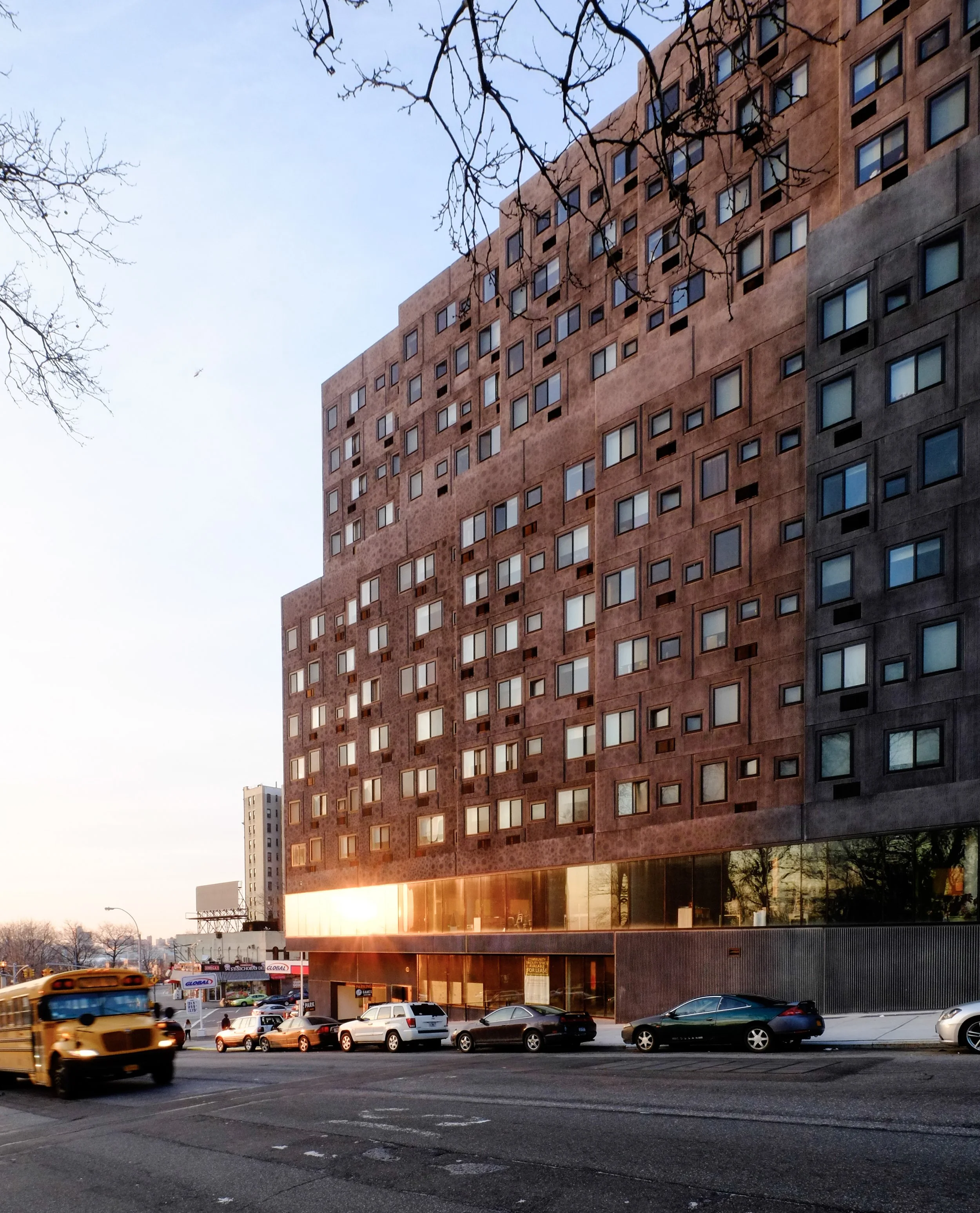
The Sugar Hill Development in New York City, by David Adjaye, 2015. It successfully combines affordable housing with community programs. Interesting program mix, where the Sugar Hill Children’s Museum of Art & Storytelling is included. The precast façade stands out - which I find well integrated within the neighborhood. The building sparked debate over whether such expressive design elements were appropriate for a project intended to deliver cost-conscious affordable housing. Photo credit: Dan Hogman.