Featured in a+u Japan: Architecture and Urbanism’s monographic issue on Pier Luigi Nervi.
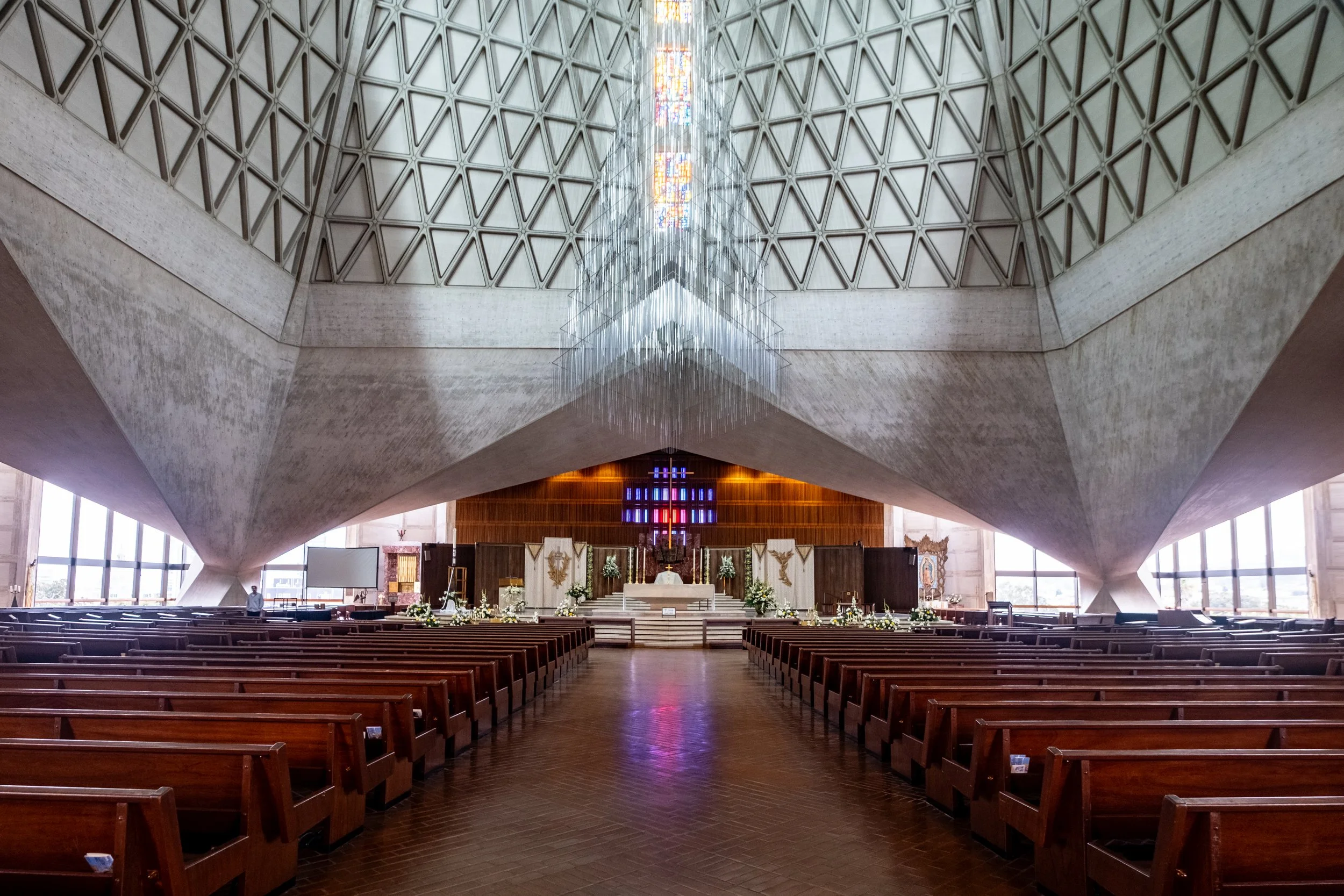
Cathedral of Saint Mary of the Assumption, San Francisco; 2025. The concrete structure where the four massive concrete pylons (two are visible in the distance) meet Nervi’s hyperbolic paraboloid shell. The lens exposes the rhythmic rigor of the lower part of the pre-cast coffers, transforming a heavy brutalist geometry into a weightless, light-filled sanctuary.
The photographic essay was featured in a+u Japan and examines Saint Mary’s Cathedral as a monograph for Pier Luigi Nervi.
Here, photography becomes a tool for reading the fleeting moments of the day, where the quality of light changes dramatically even in a relatively brief, two-hour shooting session. The camera isn’t documenting an icon; it’s tracing how matter holds itself together.
This is a visual study in structural expressionism, where the engineering of the hyperbolic paraboloid serves as a light trap for the Pacific sun. Unlike traditional smooth concrete, the precast triangular coffers create a repetitive, mathematical "weave" that provides infinite opportunities for geometric abstraction.
The cathedral features a cross-shaped skylight at the apex and four narrow vertical stained-glass windows that stretch 139 feet high. The building's shell is composed of hyperbolic paraboloids, giving light the opportunity to wrap around curved surfaces, revealing a wide array of concrete tones.
On the exterior, the travertine-clad shells react dramatically to San Francisco’s maritime light and fog. The building is known for the quality of the shadows cast by the intersection of the roof’s curves, which appear only at a specific solar angle, successfully captured in this photo essay for a+u Japan.