On the Jury: Highlights from the 2025 Architizer Vision Awards
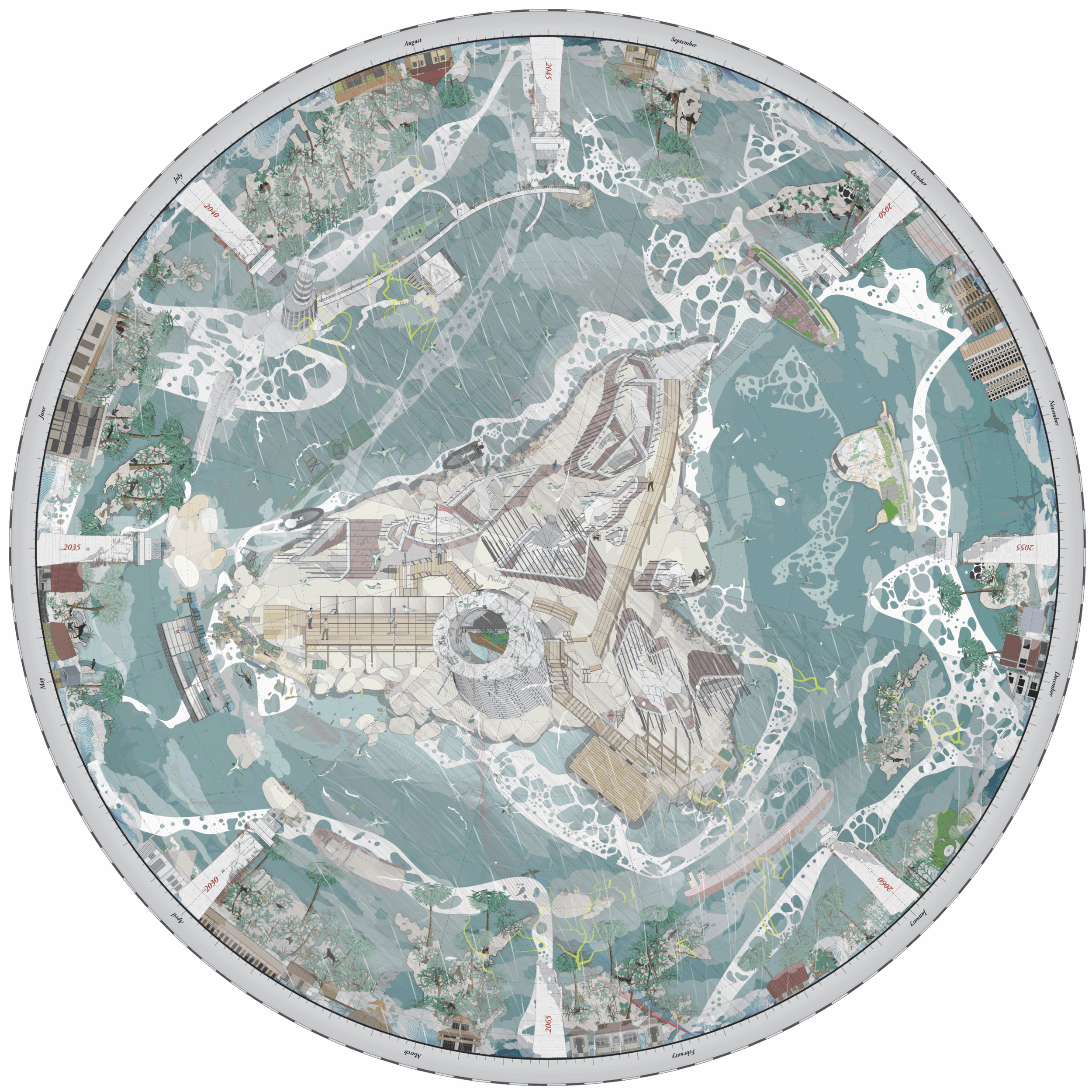
“Incomplete Landscapes on Pedra Branca” by Eugene Tan, Architizer Vision Awards 2025 finalist, reframes the island as an ecological and relational landscape, highlighting architecture as narrative. Photo courtesy of Eugene Tan / Architizer Vision Awards.
I was invited to join the jury panel for the Architizer Vision Awards - arguably the most recognized program dedicated to the art of architectural representation and storytelling. Unlike traditional design awards, the Vision Awards celebrate the "unbuilt"—recognizing excellence in architectural photography, film, rendering, and conceptual drawing - yes, this includes the analog approach!
A Quick Critique from the Jury Room
The performative nature of architectural representation. Does the contemporary image serve the building, or has it become a separate identity? My tenure on the Architizer Vision Awards jury forced me to confront this central tension. The awards ostensibly celebrate the "unbuilt," yet they reveal a profession increasingly seduced by the hyper-real, where AI is an increasingly visible component.
A mandate for narrative over artifice. If the Vision Awards are to remain relevant, they must prioritize the narrative arc of a project over the sheer resolution of its output. The panel, comprising practitioners like Steven Holl and Daniel Libeskind, served as a necessary filter against the rising tide of generic, AI-adjacent aesthetics. We looked for the friction of an idea. The question that intrigued me was simple: Does this image invite a conversation about the future of space, or does it merely provide a backdrop for a lifestyle?
The seduction of atmospheric AI. The danger of the modern architectural "vision" lies in its efficiency. Why engage with the messy complexity of material performance when a high-contrast rendering can simulate a mood? I found myself consistently questioning whether the technical virtuosity on display was clarifying the architectural argument or was, in fact, covering up a lack of structural rigor. The most successful submissions were those that resisted the urge to be perfect, leaving room for the viewer’s imagination to fill de gap of the missing pieces, especially where freehand, analogue tools are unmistakably human.
What stood out
The Resistance to "Generic AI". My vote goes to the entries that treat the machine as a medium rather than an author and prioritize works that maintain a unique "visual vocabulary" over those that rely on standard AI-generated aesthetics. Successful entries highlight the "hand" of the designer through stylized, non-photorealistic imagery.
Photography - I have to agree with the final verdict. Jason O’Rear’s Eagle + West photograph captures the tension between emerging Brooklyn skyline layers and their urban context. It’s all about juxtaposition, intended to create the tension between the subject and the larger context - NY skyline in this case.
Finally, need to highlight a particular work: Incomplete Landscapes on Pedra Branca by Eugene Tan (illustrated above). Inspired by medieval mappamundi, the drawing layered history, geopolitical data, and environmental cycles into a single image. The work proved that a single drawing can function as a "speculative cartography," holding more information than a standard 3D model.
—
You can explore the full jury and the Vision Awards program here: Architizer Vision Awards Jury.
Winners are here.